
Skip to content

BCom vs BBA

BCom vs BBA: Which Course is Better After 12th Commerce?

After completing Class 12th, many commerce students get confused between BCom and BBA. Both are popular undergraduate courses, both can lead to good career opportunities, and both are suitable for students who want to build a future in business, finance, management, banking, entrepreneurship, or corporate jobs. However, the purpose of both degrees is different.

BCom, or Bachelor of Commerce, is more focused on accounting, finance, taxation, economics, and commerce-related subjects. BBA, or Bachelor of Business Administration, is more focused on management, business operations, marketing, human resources, entrepreneurship, and leadership skills.

Quick Answer: Choose BCom if you are interested in accounting, taxation, finance, banking, or professional courses like CA, CMA, CS, CFA, or MCom. Choose BBA if you are interested in business management, marketing, HR, startups, entrepreneurship, or MBA in the future.

What is BCom?

BCom stands for Bachelor of Commerce. It is a three-year undergraduate degree that gives students a strong foundation in commerce, accounting, economics, business law, taxation, finance, auditing, and banking. BCom is one of the most chosen courses after 12th commerce because it is flexible, affordable, and suitable for many career paths.

Students who want to become accountants, financial analysts, tax consultants, bankers, auditors, investment professionals, or commerce teachers often prefer BCom. It is also a good degree for students planning to pursue professional qualifications like CA, CMA, CS, CFA, CPA, ACCA, or MBA later.

Common Subjects in BCom

  • Financial Accounting
  • Corporate Accounting
  • Business Law
  • Income Tax
  • GST and Indirect Tax
  • Cost Accounting
  • Economics
  • Auditing
  • Banking and Insurance
  • Financial Management

What is BBA?

BBA stands for Bachelor of Business Administration. It is a three-year undergraduate degree designed for students who want to understand how businesses are managed. BBA focuses on business planning, marketing, human resource management, operations, entrepreneurship, leadership, communication, and decision-making.

BBA is suitable for students who want to enter corporate management roles, start their own business, work in sales and marketing, or pursue an MBA after graduation. Compared to BCom, BBA is more practical and management-oriented. It helps students develop communication, presentation, teamwork, and leadership skills.

Common Subjects in BBA

  • Principles of Management
  • Marketing Management
  • Human Resource Management
  • Business Communication
  • Organizational Behaviour
  • Business Strategy
  • Entrepreneurship
  • Operations Management
  • Financial Management
  • Business Analytics Basics

BCom vs BBA: Quick Comparison Table

Point BCom BBA
Full Form Bachelor of Commerce Bachelor of Business Administration
Main Focus Accounting, finance, tax, economics Management, business, marketing, HR
Best For Students interested in finance and commerce Students interested in management and business
Course Type Commerce-focused Management-focused
Best Higher Study Option MCom, CA, CMA, CS, MBA, CFA MBA, PGDM, entrepreneurship, business analytics
Career Direction Accounts, finance, banking, taxation Marketing, HR, sales, business development

Eligibility for BCom and BBA

The eligibility for both BCom and BBA is usually simple. Students who have completed Class 12th from a recognized board can apply. Commerce students are naturally more comfortable with BCom because they already study accounting, business studies, and economics in school. However, students from science and arts backgrounds can also pursue BBA in many universities.

For BCom, some colleges may prefer students with commerce or mathematics background, especially for BCom Honours or finance-related specializations. For BBA, colleges usually focus on overall marks, entrance tests, interviews, or merit-based admission depending on the institution.

BCom vs BBA: Course Curriculum Difference

The biggest difference between BCom and BBA is the curriculum. BCom teaches students how commerce, accounts, finance, taxation, and banking systems work. BBA teaches students how businesses are managed, how teams operate, how brands grow, and how companies make strategic decisions.

BCom Subjects BBA Subjects
Financial Accounting Principles of Management
Cost Accounting Marketing Management
Business Law Human Resource Management
Taxation Organizational Behaviour
Auditing Business Strategy
Economics Entrepreneurship

BCom vs BBA: Which is More Practical?

BBA is generally considered more practical because it includes presentations, case studies, group discussions, projects, business simulations, internships, and management activities. It is designed to build workplace-ready skills such as communication, leadership, teamwork, and decision-making.

BCom is more academic and concept-based, especially in traditional colleges. However, modern BCom programs with specializations in finance, accounting, banking, business analytics, and taxation are becoming more practical. If students combine BCom with internships, certification courses, and professional qualifications, it can become highly career-oriented.

BCom vs BBA: Which is Better for MBA?

Both BCom and BBA students can pursue an MBA. However, BBA gives a direct foundation in management subjects, so students may feel more familiar with MBA concepts like marketing, HR, operations, strategy, and organizational behaviour.

BCom students also do very well in MBA, especially in finance, banking, business analytics, and consulting. If a BCom student wants to pursue MBA Finance, investment banking, financial analytics, or corporate finance, BCom can be a strong base.

Simple Rule: Choose BBA before MBA if you want a management-focused foundation. Choose BCom before MBA if you want a finance and commerce-focused foundation.

BCom vs BBA: Which is Better for CA, CMA, or CS?

BCom is usually better if you want to pursue professional commerce courses like CA, CMA, or CS. This is because BCom subjects overlap with these courses. Accounting, business law, taxation, auditing, economics, and financial management are common areas in BCom and professional courses.

BBA can also be pursued along with CA, CMA, or CS, but it is not as closely aligned as BCom. BBA is more suitable for students who want to move towards management, startups, marketing, HR, or MBA.

Career Options After BCom

BCom gives students a strong base for careers in finance, accounts, taxation, banking, insurance, audit, investment, and business operations. Students can start working after graduation or pursue higher studies for better roles.

Popular Jobs After BCom

  • Accountant
  • Tax Assistant
  • Audit Assistant
  • Banking Executive
  • Finance Executive
  • Insurance Advisor
  • Accounts Manager
  • Investment Associate
  • GST Executive
  • Business Analyst Trainee

Higher Studies After BCom

  • MCom
  • MBA
  • CA
  • CMA
  • CS
  • CFA
  • CPA
  • ACCA
  • PG Diploma in Banking and Finance

Career Options After BBA

BBA gives students a business and management foundation. It is good for students who want to work in corporate roles or pursue MBA later. BBA graduates can find entry-level jobs in marketing, sales, HR, operations, customer relations, business development, and startups.

Popular Jobs After BBA

  • Business Development Executive
  • Marketing Executive
  • Sales Executive
  • HR Executive
  • Operations Executive
  • Management Trainee
  • Digital Marketing Executive
  • Customer Relationship Executive
  • Startup Operations Associate
  • Brand Executive

Higher Studies After BBA

  • MBA
  • PGDM
  • MBA in Marketing
  • MBA in HR
  • MBA in Finance
  • MBA in Business Analytics
  • Digital Marketing Certification
  • Entrepreneurship Programs

Salary After BCom vs BBA

Salary after BCom or BBA depends on skills, college, internships, location, communication ability, specialization, and additional certifications. At entry level, both courses may offer moderate salary packages. However, salary improves significantly after professional qualifications, MBA, work experience, and skill-based certifications.

Course Entry-Level Career Area Growth Path
BCom Accounts, tax, banking, finance CA, CMA, CS, MBA, finance roles
BBA Marketing, sales, HR, operations MBA, management roles, entrepreneurship

BCom vs BBA: Which Has Better Scope?

Both BCom and BBA have good scope, but the scope is different. BCom has better scope in finance, accounting, tax, banking, commerce, and professional qualifications. BBA has better scope in management, marketing, HR, business development, entrepreneurship, and MBA-related career paths.

If a student wants a stable finance-oriented career, BCom may be better. If a student wants a business-oriented and management-focused career, BBA may be better. Neither course is automatically better than the other; the right choice depends on your future plan.

BCom vs BBA: Which is Better for Government Jobs?

Both BCom and BBA graduates can apply for many government exams after graduation, depending on eligibility. These may include banking exams, SSC, UPSC, state government exams, railway exams, insurance sector exams, and other graduate-level recruitment exams.

BCom students may have an advantage in banking, finance, accounting, and audit-related government roles because their subjects are closer to these areas. BBA students can also perform well in government exams if they prepare properly.

BCom vs BBA: Which is Better for Business?

BBA is usually better for students who want to start a business because it teaches management, marketing, operations, entrepreneurship, leadership, and business planning. These subjects directly help students understand how to run and grow a business.

BCom is also useful for business because it teaches accounting, taxation, finance, and compliance. A business owner must understand money, cash flow, profit, tax, and financial planning. So, BCom is better for the financial side of business, while BBA is better for the management side of business.

BCom vs BBA: Which is Better for Online Degree?

Online BCom and Online BBA are both good options for students who want flexible learning. An online degree can be useful for students who want to study along with internships, professional courses, family responsibilities, or work. However, students should always check whether the university is recognized and approved before taking admission.

You can check university recognition and higher education updates from the official UGC website. Students should also read the UGC Fee Refund Policy PDF before paying admission fees, so they understand refund timelines and deductions.

Top Online Universities for BCom and BBA

If you are planning to pursue BCom or BBA in online mode, compare universities based on recognition, fees, learning platform, student support, exam system, placement assistance, and specialization options.

University Suitable For Explore
Amity University Online Online BBA, commerce, management, flexible learning View University
NMIMS CDOE Management-focused online and distance programs View University
Online Manipal University Online BCom, BBA, and management programs View University
Jain University Online Commerce, business, and professional online programs View University
Chandigarh University Online Online BBA, BCom, and career-oriented degree options View University

Helpful Career Tools

If you are still confused between BCom, BBA, MBA, finance, management, or other career options, career tools can help you understand your interest and direction better.

Tool Use Link
Personality Interest EQ Assessment Understand your personality, interest, and emotional strengths Use Tool
Career Analysis For Working Professionals Useful for professionals planning career growth or course change Use Tool
Career Options After Graduation Explore career paths after completing BCom, BBA, BA, BSc, or other degrees Use Tool
Career Options After 12th Find suitable courses after 12th based on your stream and interest Use Tool

UGC Fee Refund Policy: Important for Students

Before taking admission in any university, students should understand the refund rules. The UGC fee refund guidelines help students know how much refund they may get if they cancel admission within a specific timeline. This is important because many students pay fees in a hurry and later change their decision.

Admission Cancellation Timeline Refund Percentage Institutional Deduction
15 days or more before the formally announced last date of admission 100% Refund Maximum ₹5,000 as processing fee
Less than 15 days before the formally announced last date of admission 90% Refund Actual processing charge limits
15 days or less after the formally announced last date of admission 80% Refund Actual processing charge limits
16 to 30 days after the formally announced last date of admission 50% Refund Actual processing charge limits
More than 30 days after the formally announced last date of admission 0% Refund Institutional retention applies

BCom vs BBA: Which One Should You Choose?

Choose BCom if your interest is in finance, accounting, taxation, banking, investment, or professional commerce courses. It is a strong option for students who like numbers, financial statements, tax rules, and commerce subjects.

Choose BBA if your interest is in management, marketing, HR, business development, entrepreneurship, or MBA. It is a better option for students who like communication, leadership, teamwork, business strategy, and practical business activities.

Final Verdict: BCom is better for finance and commerce careers, while BBA is better for management and business careers. If you want CA, CMA, CS, banking, or finance, choose BCom. If you want MBA, marketing, HR, business development, or entrepreneurship, choose BBA.

FAQs on BCom vs BBA

1. Which is better, BCom or BBA?

BCom is better for accounting, finance, taxation, and commerce careers. BBA is better for management, marketing, HR, business, and MBA-focused careers.

2. Is BBA better than BCom for MBA?

BBA gives a direct management foundation, so it is useful before MBA. However, BCom students also do very well in MBA, especially in finance and business analytics.

3. Is BCom good for CA?

Yes, BCom is one of the best graduation degrees for CA because many subjects overlap, such as accounting, law, taxation, auditing, and finance.

4. Can I get a job after BBA?

Yes, BBA graduates can get entry-level jobs in marketing, sales, HR, operations, business development, customer relations, and startups.

5. Can I get a job after BCom?

Yes, BCom graduates can get jobs in accounts, taxation, banking, insurance, finance, audit support, and business operations.

6. Which course has more salary, BCom or BBA?

Salary depends on skills, college, internships, and higher studies. BCom can lead to high salaries with CA, CMA, CFA, or MBA. BBA can lead to high salaries after MBA or strong corporate experience.

7. Is BBA good for entrepreneurship?

Yes, BBA is good for entrepreneurship because it teaches business planning, marketing, management, leadership, and operations.

8. Which is easier, BCom or BBA?

BBA may feel easier for students who like practical learning and management. BCom may feel easier for students who like accounts, commerce, finance, and theory-based concepts.

9. Can science students pursue BBA or BCom?

Yes, science students can pursue BBA in most universities. They can also pursue BCom in many institutions, but some colleges may prefer commerce or mathematics background.

10. Which course is best for banking?

BCom is generally better for banking because it includes accounting, finance, economics, and banking-related subjects.
Suggested Blogs – Career Options

IAS Full Form 2026

IAS Full Form

IAS Full Form: IAS full form is Indian Administrative Service. All you need to know about the ias full form , officer details and interesting facts for IAS exam.

What is the full form of IAS?

The full form of IAS is Indian Administrative Service. It is one of the most prestigious and competitive exams in India. The Union Public Service Commission (UPSC) conducts the IAS exam annually to select and recruit eligible candidates for various posts in the Government of India.

What is the IAS Exam?

The prestigious IAS Exam was initially established in 1858 as the Imperial Civil Service. It was renamed the Indian Administrative Service (IAS) in 1950. The IAS is the highest-ranking position among Indian administrative posts, both in terms of power and prestige.

The Union Public Service Commission (UPSC) conducts the IAS exam annually. Candidates who qualify may be appointed by the Union or State governments or assigned to district-level positions.

The IAS is part of the executive branch of the Government of India and is considered a permanent bureaucracy. Each year, lakhs of candidates from various backgrounds and categories attempt the exam.

Become our partner & earn with us

IAS Eligibility Criteria

The essential prerequisites that one has to fulfill in order to qualify for the IAS exam are as follows:

  1. Candidate’s Nationality- The candidate has to be an Indian national in order to try and attempt the Indian Civil Service Exam.
  2. Age Limit – The minimum age limit to sit for the exam is 21 years while the maximum age limit is determined to be 32.
  3. Educational Qualification – The candidate must be a graduate from a university registered under or recognised by the Government. However, candidates who are awaiting their graduation results may also apply for the examination.
  4. Number of Attempts – There is a distinct number of attempts that are assigned to the following categories. 
    • General – 6 attempts
    • OBC – 9 attempts
    • SC/ST – No fixed limit
    • Any number of attempts can be made by the SC/ST candidates until the candidate reaches the maximum age limit for the examination, i.e, 37 years
    • Economically Weaker Section – 6 attempts

Age Relaxation for IAS

The upper age relaxation that is assigned to each category can be listed as follows –

SC/ST5 years
OBC3 years
Defense Service Personnel3 years
Ex-Servicemen5 years
Deaf/Mute/Blind/Orthopedically Handicapped10 years

Tips to crack IAS 2025

Here’s a list of tips to ease the tension of aspirants and help them increase the possibilities of cracking the IAS 2025

  • Formulating a strict schedule

Time management is a major ‘make it or break it’ factor when it comes to the UPSC CSE – GS papers. But with a steady focus and rigorous schedule, Learners can work hard every day to prepare effectively and increase their chances of success.

  • Evaluating and understanding the examination pattern

The UPSC portal mentions the complete examination pattern. Go through it, familiarise yourself with the syllabus, question patterns, and structure your preparation plan accordingly.

  • Structuring your study plan efficiently

Given how vast the IAS syllabus is, the preparation process may differ for everyone. Some may entail follow-ups with specific study material; others may need particular notes to understand better.

  • Practise tests

Solving previous years’ question papers and undertaking mock tests is significantly helpful. This will help you familiarise yourself with the UPSC CSE-GS exam patterns and analyse the areas that require improvement.

IAS Salary and Benefits

According to the 7th pay commission recommendations, the pay grades for the civil servants have been abolished and Consolidated Pay levels have come into existence now. Check the IAS Salary details here-

Basic Pay (Rs.)Pay Level (Years of Service)Posts
56,10010 (1-4 years)Assistant Secretary in Central Secretariat
Undersecretary in State Secretariat
Sub-divisional Magistrate in District Administration
67,70011 (5-8 years)Deputy Secretary in State Secretariat
Additional District Magistrate in District Administration
Under-Secretary in Central Secretariat
78,80012 (9-12 year)Deputy Secretary in Central Secretariat
District Magistrate in District Administration
Joint Secretary in State Secretariat
1,18,50013 (13-16 years)Special Secretary-cum-Director in State Secretariat
District Magistrate in District Administration
Director in Central Secretariat
1,44,20014 (16-24 years)Joint Secretary in Central Secretariat
Divisional Commissioner in District Administration
Secretary-cum-Commissioner in State Secretariat
1,82,20015 (25-30 years)Principal Secretary in State Secretariat
Divisional Commissioner in District Administration
Additional Secretary in Central Secretariat
2,05,40016 (30-33 years)Additional Chief Secretary in State Secretariat
2,25,00017 (34-36 years)Secretary in Central Secretariat
Chief Secretary in State Secretariat
2,50,00018 (37+ years)Cabinet Secretary of India

Commitment and Duties of an IAS Officer

The prestigious post of an IAS officer comprises numerous roles and responsibilities. A person having utmost sincerity, patience and numerous distinct capabilities is chosen to offer his allegiance to this prestigious post. The roles and duties that an IAS officer has to assume can be listed as follows –

  1. The roles and responsibilities that are assigned to an IAS officer vary through different stages of their career. 
  2. An IAS officer is assigned to handle different governmental affairs ranging from district to state level. 
  3. An officer has to perform his/her duties in accordance with the order of the Government of India. 
  4. May be assigned to frame and furthermore implement a certain policy according to the order of the Government.
  5. Travelling to places where the respective policy is assigned to be implemented.
  6. Establishing policies to disburse required funds for concerned affairs.
  7. If an officer during his career is assigned to fulfill his duties at the state or sub-divisional level, he/she has to assume duties pertaining to law and order. 
  8. Has to fulfill developmental duties at the district level. 
  9. May serve as a State Secretariat or as Heads of governmental departments. 
  10. At the Central level, an officer plays a major role in formulating and furthermore in implementing valuable policies.

Interesting Facts about IAS

  1. Satyendranath Tagore was the first IAS officer in India.
  2. Anna Rajam Malhotra was the first woman IAS officer of India. A woman who qualified for the Civil Service Exam in 1951.
  3. Kiran Bedi qualified as Indian Police Service (IPS) officer in 1972. She is the first Indian woman in India to become an Indian Police Service (IPS) officer.
  4. IAS officers are posted at various locations like Rural, Urban, & Semi- Urban areas
  5. The youngest IAS officer of India is Ansar Ahmad Shaikh who was born on 1st June 1995

FAQ's - Your Quick Reference Guide

The full form of IAS is Indian Administrative Service.

To be eligible for the IAS Exam, a candidate must hold a graduate degree, be in the final year of their graduation course, or be awaiting their graduation results.

The maximum number of attempts that can be made by a general category student is 6.

The maximum attempts that a candidate belonging from the OBC category can be made is 9.

There is no fixed attempt limit assigned to the SC/ST category to sit for the IAS Exam. The candidate can make as many attempts as desired till he/she teaches the maximum age limit for the examination.

The maximum attempt that can be made by candidates belonging to EWS category is 6.

The number of attempts that can be made by a person (candidate) with benchmark disability is 9.

The highest post that an IAS officer can assume in his career is the post of Cabinet Secretary of India.

The minimum age limit to sit for an IAS Exam is 21

Yes, the candidate has to belong from Indian nationality.

The general age limit to sit for the IAS Examination is 32 years. There are however certain age relaxations pertaining to different categories that can be traced in the article above.

Career Options After an MBA: Exploring Your Path

The Value of an MBA

In today’s competitive job market, obtaining a Master of Business Administration (MBA) has become increasingly valued by employers across various industries. An MBA program not only provides candidates with a strong foundation in business principles but also equips them with essential leadership and analytical skills necessary to excel in organizational settings. With a curriculum designed to address multifaceted business challenges, an MBA cultivates a comprehensive understanding of management practices, finance, marketing, and operations.

One of the primary benefits of pursuing an MBA is the development of critical thinking and problem-solving abilities. These skills enable professionals to analyze intricate business scenarios and devise effective strategies. Additionally, an MBA program often emphasizes teamwork and collaboration, preparing candidates to work effectively in diverse teams. This aspect of training is particularly significant as many employers today prioritize candidates who can thrive in collaborative environments.

Current trends indicate a growing demand for MBA graduates, with companies actively seeking individuals who possess the skill set developed during these programs. Employers are not merely looking for technical competencies but are also emphasizing soft skills such as communication, adaptability, and emotional intelligence. As organizations navigate the complexities of digital transformation and global markets, the ability to lead teams through change has become paramount. Therefore, MBA graduates are seen as assets due to their enhanced ability to drive innovation and lead strategic initiatives.

Furthermore, a diverse range of career options opens up for MBA holders as they enter various sectors, including finance, healthcare, technology, and consulting. Such versatility is a testament to the broad applicability of the skills learned during an MBA program, making these candidates appealing to a multitude of employers.

Traditional Career Paths for MBA Graduates

Upon completion of an MBA program, graduates often have access to a variety of traditional career paths that are highly sought after in the business world. Among the most prominent avenues available to MBA graduates are roles in finance, consulting, and marketing, each offering distinct responsibilities and potential for career progression.

In the finance sector, MBA graduates may pursue positions such as financial analyst, investment banker, or financial manager. These roles typically involve analyzing financial data, developing financial reports, and advising organizations on investment strategies. Key skills for success in finance include analytical thinking, numeracy, and a thorough understanding of financial modeling and valuation techniques. With experience, finance professionals can advance to senior roles like Chief Financial Officer (CFO) or finance director, commanding significant compensation packages.

Consulting is another traditional career path for MBA graduates, providing an opportunity to work with a variety of clients across different industries. Roles such as management consultant or strategy consultant involve analyzing businesses to devise solutions for inefficiencies or growth opportunities. Professionals in consulting are expected to possess excellent problem-solving skills, effective communication abilities, and strong interpersonal skills. As they gain experience, consultants can progress to senior management positions, such as partner in a consulting firm, which often leads to lucrative earnings.

Marketing presents an equally exciting career option, with roles like marketing manager or brand strategist being highly popular among MBA graduates. In these positions, individuals are tasked with creating and implementing marketing strategies, analyzing market trends, and managing promotional campaigns. Essential skills in this field include creativity, strategic thinking, and adeptness in digital marketing tools. Career advancement in marketing can lead to higher-level roles, such as Chief Marketing Officer (CMO) or even executive positions influencing the overall direction of a company.

Emerging Career Opportunities in Tech and Startups

The technology sector and startup environments have become increasingly attractive to MBA graduates, presenting a multitude of career opportunities. This trend is largely driven by the rapid innovation and transformation occurring within these fields, which require skilled professionals who can navigate complex business landscapes. An MBA equips graduates with a diverse skill set, making them well-suited for various roles within tech companies and startups.

One of the prominent roles that MBA graduates are stepping into is product management. This position involves overseeing the development of products from inception to launch, requiring a mix of strategic thinking, market analysis, and teamwork. MBA programs often cover essential areas such as product lifecycle management and consumer behavior, providing graduates with the knowledge necessary to excel in this demanding role.

Another growing field for MBA graduates in the tech industry is business analytics. Companies are increasingly relying on data-driven decision-making, which necessitates skilled analysts who can interpret data trends and provide actionable insights. MBA programs typically emphasize analytical skills and statistical methods, preparing graduates to compete in the burgeoning field of analytics.

Moreover, entrepreneurship is a significant avenue for MBA graduates, particularly within startups. The curriculum at many MBA programs often includes courses on startup management, financing, and strategic growth, which are vital for launching and sustaining a new business. This specialized knowledge allows graduates to embrace entrepreneurial ventures with confidence and a strategic perspective.

In conclusion, the convergence of business acumen and technological prowess positions MBA graduates favorably in the evolving landscape of tech and startups. As these sectors continue to flourish, the opportunities for career advancement and personal fulfillment will undoubtedly expand for individuals well-versed in the intricacies of both business and innovation.

Exploring Non-Profit and Social Enterprise Careers

Graduates with a Master of Business Administration (MBA) degree are increasingly finding their calling in non-profit organizations and social enterprises. The skills acquired during an MBA program can exceptionally position professionals to tackle significant social issues while fostering community development. Non-profit sectors, which include organizations that operate without the pursuit of profit, often require effective management to align their missions with efficient operational practices.

In this context, various career paths become available to MBA graduates. For instance, leadership roles such as program directors and executive directors are essential in steering these organizations towards their goals. These positions demand strategic thinking, financial management, and operational oversight—core competencies typically developed during MBA studies. Additionally, graduates may specialize in areas like fundraising, where they apply business acumen to generate resources crucial for sustaining non-profit initiatives.

Moreover, social enterprises, which aim to solve social challenges through market-driven approaches, are another avenue where MBA graduates can make an impactful difference. Roles in these organizations often focus on balancing social impact with financial sustainability. Professionals in this arena may engage in project management, business development, or impact assessment—tasks that hinge on the analytical and leadership skills honed in an MBA program.

The intersection of business principles and social priorities exemplifies the versatility of an MBA. Many programs now emphasize social entrepreneurship and the unique challenges faced by the non-profit sector, equipping graduates with the tools needed to lead effectively. By leveraging their education, MBA holders can drive organizational effectiveness in non-profits and social enterprises, leading to sustainable solutions that improve communities and enhance quality of life.

International Career Options After an MBA

The evolving landscape of global business has expanded opportunities for MBA graduates seeking international careers. With businesses increasingly operating on a worldwide scale, the demand for individuals equipped with a global perspective has surged. An MBA program often emphasizes cross-cultural management and international business strategies, which are crucial for professionals planning to navigate foreign markets.

One significant advantage for MBA graduates is their enhanced cultural fluency, which is instrumental when pursuing roles in diverse environments. Understanding cultural nuances can significantly impact negotiations, leadership, and collaboration in international settings. Furthermore, many companies value employees who can adapt to different cultures, thereby increasing their marketability as candidates for global roles.

Relocation is another aspect to consider when contemplating an international career post-MBA. Many organizations are open to relocating their employees to various countries, providing employees the chance to gain international experience while advancing their careers. With an MBA, graduates often find roles that not only facilitate relocation but also include competitive compensation packages that reflect the challenges of adapting to new environments.

Language skills further enhance an MBA graduate’s attractiveness to multinationals. The ability to communicate in multiple languages opens doors in regions where certain languages dominate the business landscape. Proficiency in languages such as Mandarin, Spanish, or French can be particularly advantageous for securing positions in global corporations.

As business continues to grow on a worldwide scale, the scope for MBA graduates to explore international career options becomes increasingly accessible. By leveraging their skills in cultural fluency, relocation readiness, and language proficiency, these professionals can significantly impact the global business arena and shape their career trajectories in remarkable ways.

Different Industries Hiring MBA Graduates

Upon obtaining an MBA, graduates find themselves equipped with versatile skills applicable across numerous industries. Various sectors actively seek the expertise that MBA holders bring, thereby broadening their career opportunities. One such prominent industry is healthcare, where professionals with an MBA can affect change by managing healthcare facilities, overseeing operations, or strategizing for health services delivery. By integrating business acumen with healthcare knowledge, MBA graduates become indispensable in navigating evolving challenges faced by the industry.

Another sector that presents numerous openings for MBA graduates is education. Within this field, professionals can assume roles such as academic administrators, program directors, or policy advisors. The MBA skillset enables graduates to implement efficient operational strategies, develop partnerships, and enhance resource allocation, thereby contributing positively to educational institutes and organizations.

The manufacturing industry also values the analytical and managerial competencies cultivated in MBA programs. Graduates can step into roles that focus on supply chain management, production oversight, or operational excellence. Their ability to streamline processes and improve efficiencies makes them vital contributors in a competitive market characterized by continual evolution and the integration of technology.

Moreover, government sectors are increasingly seeking MBA graduates to manage public resources and implement effective policies. Roles in public administration, urban planning, and various governmental agencies often require the advanced problem-solving and leadership skills that an MBA curriculum emphasizes. This synergy ensures that government operations align with modern business practices, ultimately improving service delivery to the community.

In summary, the diversity of industries hiring MBA graduates highlights the versatility of the skills acquired during the program. From healthcare and education to manufacturing and government, these sectors recognize the valuable insights and innovative strategies that MBA professionals bring to their organizations.

Personal Branding and Networking Post-MBA

Personal branding and networking are critical elements for MBA graduates looking to carve out a successful career path. The competitive landscape requires professionals to present themselves effectively to potential employers and industry peers. Developing a strong personal brand involves introspection and clarity regarding one’s unique strengths, values, and career aspirations. This branding process is not merely about aesthetics; it includes crafting a compelling narrative that accurately reflects your professional persona.

One effective strategy for enhancing one’s personal brand is to establish a strong online presence. Leveraging platforms such as LinkedIn enables MBA graduates to showcase their skills, achievements, and career journey. Regularly updating one’s LinkedIn profile with relevant experiences, certifications, and thought leadership content can significantly augment visibility to recruiters and industry leaders. Additionally, participating in discussions or sharing insights on relevant topics can position graduates as knowledgeable professionals within their field.

Networking goes hand-in-hand with personal branding. It is imperative to foster relationships within the industry, as many opportunities arise through connections rather than conventional job searches. Attending industry conferences, joining professional organizations, and participating in alumni events can provide valuable networking opportunities. Building authentic relationships with peers, mentors, and industry veterans can lead to mentorship and guidance, facilitating career advancement.

Moreover, many MBA programs offer access to extensive alumni resources, which can be an invaluable asset. Engaging with alumni can lead to insights about various career paths and can open doors to unadvertised job opportunities. Reaching out to alumni for informational interviews not only broadens one’s network but also provides real-world perspectives on the skills and traits necessary for success in specific industries.

In summary, personal branding and networking are essential for MBA graduates aiming to maximize their career potential. By strategically enhancing their online presence and cultivating meaningful professional relationships, graduates can successfully navigate the complexities of the job market and build fulfilling careers.

Continuing Education and Specializations After MBA

In the competitive landscape of modern business, an MBA is often seen as a pivotal stepping stone towards success. However, the desire for continuous growth and adaptability in one’s career may prompt many MBA graduates to consider further education and specialized training after attaining their degree. Pursuing additional certifications or executive programs can significantly enhance an individual’s skill set and increase their employability in specific fields of interest.

One of the most common paths for MBA graduates is obtaining professional certifications. Credentials such as Certified Project Manager (PMP), Chartered Financial Analyst (CFA), or Six Sigma certification can be transformative. These programs not only provide specialized knowledge but also demonstrate a commitment to professional development and mastery of a specific domain. Employers often view these qualifications favorably, as they reflect both the candidate’s dedication to their career and their capacity to contribute effectively to the organization.

Moreover, executive education programs offered by prestigious institutions can equip MBA holders with contemporary skills and insight into emerging business practices. These short-term programs often cater to working professionals, enabling them to gain advanced knowledge without pausing their careers. Specialized areas of study might include digital marketing, data analytics, or supply chain management, addressing the increasing demand for expertise in these disciplines.

In conclusion, furthering one’s education after achieving an MBA can present numerous opportunities for career advancement. By pursuing specialized training or certifications, individuals can enhance their marketability, gain deeper sector-specific knowledge, and keep pace with industry evolution. This commitment to lifelong learning is instrumental in carving out a successful career path and maximizing the return on the investment made in an MBA degree.

Conclusion: Tailoring Your Career Path

As we have explored throughout this discussion on career options after an MBA, it is essential for individuals to evaluate their unique interests and aspirations to navigate their career journeys effectively. The versatility of an MBA opens numerous doors, allowing graduates to choose paths in management consulting, finance, marketing, operations, and beyond. Each of these fields carries its own dynamics and prospects, necessitating a thoughtful approach to career planning.

To tailor your career path post-MBA, it is crucial to reflect on your personal strengths and the specific skills you have acquired during your studies. Consider the industries that resonate with you, and don’t hesitate to reach out to professionals within those sectors to gain insights and mentorship. Engaging in networking activities and leveraging platforms such as LinkedIn can provide invaluable connections that may lead to potential job opportunities.

Moreover, understanding current market trends and demands will empower you to make informed decisions. Conducting thorough research on industry growth areas can help identify where your skills may be in high demand, ultimately guiding you toward a fulfilling and successful career. The emphasis should not solely be on immediate employment but on aligning your career choices with long-term satisfaction and professional development.

In summary, it is imperative that MBA graduates approach their career paths with a tailored strategy, taking into account both personal inclinations and market realities. By doing so, they can carve out a career that not only aligns with their professional ambitions but also enhances their overall quality of life. Take time to explore various options, seek guidance, and stay adaptable as you embark on your post-MBA journey.

Is ABC ID Mandatory for Admission?

Is ABC ID Mandatory for Admission?

Many students are asking, is ABC ID mandatory for admission? The simple answer is: it depends on the institution, course, and admission process. Many colleges, universities, and online degree providers now ask students to create an ABC ID for academic records and credit mapping.

ABC ID is connected with the Academic Bank of Credits and APAAR ID. It helps students store and manage academic credits digitally. Even if it is not required everywhere, students should create it because it is useful for admission, university records, credit transfer, and future education.

Learn More: What is ABC ID?

Official ABC Website: https://www.abc.gov.in/

Official UGC Website: https://www.ugc.gov.in/

Is ABC ID Compulsory for College Admission?

ABC ID may be required by many colleges and universities during admission or enrollment. However, whether it is compulsory depends on the rules of the specific institution. Some institutions ask for ABC ID at the time of admission, while others may ask for it later for academic credit mapping.

Situation Is ABC ID Needed?
Online degree admission Often required by universities for student records
Regular college admission May be required depending on institution rules
Distance education admission May be asked for academic record mapping
Skill-based programs Useful for linking skill credits with academic profile
School admission Rules may differ by board, state, and institution

Why Do Colleges Ask for ABC ID?

Colleges ask for ABC ID because it helps them manage student academic records digitally. It also helps in credit storage, credit transfer, and verification of student learning history.

Reason How It Helps
Digital student identity Creates one academic ID for the student
Credit mapping Helps connect course credits with the student profile
Record verification Makes student academic records easier to verify
Credit transfer Supports transfer of credits between eligible institutions
Online learning support Useful for online degree and distance education students

ABC ID Creation Steps

Students can create ABC ID online through the official ABC portal. Keep your Aadhaar-linked mobile number, DigiLocker account, and academic details ready before starting.

01

Visit ABC Portal

Go to abc.gov.in.

02

Choose Student Login

Click student login or get started option.

03

Login With DigiLocker

Use mobile number, Aadhaar, or DigiLocker details.

04

Verify OTP

Enter the OTP received on your registered mobile number.

05

Select Category

Choose school, higher education, skill learner, or other learner.

06

Enter Details

Select institution and enter roll number or admission year.

07

Submit Form

Check details carefully and accept the terms.

08

Download ABC ID

Download your ABC/APAAR card from DigiLocker.

Documents Required for ABC ID

Document / Detail Purpose
Aadhaar details For identity verification
Aadhaar-linked mobile number For OTP verification
DigiLocker account For login and ABC/APAAR card access
Institution name To connect your academic profile
Roll number or enrollment number For student record matching

What If You Do Not Have ABC ID During Admission?

If your institution asks for ABC ID and you do not have it, create it as soon as possible from the official ABC portal. In many cases, colleges may allow students to submit it later, but this depends on the admission rules of that institution.

To avoid delay, students should create ABC ID before admission or during the early enrollment stage.

Common Problems and Solutions

Problem Simple Solution
OTP not received Wait and try again with a stable network
DigiLocker login issue Check login details or reset your account
Institution not found Search using official college or university name
Name mismatch Update Aadhaar or academic records before submitting
ABC ID not showing Check whether APAAR ID was created successfully

FAQs

Is ABC ID mandatory for admission?

It depends on the college, university, course, or board. Many institutions ask for it, especially for credit mapping and academic records.

Can I take admission without ABC ID?

Some institutions may allow it, while others may require ABC ID during admission or enrollment. Always check your institution’s latest admission instructions.

Is ABC ID required for online degree admission?

Many online universities ask students to submit ABC ID because it helps with digital academic records and credit mapping.

Where can I create ABC ID?

You can create ABC ID from the official Academic Bank of Credits website: https://www.abc.gov.in/.

Is ABC ID free?

Yes, students can create ABC ID online through the official portal without paying any fee.

Conclusion

ABC ID may not be universally mandatory for every admission process, but it is becoming important for colleges, universities, online degrees, and academic credit records. Students should create ABC ID early to avoid admission delays and keep their academic records ready.

If you want to understand the basics first, read this guide: What is ABC ID?

Suggested Blogs – ABC ID

Suggested Blogs

Government Jobs After Arts 2026

Government Jobs After Arts: Courses, Jobs, Scope and Future Opportunities

Government jobs after Arts are one of the most reliable and respected career options for students who are interested in stability, public service, administration, law, teaching, and social impact. Arts graduates have access to a wide range of government roles because subjects like political science, history, sociology, economics, and languages build strong reasoning, communication, and analytical skills valued across the public sector.

Earlier, government jobs after Arts were mostly seen as limited to clerical roles, but today they include opportunities in civil services, banking, defence, teaching, police services, railways, public sector undertakings, and state-level administrative services. With increasing numbers of vacancies and structured exam-based recruitment, the scope for Arts graduates in government jobs is increasing.

Quick Answer: Arts graduates can pursue government jobs in civil services, banking, teaching, police and defence services, railways, and public sector organizations through various competitive examinations.

What are Government Jobs After Arts?

Government jobs after Arts refer to public sector roles that Arts graduates can apply for, typically through competitive examinations conducted by central or state government bodies. These jobs span administration, teaching, banking, law enforcement, defence, and public services.

In simple words, an Arts degree does not limit students to private-sector roles. Subjects like political science, economics, history, and sociology directly support careers in policy-making, administration, and public welfare. An Arts graduate may work in central government offices, state secretariats, banks, schools, or law enforcement agencies depending on the exam they qualify for.

Why Choose Government Jobs After Arts?

Government jobs are a good career choice for Arts students because they offer job security, structured career growth, pension benefits, and the opportunity to contribute to public welfare. The demand for Arts graduates in government roles is strong because civil services, teaching, and administrative positions specifically value strong communication, analytical, and general awareness skills.

Government jobs after Arts are also useful for long-term career stability. Civil services offer leadership roles in policy and administration. Banking sector jobs offer structured growth and nationwide postings. Teaching roles in government schools offer stability and social respect. Defence and police services offer discipline-oriented careers with strong benefits and pension structures.

Main Benefits of Government Jobs After Arts

  • Job security and stability compared to many private-sector roles
  • Wide range of options: administration, banking, teaching, defence, and railways
  • Suitable for students strong in reasoning, communication, and general awareness
  • Opportunities in civil services, PSUs, police, and state government departments
  • Pension, healthcare, and retirement benefits in most permanent government roles
  • Reservation and age relaxation benefits applicable as per government norms
  • Strong scope for career growth through promotions and departmental exams

Government Exams for Arts Students After 12th

Arts students can start preparing for certain government jobs right after 12th, while others require a bachelor's degree. Many students also pursue a BA alongside exam preparation to keep both academic and career paths open.

Exam/Course Eligibility Best For
SSC CHSL After 12th Students wanting clerical and assistant-level central government roles
Railway RRB Group D / NTPC (Undergraduate) After 12th Students interested in railway sector jobs
State Police Constable Exams After 12th Students interested in law enforcement and discipline-based roles
Defence Entry Exams (Agniveer, NDA) After 12th Students interested in armed forces careers

Government Exams for Arts Students After Graduation

After completing a BA degree, Arts graduates become eligible for a much wider range of prestigious government examinations, many of which specifically favour strong reasoning, writing, and general studies preparation.

  • UPSC Civil Services Examination: Suitable for students aiming for IAS, IPS, IFS, and other central administrative services.
  • State Public Service Commission (State PSC) Exams: Suitable for state-level administrative and allied services.
  • SSC CGL: Suitable for graduate-level roles in various central government departments.
  • Banking Exams (IBPS PO/Clerk, SBI PO/Clerk): Suitable for students interested in public sector banking careers.
  • Teaching Eligibility Tests (CTET/State TET) with BEd: Suitable for students aiming for government school teaching positions.
  • UGC NET: Suitable for Arts postgraduates aiming for college-level teaching and research roles.

Top Government Job Options for Arts Graduates

1. IAS/IPS/IFS Officer (Civil Services)

Civil services officers manage administration, law and order, and policy implementation at the district, state, or national level, making it one of the most prestigious paths for Arts graduates.

2. Bank PO/Clerk

Bank probationary officers and clerks manage banking operations, customer service, and financial transactions in public sector banks across the country.

3. SSC CGL Officer

SSC CGL recruits Arts graduates into various central government departments for roles like Inspector, Assistant, and Auditor, among others.

4. Government School Teacher

Arts graduates with a BEd and a qualifying TET score can teach in government schools, offering stability and structured career progression.

5. Police Officer / Sub-Inspector

Arts graduates can join police services as constables or sub-inspectors through state-level recruitment exams, focusing on law enforcement and public safety.

6. Railway Officer/Staff

Indian Railways offers various roles for Arts graduates through RRB exams, including administrative, clerical, and technical support positions.

7. Defence Services Officer

Arts graduates can join the armed forces as commissioned officers through exams like CDS, offering leadership roles in the Army, Navy, or Air Force.

8. State PSC Officer

State Public Service Commission exams recruit Arts graduates into various administrative and allied services within individual states.

9. Public Sector Undertaking (PSU) Executive

Some PSUs recruit Arts graduates for HR, administration, and general management roles through management trainee and graduate-level exams.

10. College Lecturer (Government Colleges)

Arts postgraduates who clear UGC NET can teach at government-aided colleges and universities, combining teaching with research opportunities.

Government Job Options Table

Career Option Recruiting Body Best For
IAS/IPS/IFS Officer UPSC Students aiming for top administrative and policy roles
Bank PO/Clerk IBPS, SBI Students interested in banking and finance
SSC CGL Officer SSC Students seeking central government department roles
Government School Teacher State Education Boards Students interested in teaching with stability
Defence Services Officer UPSC (CDS), Ministry of Defence Students interested in armed forces careers

Skills Required for Government Jobs After Arts

Government job preparation requires both academic knowledge and disciplined exam-focused skills. Arts graduates should build strong general awareness, reasoning ability, and consistent study habits.

  • General Awareness: Important for exams covering current affairs, history, and polity.
  • Reasoning and Aptitude: Required for objective-type sections in most competitive exams.
  • Written Communication: Useful for essay and descriptive papers in exams like UPSC.
  • Time Management: Important for completing lengthy syllabi and multiple exam attempts.
  • Discipline and Consistency: Essential given the long-term nature of exam preparation.
  • Analytical Thinking: Helps interpret case studies, passages, and policy questions.
  • Interview Skills: Important for personality tests conducted in services like UPSC and SSC.
  • Current Affairs Awareness: Continuously important throughout preparation and in the job itself.

Top Universities for Arts Degree and Government Exam Preparation

Students planning to pursue a BA or MA through regular or online mode before appearing for government exams should verify university recognition from the official UGC website before taking admission.

University Suitable For Explore
Amity University Online Online Arts and humanities degrees for exam aspirants View University
Online NMIMS Online management and general studies-oriented programs View University
Dr. D.Y. Patil, Pune Arts, humanities, and professional degree programs View University
Online Manipal University Online humanities and flexible Arts degree options View University
Shoolini University Arts, humanities, and career-focused programs View University
Jain University Online Online humanities, Arts, and general studies programs View University
LPU Online Flexible online degrees for Arts and general studies students View University
Chandigarh University Online Online Arts, management, and exam-focused learning options View University
Sikkim Manipal University (Distance Education) Distance education for Arts and general studies programs View University

UGC Fee Refund Policy for Students

Students should understand fee refund rules before taking admission in any Arts or humanities-related course. The complete UGC Fee Refund Policy document and further details are available on the official UGC website, and the refund percentages based on the admission cancellation timeline are summarized below.

Admission Cancellation Timeline Refund Percentage Institutional Deduction
15 days or more before the formally announced last date of admission 100% Refund Maximum ₹5,000 as processing fee
Less than 15 days before the formally announced last date of admission 90% Refund Actual processing charge limits
15 days or less after the formally announced last date of admission 80% Refund Actual processing charge limits
16 to 30 days after the formally announced last date of admission 50% Refund Actual processing charge limits
More than 30 days after the formally announced last date of admission 0% Refund Institutional retention applies

How to Prepare for Government Jobs After Arts?

To start preparing for government jobs after Arts, students should first complete their 12th and decide whether to begin with exams open right after school (like SSC CHSL or railway exams) or pursue a BA degree for wider eligibility. During graduation, they should read newspapers regularly, join test series, and build strong general studies notes.

After graduation, students should choose their target exams based on interest — administrative services, banking, teaching, or defence — and follow a structured study plan with mock tests, current affairs revision, and previous years' papers. Joining coaching institutes or online exam preparation platforms, along with consistent self-study, is very important for cracking competitive government exams.

Final Verdict: Government jobs after Arts are a good career path for students who value stability, public service, and structured career growth. Success requires discipline, consistent preparation, and strong general awareness, but it can lead to a secure and respected career.

FAQs on Government Jobs After Arts

1. Are government jobs good for Arts students?

Yes, government jobs are a good option for Arts students because subjects like political science, history, and sociology directly support exams like UPSC, State PSC, and SSC.

2. Which government exams can be attempted right after 12th?

SSC CHSL, Railway RRB exams, state police constable exams, and defence entry exams like Agniveer are open to students right after 12th.

3. Can Arts students appear for UPSC?

Yes, Arts graduates are among the most common candidates for UPSC Civil Services, as subjects like history, political science, and sociology are popular optional subjects.

4. Is a BA degree compulsory for government jobs?

Not for all jobs — some exams like SSC CHSL and railway group D are open after 12th, but most prestigious roles like UPSC, State PSC, and bank PO require a bachelor's degree.

5. What are the top government jobs after Arts?

Popular options include IAS/IPS officer, bank PO/clerk, SSC CGL officer, government school teacher, police officer, and defence services officer.

6. Is government exam preparation difficult?

Government exam preparation is not difficult if approached with a structured plan, though it does require long-term discipline and consistent revision.

7. Is maths required for government jobs after Arts?

Basic numerical ability is often tested in most government exams, but advanced maths is not required for Arts-related government roles.

8. Can Arts graduates get banking jobs?

Yes, Arts graduates are eligible for banking exams like IBPS PO/Clerk and SBI PO/Clerk, which do not require a specific academic background.

9. Is an online Arts degree valid for government job eligibility?

An online degree may be valid if offered by a UGC-recognized university, but students should verify recognition carefully before relying on it for exam eligibility.

10. How do I start preparing for government jobs after Arts?

Start by choosing your target exam, complete a relevant BA degree if required, follow a structured study plan with regular current affairs reading, and practice with mock tests and previous years' papers.

Suggested Blogs – Career Options

Is Shoolini University Online Worth It in 2026? Honest Review, Fees, Placements & ROI

Is Shoolini University Online Worth It in 2026? Honest Review, Fees, Placements & ROI

If you're researching Shoolini University Online before making an admission decision in 2026, you're likely trying to answer one core question: is this university genuinely worth the fee you'll pay, or is it just another online degree that looks good on a landing page but doesn't deliver in the real world? This review has been updated using the exact, current fee structures published on Shoolini's own official platform (shoolini.online), covering every active program, along with accreditation, the Pay-After-Placement model, admission process, placement partners, and a practical ROI analysis.

Shoolini University itself has an established on-campus history, based in Kasauli Hills, Solan, Himachal Pradesh, and has built a reputation as one of India's top-ranked private universities. Shoolini University Online is the university's online learning arm, offering UGC-entitled degrees across management, commerce, computer applications, data science, journalism, and English literature. This review is based on publicly available fee and program information from the official Shoolini University Online pages, and we still encourage you to independently verify current details directly with the admissions team before paying any fee, since scholarship offers and fee structures are described as "limited period" and can change.

Quick Answer: Shoolini University Online is a reasonable choice if you want a NAAC A+, UGC-entitled degree with a genuine Pay-After-Placement option (pay roughly 80% upfront, 20% after placement) and moderate fees ranging from about ₹60,000 (MA English, after scholarship) to ₹1,80,000 (MBA Premium, after scholarship). It may not suit you if you want the absolute lowest-cost online degree, or if you're not comfortable with fees that vary based on which scholarship/PAP option you choose.

Note: All fee figures below are taken directly from the official program pages on shoolini.online at the time of writing (2026 admission cycle). Scholarship amounts are explicitly listed as "limited period offers," so always confirm the live fee applicable to your batch with the admissions team (+91 78070 71777 or admissions@shoolini.online) before making a payment.

About Shoolini University Online

Shoolini University is based in Kasauli Hills, Solan, Himachal Pradesh, and has grown into one of India's recognized private universities. Building on its on-campus reputation, the university operates Shoolini University Online to extend undergraduate and postgraduate programs to students who prefer flexible, remote learning through its Centre for Distance and Online Education.

According to the official website, the university's online programs currently carry the following recognitions: NAAC 2024 Accredited A+, a position in the Top 200 Universities in the world (Times Higher Education Impact Rankings), #1 in India and #6 in Asia in Citations per Paper (QS), a Diamond Rated University status, #2 in India in Engineering, #3 in India in Patents Filed, and a UGC-entitled degree status for its online programs. These are strong, specific claims (more detailed than generic "top-ranked" marketing), and prospective students should still verify the current UGC-DEB entitlement status of their specific program and batch year directly on the UGC website, since entitlement lists are refreshed periodically.

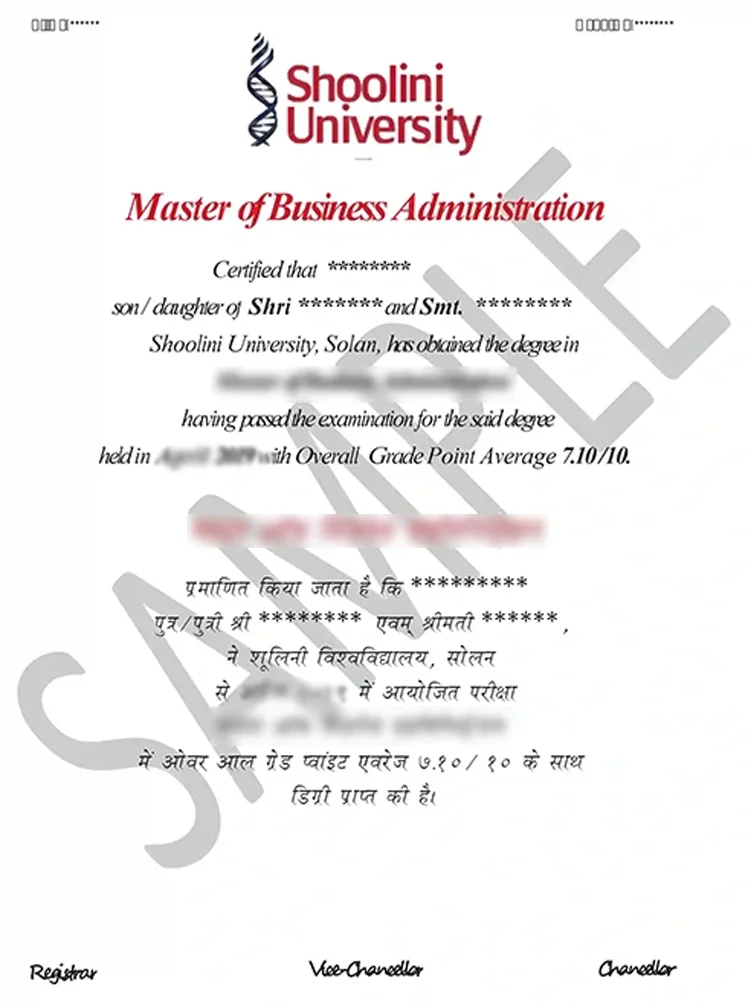
Shoolini University Online Sample Certificate

Sample certificate image shared for illustrative purposes. Actual design and wording may vary by course and batch.

Alongside this sample certificate, the university highlights a UGC-entitled degree, NAAC A+ accreditation, a Times Higher Education Top 200 global ranking, and QS citation-based rankings as the credentials backing its online degrees. As with all marketing claims, it's worth confirming the specific ranking category and year directly through the original NAAC, THE, and QS publications, since ranking claims can sometimes refer to a specific sub-category (like "citations per paper") rather than an overall institutional ranking.

Key Facts About Shoolini University Online

  • Extension of an established Himachal Pradesh-based university into the online learning space
  • NAAC 2024 A+ accredited, with UGC entitlement stated for its online programs
  • Degrees are delivered through a Learning Management System (LMS) with live sessions and discussion forums
  • Distinctive Pay-After-Placement (PAP) model — pay roughly 80% of the fee across semesters, and the remaining ~20% after placement (varies slightly by program)
  • India's first Pay-After-Placement Online MBA, according to the university
  • Claims 250+ hiring partners across its various programs, including Accenture, Deloitte, KPMG, Ericsson, and ICICI
  • Offers free value add-ons with every program: AI-based interview prep, mock interviews, certifications, government exam prep (Banking/SSC/Railways/UPSC), and self-paced upskilling courses (Data Science, Python, Full Stack Dev)
  • Also offers a "Global Gateway" option — IELTS prep and a 1+1 pathway to transfer to a global university partner for a Master's after one year

Is an Online Degree From Shoolini Valid and Recognized?

According to the university, its online degrees are equivalent to on-campus degrees in terms of curriculum and recognition. This claim is backed by a specific citation: UGC Notification No. F. 1-1/2020(DEB-I), dated 4th September 2020 — Part VI, Page 79, Point 22, which states that degrees and postgraduate diplomas awarded through the Online mode by recognized Higher Educational Institutions are treated as equivalent to the corresponding awards offered through the conventional mode.

That said, "equal recognition" claims are common across most online universities, and the real-world value of a degree also depends on whether the university's UGC-DEB entitlement for that specific program is active in the year you enroll. Before paying any fee, it's worth independently confirming this entitlement status directly through the official UGC website, since entitlement lists are refreshed annually.

Shoolini University Online: Accurate 2026 Fee Structure (Program-Wise)

Unlike many online universities that only publish a single flat fee, Shoolini's official website lists two distinct paths for most programs: a Pay-After-Placement (PAP) option and a Standard (opt-out of PAP) option, each with its own scholarship percentage. Below is the exact, program-wise fee breakdown as published on the official site for the 2026 admission cycle.

1. Online MBA (19 Specializations, 2 Years, 4 Semesters)

Option Regular Fee Fee After Scholarship Per Semester Pay After Placement
Offer 1: With Pay-After-Placement ₹2,00,000 ₹1,58,000 (save 21%) ₹31,600 ₹31,600 (paid after job/placement)
Offer 2: Opt-out of PAP (Standard) ₹2,00,000 ₹1,30,000 (save 35%) ₹32,500 N/A

Application Fee: ₹500 (non-refundable). Additional 10% merit scholarship if 90%+ in your qualifying exam. International fee: $3,000 standard, $1,800–$2,000 after scholarship.

2. Online MBA Premium (2 Years, 4 Semesters)

Regular Fee Scholarship Fee After Scholarship Per Semester
₹2,00,000 ₹20,000 ₹1,80,000 ₹45,000

No Pay-After-Placement option on this specific track. Additional 10% scholarship for full one-time payment, plus 5% more for full annual payment. No-interest EMI and loan options available. Application Fee: ₹500 (non-refundable).

3. Online BCA (3 Years, 6 Semesters)

Option Regular Fee Fee After Scholarship Per Semester Pay After Placement
Offer 1: Pay-After-Placement BCA ₹1,35,000 ₹1,12,500 (save 17%) ₹15,000 ₹22,500
Offer 2: Standard BCA ₹1,35,000 ₹96,000 (save 29%) ₹16,000 N/A

Specializations: AI & ML, Cyber Security, Full-Stack Development, Data Science. Additional 15% scholarship if you opt out of PAP. Application Fee: ₹500 (non-refundable).

4. Online BBA (3 Years, 6 Semesters)

Option Regular Fee Fee After Scholarship Per Semester Pay After Placement
Offer 1: Pay-After-Placement BBA ₹1,35,000 ₹1,12,500 (save 17%) ₹15,000 ₹22,500
Offer 2: Standard BBA ₹1,35,000 ₹96,000 (save 29%) ₹16,000 N/A

Subject areas: Marketing, HR, Finance, Digital Marketing, Direct Selling, Computer Science. India's first BBA offering Pay-After-Placement, per the university. Includes a 3rd-year internship placement component. Application Fee: ₹500 (non-refundable).

5. Online B.Com (Honours) (3 Years, 6 Semesters)

Regular Fee Scholarship Fee After Scholarship Per Semester
₹1,20,000 ₹30,000 ₹90,000 (save 25%) ₹15,000

No Pay-After-Placement option currently listed for this program. Specialization areas: Accounting, Finance, and Taxation. Application Fee: ₹500 (non-refundable).

6. Online MCA (2 Years, 4 Semesters)

Option Regular Fee Fee After Scholarship Per Semester Pay After Placement
Offer 1: Pay-After-Placement MCA ₹2,00,000 ₹1,50,000 (save 25%) ₹30,000 ₹30,000
Offer 2: Standard MCA ₹2,00,000 ₹1,30,000 (save 35%) ₹32,500 N/A

Specializations: AI & ML, Data Science, Full-Stack Development. Additional 13% scholarship if you opt out of PAP. Eligibility requires a compulsory bridge course for students without a Maths background at +2 or UG level. Application Fee: ₹500 (non-refundable).

7. Online M.Sc in Data Science (2 Years, 4 Semesters)

Regular Fee Scholarship Fee After Scholarship Per Semester
₹1,60,000 ₹40,000 ₹1,20,000 (save 25%) ₹30,000

Includes exclusive access to Coursera certifications from Google, Johns Hopkins, University of Pennsylvania, University of Colorado, DeepLearning.AI, and University of London at no extra cost. No Pay-After-Placement option currently listed. Application Fee: ₹500 (non-refundable).

8. Online MA in Journalism & Mass Communication (MAJMC) (2 Years, 4 Semesters)

Regular Fee Scholarship Fee After Scholarship Per Semester
₹1,33,333 ₹53,333 ₹80,000 (save 40%) ₹20,000

This program currently shows the highest scholarship percentage (40%) among all Shoolini Online programs. No Pay-After-Placement option currently listed. Application Fee: ₹500 (non-refundable).

9. Online MA English Literature (2 Years, 4 Semesters)

Regular Fee Scholarship Fee After Scholarship Per Semester
₹84,000 ₹24,000 ₹60,000 (save 29%) ₹15,000

This is currently the lowest full-fee program at Shoolini Online. No Pay-After-Placement option currently listed. International fee: $300/semester (non-SAARC), $150/semester (SAARC countries). Application Fee: ₹500 (non-refundable).

Summary Table: All Shoolini Online Programs at a Glance

Program Duration Regular Fee Best Fee After Scholarship PAP Available?
Online MBA 2 Years ₹2,00,000 ₹1,30,000 Yes
Online MBA Premium 2 Years ₹2,00,000 ₹1,80,000 No
Online BCA 3 Years ₹1,35,000 ₹96,000 Yes
Online BBA 3 Years ₹1,35,000 ₹96,000 Yes
Online B.Com (Honours) 3 Years ₹1,20,000 ₹90,000 No
Online MCA 2 Years ₹2,00,000 ₹1,30,000 Yes
Online M.Sc Data Science 2 Years ₹1,60,000 ₹1,20,000 No
Online MAJMC 2 Years ₹1,33,333 ₹80,000 No
Online MA English Literature 2 Years ₹84,000 ₹60,000 No

The Pay-After-Placement (PAP) Model: What It Actually Means

One of the most talked-about features of Shoolini University Online is its Pay-After-Placement option, currently available on the MBA, BCA, BBA, and MCA programs. Based on the exact fee tables published by the university, the structure works out to approximately 80% of the (scholarship-adjusted) fee paid across your semesters, and roughly 20% paid only after you secure a placement or admission to a study-abroad university. For example, on the MBA PAP track, ₹1,26,400 is paid across 4 semesters and ₹31,600 (20% of the ₹1,58,000 total) is paid after placement.

Importantly, opting into PAP currently gets you a smaller scholarship than opting out. For instance, on the BCA program, the PAP track only saves you 17% (final fee ₹1,12,500) while the Standard, non-PAP track saves you 29% (final fee ₹96,000). This means PAP genuinely reduces your immediate cash outflow and risk, but it is not free — you effectively pay a premium (in the form of a smaller scholarship) for that flexibility. Whether this trade-off is worth it depends on your personal cash-flow situation and confidence in the job market for your specialization.

Questions to Ask Before Enrolling in the Pay-After-Placement Track

  • What is the minimum salary or job type that qualifies as a "successful placement" under this scheme?
  • Is there a maximum time window after course completion within which placement must occur, after which the remaining ~20% becomes due regardless?
  • Are there penalties or interest charges if a student doesn't get placed within the specified window?
  • Does opting for PAP restrict eligibility for the "pay once, save more" full-payment scholarships offered on the Standard track?
  • Is the specific placement support (number of interview attempts, resume reviews, referrals) guaranteed, or "best effort" only?

The university does publish a formal Pay-After-Placement Policy document on its website's footer links — request and read this document in full before signing up for the PAP track, since it should spell out the exact conditions referenced above.

EMI and Education Loan Options

Unlike the earlier version of this review, the official program pages now explicitly confirm: "No-Interest EMI and loan options are applicable for all payment options: semester/annual/full fees" across most programs, including MBA, BCA, BBA, MCA, B.Com, M.Sc Data Science, and MBA Premium. This is a meaningful update — students who need to spread out payments in smaller monthly installments (separate from the semester-wise structure) do have this option available directly through the university, in addition to the Pay-After-Placement route on eligible programs.

Additional Discount and Scholarship Opportunities

Beyond the headline PAP vs. Standard fee options, the university lists several additional, stackable discount opportunities across most programs:

  • Special Merit Scholarship: An additional 10% scholarship if you scored more than 90% in Class 12 (for UG entry) or more than 90% in your UG degree (for PG admission).
  • Opt-out of PAP bonus: If you choose not to use Pay-After-Placement, you get an extra scholarship — 15% for BCA/BBA, 18% for MBA, and 13% for MCA — on top of the standard scholarship already reflected in the fee tables above.
  • Full one-time payment discount (MBA Premium): An additional 10% scholarship for paying the entire course fee in a single payment, plus another 5% for paying the full annual fee in advance.
  • International student discounts: A 30% scholarship for a single full-fee payment, and a 20% scholarship for paying one year's fee in advance (applicable to international fee structures).

Admission Process and Eligibility for Shoolini University Online (2026)

Admission to Shoolini Online is direct-entry, without a formal entrance exam, based on eligibility criteria and document verification. Start dates vary by program — for example, BBA, MCA, MAJMC, and MA English Literature list a January 2026 start date, while MBA and BCom (Honours) list an August 2026 start date, and BCA and MSc Data Science also show January 2026 in their published tables. Always confirm the exact current intake cycle for your specific program with the admissions team, as these dates are refreshed periodically.

Program Eligibility
BCA / BBA / B.Com (Hons) 10+2 in any discipline with 40% marks (60% for international students)
MBA / MBA Premium Bachelor's degree (min. 3 years) with at least 50% marks (45% for reserved category, 60% for international students)
MCA Bachelor's degree in any discipline with min. 50% marks (bridge course required if no Maths background at +2/UG level)
M.Sc Data Science Graduation in Science, Technology, Engineering, CSE, or related discipline with min. 50% marks
MAJMC Graduation in any discipline with min. 40% marks
MA English Literature Bachelor's degree in any discipline with min. 40% marks (60% for international students)

Documents Required for Admission

  • Grade Sheet of Class X
  • Grade Sheet of Class XII
  • Grade Sheets of all Semesters of Bachelor's Degree / Consolidated Marksheet (PG programs only)
  • Degree Certificate / Provisional Degree Certificate (PG programs only)
  • Aadhaar Card (Indian nationals) or Passport (foreign nationals), both sides
  • Photocopy of signature and a passport-size photograph
  • Category certificate (if applicable) and Bonafide Certificate (if from Himachal Pradesh)

Free Value Add-Ons Included With Every Program

A notable positive from the updated information is that every Shoolini Online program bundles in one free "value add-on" of the student's choice, at no extra cost:

  • Power Job Preparation: AI-based interview preparation or communication skills training, plus two certifications from a range of specialized programs and industry mentorship with career coaching.
  • Global Gateway: IELTS prep or a 1+1 international pathway, with the option to transfer to a global university partner after one year for a Master's degree, plus guidance for UK, US, Australia, and Canada admissions.
  • Govt. Test Prep Exams: Coverage of 200+ government exams (Banking, SSC, Railways) with live classes, mock tests, books, and 10,000+ mock test access.
  • UPSC CSE-GS Prep (via StudyIQ): 1,000+ hours of recorded classes, 1-to-1 mentorship, prelims and mains test series, and a 3-month mains residential program.
  • Upskilling Courses: 200+ self-paced courses in Data Science, Python, and Full-Stack Development with industry-oriented projects and certification on completion.

These value add-ons don't cost extra on top of your course fee, and they materially improve the overall value proposition, especially for students who also want to prepare for government exams or study-abroad pathways alongside their degree.

Placement Support and Hiring Partners

Shoolini Online states it has 250+ hiring partners across its various programs. Named companies specifically listed as recruiters include Accenture, Deloitte, KPMG, Ericsson, ICICI, Mercer, Adani, Grant Thornton, L'Oréal, Piramal Group, Hindustan Unilever Limited (HUL), Aditya Birla Group, Bank of America, and Genpact — a notably more recognizable and diverse list of names than a typical online-only program.

Career pathways highlighted for MBA graduates specifically include roles like Business Analyst, Marketing Manager, Financial Analyst, Operations Manager, HR Manager, Data Scientist, Investment Banker, Management Consultant, and Product Manager, among others. As with any placement claim, treat the "250+ hiring partners" figure as an indication of breadth of relationships rather than a guarantee — ask the admissions team for actual placement data (number of students placed, average package, and which of these named companies hired from your specific specialization) in the last one or two batches before enrolling.

Examination Pattern at Shoolini University Online

Examinations at Shoolini Online follow a semester system and are conducted through AI-proctored technology, allowing students to appear for exams remotely while maintaining fair examination practices. Students can interact with faculty during live sessions and through the LMS discussion forum or chat, and a complete calendar of due dates and deadlines is made available on the Learning Management System (LMS).

If you're considering this program, confirm your internet connectivity and device compatibility with the proctoring software well before your first semester exam, since technical issues during a proctored exam can create unnecessary stress.

Honest Pros and Cons of Shoolini University Online

Pros

  • Detailed, program-specific fee tables: Unlike vague "starting from" pricing, Shoolini publishes exact regular fees, scholarship amounts, and per-semester breakdowns for each program.
  • Genuine EMI and no-interest loan options: Confirmed available across almost all programs, in addition to the Pay-After-Placement route.
  • Strong, named hiring partners: Companies like Accenture, Deloitte, KPMG, and HUL lend real credibility to placement claims.
  • NAAC A+ and multiple ranking credentials: A more detailed accreditation profile (NAAC 2024 A+, THE Top 200, QS citations ranking, UGC entitlement) than many peers.
  • Free value add-ons on every program: Government exam prep, study-abroad pathways, and upskilling courses bundled in at no extra cost.
  • Direct-entry admission: No entrance exam requirement simplifies and speeds up enrollment.

Cons / Things to Verify Carefully

  • PAP comes at a scholarship cost: Choosing Pay-After-Placement gets you a smaller discount (e.g., 17% vs. 29% on BCA) than opting out, so it isn't a purely "extra" benefit — you're trading a bigger discount for reduced upfront risk.
  • Fees and scholarships are explicitly "limited period": The exact numbers in this review reflect the 2026 cycle at the time of writing and can change — always reconfirm before paying.
  • Placement statistics need program-specific verification: "250+ hiring partners" is a strong claim across all programs combined; ask specifically about outcomes for your chosen specialization.
  • Terms of Pay-After-Placement aren't fully detailed on the program pages: Request the full Pay-After-Placement Policy document from admissions to understand qualifying conditions before enrolling.
  • No PAP option on several programs: B.Com (Hons), M.Sc Data Science, MAJMC, and MA English Literature currently do not offer the Pay-After-Placement route at all.

Is Shoolini University Online Worth the ROI in 2026?

For Undergraduate Courses (BCA, BBA, B.Com Honours)

At ₹90,000 to ₹96,000 after scholarship for a full 3-year UG degree (Standard/non-PAP track), or roughly ₹1,12,500 with Pay-After-Placement, the fee is relatively affordable, and the inclusion of no-interest EMI options makes it accessible without needing a large lump sum. This represents solid value for a NAAC A+, UGC-entitled degree, provided current entitlement is confirmed for your enrollment year.

For the Online MBA and MBA Premium

An online MBA at ₹1,30,000 (Standard, non-PAP) to ₹1,58,000 (PAP) for 2 years is priced competitively for a NAAC A+ university with 250+ named hiring partners. MBA Premium, at ₹1,80,000, offers a wider specialization list (16 subject areas) but no PAP option — this track suits students who are confident in their post-MBA outcome and want the widest specialization choice without needing the placement-linked deferral.

For MCA and M.Sc Data Science

MCA (₹1,30,000 Standard / ₹1,50,000 PAP) and M.Sc Data Science (₹1,20,000, with bundled Coursera certifications from Google, Johns Hopkins, and others) both offer strong technical specializations at a reasonable price point relative to many premium online tech-focused programs elsewhere.

Overall ROI Verdict

Based on the now-confirmed, exact fee-to-recognition ratio, Shoolini University Online offers genuinely good value on paper — particularly given the confirmed EMI/loan availability, NAAC A+ accreditation, and a long list of named hiring partners. The Pay-After-Placement option is a real, distinctive feature, but it's important to recognize it comes at the cost of a smaller scholarship, not as a pure bonus. "Worth it" ultimately still depends on your specific program, effort in leveraging placement support, and independent verification of current entitlement and placement outcomes.

UGC Fee Refund Policy for Shoolini University Online Students

Shoolini University Online links directly to the official UGC Fee Refund Policy document from its website footer, and further details are available on the official UGC website. The refund percentages based on the admission cancellation timeline are summarized below.

Admission Cancellation Timeline Refund Percentage Institutional Deduction
15 days or more before the formally announced last date of admission 100% Refund Maximum ₹5,000 as processing fee
Less than 15 days before the formally announced last date of admission 90% Refund Actual processing charge limits
15 days or less after the formally announced last date of admission 80% Refund Actual processing charge limits
16 to 30 days after the formally announced last date of admission 50% Refund Actual processing charge limits
More than 30 days after the formally announced last date of admission 0% Refund Institutional retention applies

Note that the ₹500 application fee is explicitly stated as non-refundable on every program page, regardless of when the cancellation occurs. Always request written confirmation of the exact refund terms applicable to your specific program before making your first payment.

Top Universities to Compare Against Shoolini Online

University Suitable For Explore
Shoolini University Online Program-specific scholarships, genuine Pay-After-Placement, EMI/loan options View University
Amity University Online Online management, tech, and business-related pathways View University
Online NMIMS Online management and business-oriented programs View University
Online Manipal University Online management, tech, and flexible degree options View University
Jain University Online Online business, management, and tech-related programs View University
LPU Online Flexible online degrees for management and tech students View University
Chandigarh University Online Online management, tech, and career-focused learning options View University
Sikkim Manipal University (Distance Education) Distance education for management and business programs View University

Who Should (and Shouldn't) Choose Shoolini University Online?

Good Fit If You...

  • Want exact, transparent, program-specific fee and scholarship figures rather than vague pricing
  • Are interested in reducing upfront cash outflow through Pay-After-Placement, and are comfortable trading a smaller scholarship for that flexibility
  • Need genuine no-interest EMI or loan options and want confirmation these exist before applying
  • Value having NAAC A+ accreditation and a long list of named corporate hiring partners
  • Want free bundled value add-ons like government exam prep or a study-abroad pathway alongside your degree

Consider Alternatives If You...

  • Want the Pay-After-Placement option specifically on B.Com (Hons), M.Sc Data Science, MAJMC, or MA English Literature — it's currently not offered on these programs
  • Want independently audited, program-specific placement data before enrolling, rather than a combined "250+ hiring partners" figure
  • Are uncomfortable with fee structures that change based on which scholarship option you select

Final Verdict: Is Shoolini University Online Worth It in 2026?

Final Verdict: Based on accurate, program-specific fee data now confirmed directly from the official Shoolini University Online website, this university offers competitively priced, NAAC A+ accredited, UGC-entitled degrees, with genuinely confirmed no-interest EMI/loan options and a real (though scholarship-adjusted) Pay-After-Placement model on select programs. Fees range from around ₹60,000 (MA English Literature, after scholarship) up to ₹1,80,000 (MBA Premium, after scholarship), making it accessible across a range of budgets. It is worth serious consideration in 2026, provided you carefully compare the PAP vs. Standard scholarship trade-off for your chosen program and independently verify current entitlement and placement claims with the admissions team before enrolling.

Let's clear up some doubts

What is the exact fee for the Shoolini Online MBA?

The regular fee is ₹2,00,000. With the Pay-After-Placement option, it comes to ₹1,58,000 after scholarship. If you opt out of PAP (Standard track), it comes to ₹1,30,000 after scholarship — a bigger discount.

Does Shoolini University Online offer EMI or education loans?

Yes. The official program pages confirm that no-interest EMI and loan options are applicable across semester, annual, and full-fee payment options for nearly all programs.

Is Pay-After-Placement really free money, or does it cost something?

It comes at a cost — choosing PAP gives you a smaller scholarship than opting out. For example, on BCA, PAP saves 17% while opting out saves 29%. PAP reduces upfront risk but is not a pure bonus on top of the best discount.

Which programs currently don't offer Pay-After-Placement?

B.Com (Honours), M.Sc in Data Science, MA in Journalism & Mass Communication, and MA English Literature do not currently list a Pay-After-Placement option on their official fee pages.

Is there an entrance exam for admission to Shoolini University Online?

No, admission is based on a direct application process with document verification and eligibility checks, not a formal entrance exam.

What accreditations does Shoolini Online currently hold?

The university states NAAC 2024 A+ accreditation, a Times Higher Education Top 200 global ranking, a QS #1 India/#6 Asia ranking in Citations per Paper, Diamond Rated University status, and UGC entitlement for its online degrees.

What is the cheapest program at Shoolini University Online?

The MA English Literature program currently has the lowest fee, at ₹60,000 after scholarship (regular fee ₹84,000) for the full 2-year program.

Who are the placement partners for Shoolini University Online?

The university lists 250+ hiring partners including Accenture, Deloitte, KPMG, Ericsson, ICICI, Hindustan Unilever Limited, Aditya Birla Group, Genpact, and Bank of America, among others.

Is the online degree from Shoolini equal to an on-campus degree?

The university states this is backed by UGC Notification No. F. 1-1/2020(DEB-I), which treats online-mode degrees as equivalent to conventional-mode degrees, provided the program held valid UGC entitlement at the time of enrollment.

What is the refund policy if I cancel my admission?

The university follows the UGC-aligned refund policy: 100% refund (minus a small processing fee) if cancelled 15+ days before the admission deadline, tapering to 0% after 30 days past the deadline. The ₹500 application fee is non-refundable in all cases.

How to Create ABC ID Online in 5 Minutes

How to Create ABC ID Online in 5 Minutes

Creating an ABC ID, also known as an Academic Bank of Credits ID, is now an important step for students in India. Whether you are taking admission in a regular degree, online degree, distance education program, skill course, or university program, your ABC ID helps you manage your academic credits digitally.

The Academic Bank of Credits is connected with the APAAR ID system. APAAR stands for Automated Permanent Academic Account Registry. It works as a lifelong academic identity for students and helps connect learning records, academic credits, certificates, and educational achievements in one digital system.

Students can create their ABC ID online through the official Academic Bank of Credits website and DigiLocker login. If your mobile number is linked with Aadhaar and your basic academic details are ready, the process can be completed in around 5 minutes.

Official UGC Website: https://www.ugc.gov.in/

Academic Bank of Credits Website: https://www.abc.gov.in/

Step-by-Step PDF Guide: Download ABC ID Student Guide PDF

What is ABC ID?

ABC ID is a unique digital academic identity used by students on the Academic Bank of Credits platform. It helps store, track, transfer, and manage academic credits earned from recognized educational institutions.

Think of it like a digital academic account. Just as a bank account stores your money, the Academic Bank of Credits stores your academic credits. When you complete eligible courses, subjects, programs, or skill-based learning from recognized institutions, those credits can be linked to your ABC account.

Term Meaning Purpose
ABC Academic Bank of Credits Stores and manages academic credits digitally
ABC ID Academic Bank of Credits ID Identifies the student in the ABC system
APAAR ID Automated Permanent Academic Account Registry ID Acts as a lifelong academic identity for learners
DigiLocker Government digital document wallet Used for login, verification, and accessing ABC/APAAR ID

Why Do Students Need ABC ID?

Many universities, colleges, and online education institutions now ask students to create and submit their ABC ID during admission, registration, or academic record verification. It helps institutions map student credits correctly and maintain academic records in a digital format.

ABC ID is especially useful for online degree students because online learning depends heavily on digital records, online exams, digital mark sheets, and credit-based academic systems.

Use Case How ABC ID Helps
Online degree admission Helps universities connect student details with academic credit records
Credit transfer Makes it easier to track credits earned from recognized institutions
Multiple entry and exit Supports flexible learning under credit-based education systems
Academic verification Provides a digital identity for checking student academic records
Future education Helps students continue learning with a connected academic profile

Documents and Details Required to Create ABC ID

Before creating your ABC ID, keep your basic details ready. This will make the process faster and reduce errors while filling the form.

Requirement Why It Is Needed
Aadhaar number Used for identity verification through DigiLocker
Aadhaar-linked mobile number Required for OTP verification
DigiLocker account Required to access ABC/APAAR ID services
Institution name Needed to select your school, college, university, or institution
Admission year May be required while creating the academic profile
Roll number or enrollment number Helps match your academic record with your institution

How to Create ABC ID Online in 5 Minutes

Follow these simple steps to create your ABC ID online.

Step 1: Visit the Official ABC Website

Go to the official Academic Bank of Credits website: https://www.abc.gov.in/.

Step 2: Choose Student Login

On the website, look for the student login, get started, or APAAR ID creation option. The portal may redirect you to DigiLocker for authentication.

Step 3: Login With DigiLocker

Enter your DigiLocker login details. You can usually log in using your mobile number, Aadhaar number, username, or other available login method. Complete OTP verification.

Step 4: Select Education Category

Choose the correct learner category, such as higher education learner, skill education learner, or other learner, depending on your education type.

Step 5: Enter Academic Details

Select your institution and enter details such as admission year, roll number, or enrollment number if asked.

Step 6: Submit and Download ABC ID

Check your details carefully, accept the terms, and submit. Once generated, download or save your ABC ID/APAAR ID from DigiLocker.

Quick Process Summary

Step Action Estimated Time
1 Open ABC website 30 seconds
2 Login through DigiLocker 1 minute
3 Complete OTP verification 1 minute
4 Select education category and institution 1 minute
5 Submit details and download ID 1-2 minutes

Common Problems While Creating ABC ID

Problem Possible Reason What You Can Do
OTP not received Network issue or Aadhaar-linked mobile problem Wait and try again after some time
Institution not found Wrong spelling or institution listed under parent university Search using university name or try alternate spelling
Name mismatch Aadhaar and academic record details are different Correct the mismatch in the relevant document
Website loading slowly Heavy traffic or unstable internet Use stable internet or try again later
DigiLocker login issue Incorrect login details or OTP problem Reset login or use another available login method

Important Tips for Students

  • Always create your ABC ID from the official website only.
  • Do not share your OTP, Aadhaar details, or DigiLocker password with anyone.
  • Use the same name and details that appear in your academic records.
  • Download your ABC ID after it is generated.
  • Keep your ABC ID saved safely for admission and university use.
  • Use the PDF guide if you want step-by-step visual help.

Useful Official Links

Website / Resource Purpose Link
UGC Website Official higher education regulator website Visit UGC
Academic Bank of Credits Create and access ABC/APAAR ID Visit ABC Portal
ABC ID PDF Guide Step-by-step student guide to create ABC ID Download PDF

FAQs on ABC ID

Is ABC ID free?

Yes, students can create their ABC ID online through the official portal without paying any fee.

Is ABC ID and APAAR ID the same?

They are closely connected. APAAR ID works as a lifelong academic identity, and the Academic Bank of Credits uses it to manage academic credits.

Can I create ABC ID without DigiLocker?

DigiLocker is generally used for login and verification, so students should create or access their DigiLocker account during the process.

What if my college name is not showing?

Try searching with the university name, official institution name, or alternate spelling. If it still does not appear, contact your institution.

Do online degree students need ABC ID?

Many online universities and higher education institutions ask students to submit ABC ID for academic records and credit mapping.

Conclusion

Creating an ABC ID online is a simple process if your Aadhaar-linked mobile number, DigiLocker account, and academic details are ready. Visit the official ABC website, log in through DigiLocker, select your education category, enter your institution details, and submit the form.

Once your ABC ID or APAAR ID is generated, download it and keep it safe. You may need it for admission, university registration, credit transfer, examination forms, and future academic records.

How Does NMIMS Online Learning Work_ [A Complete Guide]

How Does NMIMS Online Learning Work? A Complete Student Guide

With advancements in educational technology, thousands of students and working professionals are shifting toward flexible online degrees. As a pioneer in management education, the Narsee Monjee Institute of Management Studies (NMIMS University) Centre for Distance and Online Education (CDOE) has built a robust digital framework to deliver high-quality programs. If you are considering applying, understanding how the virtual classroom operates is essential before initiating your NMIMS Distance Admission 2026 process.

Approved fully by the University Grants Commission (UGC), NMIMS Online Learning mirrors the academic rigour of traditional on-campus education. Before committing financially, many applicants closely analyze the program structures, curriculum modules, and industry placement assistance to answer a critical query: Is NMIMS MBA Good or Bad? Full Review and Facts. This comprehensive guide outlines exactly how the online framework works, from orientation to graduation.

Core Highlights: NMIMS online education operates through a dedicated Student Portal and Mobile Application, providing seamless access to live weekend sessions, digital textbooks, query resolution tools, and proctored home exams.

Key Pillars of NMIMS Online Learning

The university uses an advanced custom Learning Management System (LMS) designed to facilitate continuous learning without disrupting a student's daily professional schedule. The entire ecosystem revolves around four central pillars:

Live & Recorded Interactive Lectures Attend real-time classes over weekends to interact with senior faculty, or view high-definition recorded archives at your convenience.
The Digital Library (E-Content) Access a massive repository of e-books, research journals, multimedia summaries, and structured case studies directly through the application.
Dynamic Discussion Boards Post academic queries, collaborate on group case studies, and clear concept doubts directly with designated mentors via the "Ask the Faculty" feature.

Diverse Online Courses & Specialized Specializations Offered

NMIMS offers multiple technical and management tracks built directly around modern industry requirements. Depending on your professional objectives, you can choose specialized paths ranging from traditional corporate governance to advanced data analytics:

  • 2-Year Master of Business Administration (Online/Distance MBA): The flagship track covering core domains like Finance, Human Resources, Supply Chain, and Marketing Management. To evaluate your post-degree financial growth, you can check your metrics using an online MBA ROI Calculator.
  • 1-Year Specialized Management Track: Tailored for working professionals looking to secure quick functional competencies through a structured NMIMS Distance PGDM diploma format.
  • 3-Year Undergraduate Programs: Foundational tracks including BBA and B.Com. For students looking to transition into quantitative tech roles, the university provides a highly popular, specialized NMIMS BBA in Business Analytics track.

How Online Evaluation and Examinations Work

To ensure academic credibility while offering maximum flexibility to remote learners, NMIMS CDOE implements a balanced, dual-component evaluation strategy:

Assessment Component Weightage Methodology & Student Workflow
Continuous Internal Assignments 30% Case-study based assignment prompts are published on the portal. Students download, research, draft, and upload their submissions before the semester deadline.
Term-End Examinations 70% Conducted entirely through a secure online proctored examination platform. Students slot their preferred exam dates and take tests from home using a computer setup with a webcam and microphone.

The examination paper layout balances concept retention and real-world implementation, featuring an integrated mix of objective Multiple Choice Questions (MCQs) alongside descriptive application-based inquiries.

Student Support and Scholarship Facilities

NMIMS provides extensive assistance to ensure distance learners never feel isolated during their academic journey. Dedicated student relationship managers are accessible via phone and email ticketing systems to resolve technical portal glitches or registration queries swiftly.

Furthermore, to make professional education accessible, the university provides structured financial concessions across specific categories. These include specialized fee reductions for defense personnel, corporate alumni discounts, and seasonal scholarship programs alongside flexible No-Cost EMI payment facilities with major banking partners.

Corporate Placement Assistance and Hiring Networks

The online programs are built to bridge the gap between academic theory and active career progression. NMIMS operates a dedicated Corporate Placement Assistance cell that works actively to connect enrolled students with modern hiring domains. Distance and online learners receive access to comprehensive career coaching services, resume polishing webinars, mock interview training sessions, and exclusive job fairs.

NMIMS graduates are heavily sought after across diverse industry verticals, transitioning successfully into leadership roles across finance, strategy, supply chain management, retail, and tech operations networks.

Conclusion

The NMIMS Online Learning model seamlessly blends academic excellence with modern digital convenience. Driven by an advanced tech ecosystem, a market-centric curriculum, clear evaluation parameters, and dedicated corporate support, it functions as a highly reliable option for professionals aiming to unlock higher executive roles safely.

Frequently Asked Questions

Are online degrees from NMIMS recognized by UGC?

Yes, all undergraduate, postgraduate, and diploma courses offered via the NMIMS University Centre for Distance and Online Education are fully approved and recognized by the University Grants Commission (UGC) and DEB.

Can I attend online lectures using my mobile phone?

Yes, NMIMS has a customized student application available on both iOS and Android platforms, allowing you to stream live or recorded lectures, download study material, and track assignment status on your mobile device.

Do I need to visit an exam center for my final semester papers?

No, final exams are conducted entirely online through a secure remote proctored format. You can easily complete your exams from your home or office using a webcam-enabled computer setup.

What is the submission weightage for assignments?

The academic assignments hold a 30% weightage in your overall grade for each subject, while the term-end proctored examinations account for the remaining 70% of the evaluation.

Suggested Blogs – NMIMS University

Digital Marketing Career

Digital Marketing Career: Complete Guide, Scope, Jobs, Skills and Salary

A digital marketing career is one of the fastest-growing career options for students, graduates, working professionals, freelancers, and business owners. As companies are shifting from traditional marketing to online platforms, the demand for skilled digital marketers is increasing in almost every industry. Today, brands need professionals who can promote products on Google, social media, websites, YouTube, email, marketplaces, and mobile apps.

Digital marketing is not limited to posting on Instagram or running ads. It includes SEO, social media marketing, content marketing, Google Ads, email marketing, website analytics, performance marketing, influencer marketing, e-commerce marketing, video marketing, branding, and online lead generation. This makes it a flexible and practical career option for students from commerce, arts, science, management, IT, design, and communication backgrounds.

Quick Answer: Digital marketing is a good career option for students who enjoy creativity, online platforms, content, analytics, advertising, branding, communication, and business growth. Popular roles include SEO Executive, Social Media Manager, Content Marketer, Performance Marketer, PPC Specialist, Email Marketer, Digital Marketing Manager, and Growth Marketer.

What is Digital Marketing?

Digital marketing means promoting products, services, brands, or businesses through online channels. These channels may include search engines, social media platforms, websites, emails, mobile apps, video platforms, and paid advertisements. The main goal of digital marketing is to reach the right audience, generate leads, increase sales, build brand awareness, and improve customer engagement.

For example, when a company appears on Google search results, runs Instagram ads, sends promotional emails, uploads YouTube videos, publishes blogs, or sells products through an e-commerce website, it is using digital marketing. Because customers now spend a lot of time online, businesses need digital marketing to stay visible and competitive.

Why Choose a Career in Digital Marketing?

Digital marketing is a strong career choice because every business wants online growth. Whether it is an education company, hospital, real estate firm, fashion brand, restaurant, coaching institute, software company, startup, or multinational company, everyone needs digital marketing to attract customers.

Another major benefit is flexibility. Digital marketers can work full-time, freelance, work remotely, start an agency, become content creators, or support their own business. Unlike many traditional careers, digital marketing values practical skills, portfolio, creativity, and results more than only degrees.

Main Benefits of Digital Marketing Career

  • High demand across almost every industry
  • Suitable for students from any stream
  • Good career scope in jobs, freelancing, and business
  • Remote work and work-from-home opportunities
  • Fast skill-based growth
  • Creative and analytical career options
  • Useful for startups, personal branding, and entrepreneurship

Digital Marketing Career Options

Digital marketing has multiple career paths. Students can choose one specialization or become a full-stack digital marketer by learning multiple skills. Some roles are more creative, while others are more data-driven. The best role depends on your interest and strengths.

1. SEO Executive

SEO stands for Search Engine Optimization. An SEO Executive helps websites rank higher on Google and other search engines. The work includes keyword research, content optimization, technical SEO, backlink building, website audits, competitor analysis, and improving organic traffic.

SEO is suitable for students who enjoy research, content, analytics, website improvement, and long-term growth strategy. It is one of the most stable digital marketing skills because businesses always want free organic traffic from search engines.

2. Social Media Manager

A Social Media Manager handles platforms like Instagram, Facebook, LinkedIn, X, YouTube, and Pinterest. Their work includes creating content calendars, planning posts, writing captions, managing communities, tracking engagement, coordinating creatives, and building brand presence.

This role is suitable for students who are creative, trend-aware, good at communication, and interested in branding. Social media managers are in demand in agencies, startups, media companies, education brands, fashion brands, and personal branding teams.

3. Content Marketer

Content marketing focuses on creating valuable content to attract and educate customers. Content can include blogs, website pages, videos, social media posts, newsletters, case studies, e-books, scripts, and landing page copy.

Content marketing is suitable for students who enjoy writing, storytelling, research, and explaining ideas clearly. It works closely with SEO, branding, lead generation, and social media.

4. Performance Marketer

Performance marketing is focused on paid advertising and measurable results. A Performance Marketer runs ads on platforms like Google Ads, Meta Ads, YouTube Ads, LinkedIn Ads, and other paid channels. The goal is to generate leads, sales, app installs, website traffic, or conversions at the best cost.

This role is suitable for students who like numbers, analytics, testing, strategy, and business growth. Performance marketers are highly valued because their work directly affects revenue.

5. PPC Specialist

PPC stands for Pay-Per-Click advertising. A PPC Specialist manages paid search campaigns, mostly on Google Ads and Bing Ads. They choose keywords, write ad copies, manage bids, improve landing pages, monitor conversions, and optimize ad budgets.

PPC is a good career option for students who are interested in paid advertising, keyword strategy, data analysis, and lead generation.

6. Email Marketing Specialist

Email marketing is used to communicate with leads and customers through newsletters, promotional emails, automated campaigns, product updates, and customer retention campaigns. Email marketers create campaigns, segment audiences, write subject lines, track open rates, and improve conversions.

This role is suitable for students who are good at writing, customer psychology, automation, and campaign planning.

7. Digital Marketing Analyst

A Digital Marketing Analyst studies campaign performance using data. They track website traffic, conversion rates, ad performance, customer behaviour, keyword rankings, social media engagement, and sales funnels. They use tools like Google Analytics, Search Console, ad dashboards, and reporting software.

This role is suitable for students who like data, reports, numbers, and decision-making. It is a strong career path for those who want to combine marketing with analytics.

8. E-commerce Marketing Specialist

E-commerce marketing focuses on selling products online through websites, marketplaces, social media, and ads. Professionals in this field work on product listings, marketplace SEO, paid ads, offers, conversion optimization, customer reviews, and sales growth.

This role is useful for students interested in online selling, product marketing, marketplaces, and direct-to-consumer brands.

9. Influencer Marketing Executive

Influencer marketing involves collaborating with creators and influencers to promote brands. An Influencer Marketing Executive finds influencers, negotiates deals, plans campaigns, tracks performance, and manages brand collaborations.

This role is suitable for students who understand social media culture, content creators, trends, brand communication, and audience behaviour.

10. Digital Marketing Manager

A Digital Marketing Manager leads the overall online marketing strategy of a company. They manage SEO, ads, social media, content, email, website, analytics, and team coordination. This is a senior role that requires experience and understanding of multiple digital marketing channels.

Students usually start as executives or interns and grow into manager-level roles after gaining practical experience.

Digital Marketing Career Options Table

Career Option Best For Key Skills
SEO Executive Students interested in Google ranking and website traffic Keyword research, content SEO, technical SEO
Social Media Manager Creative students who like social platforms Content planning, captions, trends, engagement
Performance Marketer Students interested in ads and measurable results Google Ads, Meta Ads, analytics, conversion tracking
Content Marketer Students good at writing and storytelling Writing, research, SEO, content strategy
Digital Marketing Analyst Students who like data and reporting Google Analytics, reporting, data interpretation

Who Can Build a Career in Digital Marketing?

Digital marketing is open to students from almost every educational background. A commerce student can use digital marketing for business and sales. An arts student can use writing, creativity, and communication skills. A science or IT student can enter analytics, SEO, automation, and marketing technology. A management student can grow in branding, strategy, performance marketing, and business development.

The most important requirement is not your stream but your willingness to learn practical tools, understand customers, analyze performance, and keep updating your skills.

Digital Marketing is Suitable For:

  • Students after 12th
  • Graduates from any stream
  • BBA, BCom, BA, BCA, BSc, and MBA students
  • Working professionals planning a career switch
  • Freelancers and content creators
  • Business owners and startup founders
  • Homemakers looking for flexible work

Best Courses for Digital Marketing Career

Digital marketing does not always require a specific degree, but a good educational foundation helps. Students can choose a degree based on their long-term goal and then add digital marketing certifications.

Course Best For
BBA Marketing, management, brand strategy, business growth
BCom Business, finance, e-commerce, performance marketing
BA Mass Communication Content, media, advertising, social media, communication
BCA Marketing technology, analytics, website management, automation
MBA Marketing Digital strategy, brand management, leadership roles

Skills Required for Digital Marketing

Digital marketing is a practical field, so skills matter a lot. A student with strong practical knowledge, a good portfolio, and real project experience can grow faster than someone who only has theoretical knowledge.

  • SEO Skills: Keyword research, on-page SEO, technical SEO, backlinks, and content optimization.
  • Social Media Skills: Content planning, platform understanding, community building, and trend analysis.
  • Content Writing: Blog writing, ad copies, captions, emails, website content, and storytelling.
  • Paid Advertising: Google Ads, Meta Ads, YouTube Ads, campaign setup, and budget optimization.
  • Analytics: Google Analytics, Search Console, conversion tracking, and performance reports.
  • Design Sense: Basic understanding of creatives, branding, layout, and visual communication.
  • Communication: Client handling, reporting, team coordination, and presentation skills.
  • AI and Automation: Using AI tools, email automation, CRM tools, and marketing workflows.

Salary in Digital Marketing

Digital marketing salary depends on skills, experience, city, company, portfolio, and specialization. Entry-level students usually start as interns or executives. With experience, they can become specialists, managers, strategists, consultants, or agency owners.

Performance marketing, SEO strategy, analytics, marketing automation, and growth marketing roles often offer better salaries because they directly impact business revenue. Freelancers can also earn well if they build strong client results and a good portfolio.

Experience Level Common Roles Growth Focus
Beginner Intern, SEO Executive, Social Media Executive Learn tools, build portfolio, understand platforms
Intermediate SEO Specialist, PPC Specialist, Content Strategist Handle campaigns, improve performance, manage clients
Senior Digital Marketing Manager, Growth Manager Strategy, team leadership, revenue growth

Top Online Universities for Digital Marketing-Related Degrees

Students who want flexible learning can choose online degrees in BBA, BCom, MBA, mass communication, or business programs and add digital marketing certifications along with them. Before taking admission, always verify university recognition from the official UGC website. Students should also read the UGC Fee Refund Policy PDF before paying admission fees.

University Suitable For Explore
Amity University Online Online BBA, MBA, management, and marketing-related programs View University
NMIMS CDOE Management, marketing, and business-focused programs View University
Online Manipal University Online commerce, business, media, and management programs View University
Jain University Online Online business, marketing, and MBA programs View University
Chandigarh University Online Online BBA, BCom, MBA, and career-oriented degrees View University

Helpful Career Tools

If you are unsure whether digital marketing is the right career for you, career tools can help you understand your interests, personality, and suitable career direction.

Tool Use Link
Personality Interest EQ Assessment Understand your personality, interests, and emotional strengths Use Tool
Career Analysis For Working Professionals Useful for professionals planning a switch into digital marketing Use Tool
Career Options After Graduation Explore career paths after completing a bachelor’s degree Use Tool
Career Options After 12th Find suitable courses after 12th based on your stream and interest Use Tool

UGC Fee Refund Policy for Students

Before enrolling in any online or regular degree related to digital marketing, business, or management, students should understand the admission cancellation and fee refund rules. The UGC fee refund policy provides clarity on refund percentages based on cancellation timelines.

Admission Cancellation Timeline Refund Percentage Institutional Deduction
15 days or more before the formally announced last date of admission 100% Refund Maximum ₹5,000 as processing fee
Less than 15 days before the formally announced last date of admission 90% Refund Actual processing charge limits
15 days or less after the formally announced last date of admission 80% Refund Actual processing charge limits
16 to 30 days after the formally announced last date of admission 50% Refund Actual processing charge limits
More than 30 days after the formally announced last date of admission 0% Refund Institutional retention applies

How to Start a Career in Digital Marketing?

To start a career in digital marketing, begin with the basics of SEO, social media, Google Ads, content writing, email marketing, and analytics. After that, choose one specialization and practice on real projects. You can create your own blog, Instagram page, YouTube channel, portfolio website, or run small ad campaigns to gain practical experience.

Internships are very important in digital marketing. Even a short internship can help you understand client work, campaign planning, reporting, content calendars, website traffic, and lead generation. Students should also build a portfolio with sample blogs, SEO reports, ad copies, social media posts, and campaign results.

Final Thoughts

Digital marketing is a practical, flexible, and future-ready career option. It is suitable for students who want a creative yet business-focused career. The field has opportunities in jobs, freelancing, remote work, entrepreneurship, content creation, and agency building.

The best way to grow in digital marketing is to keep learning, keep testing, and keep building real experience. Tools and platforms may change, but the main goal remains the same: understand the audience, create useful content, promote it smartly, measure results, and improve continuously.

Final Verdict: Digital marketing is a good career choice for students who enjoy online platforms, creativity, analytics, branding, advertising, and business growth. With the right skills and portfolio, it can offer strong career growth in jobs, freelancing, and entrepreneurship.

FAQs on Digital Marketing Career

1. Is digital marketing a good career?

Yes, digital marketing is a good career because businesses need online visibility, leads, sales, branding, and customer engagement.

2. Who can pursue digital marketing?

Students from any stream, graduates, working professionals, freelancers, and business owners can learn digital marketing.

3. Which course is best for digital marketing?

BBA, BCom, BA Mass Communication, BCA, MBA Marketing, and digital marketing certifications are useful for this career.

4. Is coding required for digital marketing?

Coding is not compulsory, but basic knowledge of websites, HTML, tracking codes, and analytics can be helpful.

5. Which digital marketing skill is best?

SEO, performance marketing, content marketing, analytics, social media marketing, and marketing automation are among the most useful skills.

6. Can I do digital marketing after 12th?

Yes, students can start learning digital marketing after 12th along with a degree like BBA, BCom, BA, BCA, or mass communication.

7. Can digital marketers work from home?

Yes, many digital marketing roles offer remote work, freelance work, and work-from-home opportunities.

8. Is digital marketing good for freelancing?

Yes, digital marketing is excellent for freelancing. SEO, social media, paid ads, content writing, and email marketing are common freelance services.

9. What is the future of digital marketing?

The future is strong because online shopping, social media, search engines, AI tools, digital payments, and online businesses are growing rapidly.

10. How do I start digital marketing?

Start with SEO, social media, Google Ads, content writing, and analytics. Practice on real projects, build a portfolio, and apply for internships.

Suggested Blogs – Career Options

Best Career After 12th for Girls

Best Career After 12th for Girls: Courses, Jobs, Scope and Future Opportunities

Choosing the best career after 12th for girls is really about identifying strong, high-growth fields, understanding available scholarships and support systems, and picking a path that matches personal interest and strength — the same criteria that matter for any student. Today, young women are entering and excelling in every field, from engineering, medicine, and law to defence, aviation, and entrepreneurship, and there is no career that is "off-limits" based on gender.

That said, many girls specifically look for information on scholarships reserved for women, safety and flexibility considerations at certain colleges or hostels, and fields with strong peer communities and mentorship networks for women. This guide covers popular and high-growth career paths after 12th, along with practical details like women-specific scholarships and support that can help with the decision-making process.

Quick Answer: Popular and high-growth career paths for girls after 12th include Medicine, Engineering (especially CS/IT), Law, Design, Civil Services, Aviation, Teaching, and Management, supported by several dedicated scholarships and mentorship programs for women.

What Should Girls Consider While Choosing a Career After 12th?

Choosing a career after 12th should primarily be based on personal interest, academic strength, and long-term goals, exactly as it would be for any student. However, many girls also consider practical factors such as availability of scholarships, hostel and safety facilities at colleges, flexibility for further studies or family responsibilities, and the presence of women mentors or professional networks in the chosen field.

In simple words, the "best" career is the one that fits a person's skills and ambitions. This guide highlights fields where women are increasingly represented and successful, along with specific support systems that make entry and growth in these fields easier for girls.

Why These Career Options Are Popular Choices for Girls

Fields like medicine, teaching, design, and civil services have traditionally seen strong participation from women and offer well-established support networks, mentorship, and flexible working options. At the same time, fields like engineering, technology, aviation, and defence services are seeing rapidly growing numbers of women, backed by targeted scholarships and diversity hiring initiatives from both government bodies and private companies.

Additionally, many of these career paths offer strong financial independence, structured growth, and increasingly flexible work arrangements such as remote work and part-time options, which can be valuable depending on individual life circumstances and preferences.

Key Considerations While Choosing a Career

  • Personal interest and academic strength in relevant subjects
  • Availability of scholarships and financial aid specifically for women
  • Campus safety, hostel facilities, and support systems at shortlisted colleges
  • Presence of women mentors, alumni networks, or peer communities in the field
  • Flexibility for further studies, career breaks, or work-life balance if needed
  • Growing industry demand and long-term career stability
  • Opportunities for financial independence and leadership growth

Popular Courses After 12th for Girls

Course Duration Best For
MBBS / BDS (Medicine and Dentistry) 5 to 5.5 Years Students interested in healthcare and patient care
B.Tech (CS/IT/Engineering) 4 Years Students strong in maths and interested in technology
BA LLB / Law 5 Years Students interested in justice, advocacy, and reasoning
Bachelor of Design (BDes) 4 Years Students interested in creativity and visual design
BA/BSc + Civil Services Preparation 3 Years + Preparation Students interested in administration and public service

Top Career Options for Girls After 12th

1. Doctor / Healthcare Professional

Medicine remains one of the most respected and rewarding fields, with women forming a large and growing share of doctors, surgeons, and healthcare specialists across India.

2. Software Engineer / IT Professional

Technology companies are actively hiring and promoting women engineers through diversity programs, women-in-tech scholarships, and returnship initiatives, making this a strong and growing field.

3. Civil Services Officer (IAS/IPS/IFS)

Civil services offer a prestigious, impactful career path with strong representation of women in top administrative and police leadership roles across India.

4. Lawyer

Law offers strong opportunities in litigation, corporate law, and human rights advocacy, with women increasingly represented in top law firms and the judiciary.

5. Fashion/Product Designer

Design fields offer creative, flexible career paths with strong representation of women designers in fashion houses, e-commerce brands, and independent labels.

6. Commercial Pilot

Aviation has seen a notable rise in women pilots in India, supported by scholarships and training programs specifically encouraging women to enter this high-paying field.

7. Teacher / Academic

Teaching offers a stable, respected career with flexible working hours, making it a consistently popular choice, especially at the school and college level.

8. Chartered Accountant

CA offers strong financial independence and career stability, with growing numbers of women succeeding in this rigorous but rewarding profession.

9. HR / Management Professional

Human resources and general management roles are widely pursued by women, offering strong growth into leadership positions across industries.

10. Entrepreneur / Startup Founder

A growing number of women are launching startups across sectors like e-commerce, wellness, and technology, supported by dedicated women-entrepreneur funding schemes and incubators.

Career Options Table

Career Option Work Area Best For
Doctor Hospitals, clinics, healthcare institutions Students interested in medicine and patient care
Software Engineer Tech companies, startups Students interested in coding and technology
Civil Services Officer Government administration Students interested in public service and policy
Lawyer Courts, law firms, corporate legal departments Students interested in law and advocacy
Commercial Pilot Airlines, aviation companies Students interested in aviation careers

Scholarships and Support Specifically for Girls

Several government and private scholarships are designed to support girls in pursuing higher education, especially in fields like engineering, science, and technology where women have historically been underrepresented.

  • AICTE Pragati Scholarship: Supports girl students pursuing technical education in AICTE-approved institutions.
  • National Scholarship Portal Schemes: Various state and central schemes offer merit and means-based scholarships for girl students.
  • Women in STEM Scholarships: Several universities and private organizations offer dedicated scholarships for girls pursuing science and engineering degrees.
  • State Government Girl Child Education Schemes: Many states offer fee waivers or incentives for girls pursuing higher education.
  • University-Specific Merit Scholarships: Many private universities offer merit-based fee concessions for top-performing girl students.

Skills Required for Career Success

  • Subject Expertise: Strong foundational knowledge in the chosen field of study.
  • Confidence and Communication: Important for interviews, networking, and workplace visibility.
  • Time Management: Helps balance academics, preparation, and personal commitments.
  • Networking: Building connections with mentors and peer communities in the chosen field.
  • Adaptability: Useful for navigating evolving industries and workplace environments.
  • Financial Planning: Helps make informed decisions about scholarships, loans, and course fees.

Top Universities to Consider

Students planning to pursue higher education through regular or online mode should verify university recognition from the official UGC website before taking admission, and also check for any women-specific scholarships or support cells offered by the institution.

University Suitable For Explore
Amity University Online Online management, arts, and technology-related pathways View University
Online NMIMS Online management and business-oriented programs View University
Dr. D.Y. Patil, Pune Medicine, engineering, and professional degree programs View University
Online Manipal University Online management, arts, and flexible degree options View University
Shoolini University Design, applied sciences, and career-focused programs View University
Jain University Online Online humanities, business, and career-related programs View University
LPU Online Flexible online degrees for arts and management students View University
Chandigarh University Online Online management, arts, and career-focused learning options View University
Sikkim Manipal University (Distance Education) Distance education for arts, management, and general programs View University

UGC Fee Refund Policy for Students

Students should understand fee refund rules before taking admission in any course. The complete UGC Fee Refund Policy document and further details are available on the official UGC website, and the refund percentages based on the admission cancellation timeline are summarized below.

Admission Cancellation Timeline Refund Percentage Institutional Deduction
15 days or more before the formally announced last date of admission 100% Refund Maximum ₹5,000 as processing fee
Less than 15 days before the formally announced last date of admission 90% Refund Actual processing charge limits
15 days or less after the formally announced last date of admission 80% Refund Actual processing charge limits
16 to 30 days after the formally announced last date of admission 50% Refund Actual processing charge limits
More than 30 days after the formally announced last date of admission 0% Refund Institutional retention applies

How to Choose the Right Career?

To choose the right career after 12th, start by honestly evaluating your interests and academic strengths rather than following trends or family expectations alone. Talk to women professionals already working in fields you're considering, attend career counselling sessions, and research scholarship and support options at shortlisted colleges.

Once you've narrowed down a field, focus on building strong foundational skills, seeking mentorship, and staying informed about scholarships and growth opportunities specifically available to support women in that industry.

Final Verdict: There is no single "best" career for girls — the right choice depends on individual interest, strength, and goals, just as it would for any student. What matters most is choosing a field with growth potential, seeking out scholarships and mentorship support where available, and pursuing it with confidence, since women today are succeeding across every industry and profession.

Let's clear up some doubts

Is there a specific "best" career for girls?

No, there is no single best career based on gender. The right choice depends on individual interest, academic strength, and goals, and women today succeed across every field and profession.

Are there scholarships specifically available for girls?

Yes, schemes like the AICTE Pragati Scholarship, various state government schemes, and university-specific merit scholarships are designed to support girls pursuing higher education, especially in technical fields.

Which fields have strong support systems for women professionals?

Fields like technology, aviation, civil services, and medicine have well-established mentorship networks, diversity hiring programs, and women's professional associations to support career growth.

Can girls pursue traditionally male-dominated fields like engineering or aviation?

Yes, women are increasingly entering and excelling in engineering, aviation, defence services, and other historically male-dominated fields, supported by targeted scholarships and diversity initiatives.

What should I check about hostel and safety facilities before choosing a college?

Check for secure hostel accommodations, campus security measures, women's grievance cells, and reviews from current or former women students before finalizing a college.

Is it possible to balance a career with family responsibilities later?

Yes, many fields today offer flexible work arrangements, remote work options, and career-break support, making it increasingly possible to balance career growth with personal responsibilities.

Are online degrees a good option for girls who prefer flexible learning?

Yes, online degrees from UGC-recognized universities offer flexibility for students who prefer studying from home or need to balance other commitments, and are valid for most career opportunities.

How important is mentorship in career growth for women?

Mentorship can be very valuable, offering guidance, confidence-building, and access to professional networks, which can meaningfully accelerate career growth in any field.

What if I'm unsure which career to choose?

Consider talking to career counsellors, taking aptitude tests, and speaking with professionals already working in fields of interest to gain clarity before making a final decision.

How do I start planning my career path after 12th?

Start by identifying your interests and strengths, research relevant courses and scholarships, speak with mentors or counsellors, and shortlist universities based on recognition, safety, and support systems.

Suggested Blogs – Career Options