Skip to content

University Wise Result

Exams are over, the waiting has begun, and there is only one question on every student’s mind: “When will my result come, and where do I check it?” Whether you are pursuing an MBA, BBA, BCA, MCA, B.Com or BA through regular, distance or online mode, every university follows its own process for declaring semester and annual results.

This creates a lot of confusion. A student of NMIMS checks results on one portal, a learner at LPU Online uses another, and a student of Amity University Online follows a completely different route. Add to this the new rules around ABC ID, DigiLocker marksheets and SGPA and CGPA calculations, and it is easy to feel lost.

That is exactly why we created this University Wise Result guide. In this blog, Career Hike explains how university results are prepared, how to check your result step by step, what details you need, how to read your marksheet, what to do if your result is withheld or shows an error, and a university-by-university breakdown for India’s most popular online and distance universities. Bookmark this page so you can come back every semester.

What Is a University Wise Result?

A university wise result simply means the examination result declared by a particular university for its own students, for a specific programme, semester or year. Since every university in India is an independent body (recognised by the UGC), each one sets its own exam calendar, evaluation method and result declaration timeline.

For example, a student enrolled in an online MBA at Manipal University Online will see results based on Manipal’s evaluation calendar, while a student enrolled in the same course at Jain University Online will receive results according to Jain’s schedule. Even if both students wrote their exams in the same week, their results may come out on different dates.

University wise results generally include:

  • Semester results – declared at the end of every semester (most common in online and regular programmes).
  • Annual results – declared once a year for programmes that follow a yearly pattern (common in some distance and traditional universities).
  • Supplementary / back paper results – for students who reappeared in a subject they could not clear earlier.
  • Revaluation or re-totalling results – revised marks after a student applies for rechecking.
  • Final degree results – the consolidated result after the last semester, which leads to the provisional certificate and degree.

Why Checking Your Result on Time Is Important

Many students treat the result as just a number. In reality, your result affects several important decisions, and checking it on time can save you from unnecessary stress later.

  • Promotion to the next semester: Most universities allow you to move ahead only when your result is declared and your credits are recorded.
  • Back paper deadlines: If you have not cleared a subject, there is a limited window to register for the supplementary exam. Missing it can delay your degree by months.
  • Revaluation window: Universities usually allow revaluation applications only for a short period (often 7–15 days) after the result is published.
  • Job and internship applications: Recruiters often ask for your latest marksheet or CGPA. If you are planning your next step after an MBA or BCA, your result is the first thing employers will check.
  • Higher education admissions: Admission to an MCA, M.Com, MA or PhD programme requires your qualifying exam result.
  • Scholarship and fee concessions: Many universities link merit scholarships to your semester performance.
  • Academic Bank of Credits: Your credits are now uploaded to your ABC ID. Checking your result helps you confirm that the credits have been recorded correctly.

How Are University Results Prepared?

Before you start refreshing the result portal, it helps to understand what goes into your result. Most UGC-approved universities, especially those offering online degrees, follow a similar structure.

1. Internal Assessment (Continuous Evaluation)

Internal assessment includes assignments, quizzes, case studies, projects, discussion forum participation and mid-term tests. In online programmes, these are usually submitted through the university’s Learning Management System (LMS). Internal marks generally carry 20% to 40% weightage depending on the university and course.

2. Term End Examination (TEE)

The term end examination is the main exam held at the end of every semester. Depending on the university, it may be conducted online with AI and live proctoring, or at a designated exam centre. If you are curious about how this works, read our detailed guide on how exams are conducted and whether exams are online. Term end exams usually carry 60% to 80% weightage.

3. Evaluation and Moderation

Once exams are over, answer sheets are evaluated by faculty members. Objective-type online exams are often evaluated automatically, while descriptive answers are checked manually. Universities then apply moderation and quality checks before finalising marks.

4. Grading and SGPA/CGPA Calculation

Most universities follow the UGC’s Choice Based Credit System (CBCS), where marks are converted into grade points on a 10-point scale. Your Semester Grade Point Average (SGPA) is calculated for each semester, and your Cumulative Grade Point Average (CGPA) is calculated across all completed semesters. If you are confused about the difference, our complete guide on SGPA and CGPA explains it with examples.

5. Result Approval and Publication

The final step is approval by the Controller of Examinations and the university’s examination committee. Only after this approval is the result published on the student portal, LMS or official website.

How to Check Your University Result Online: Step-by-Step

Although every university has its own portal, the basic process of checking a result is almost the same everywhere. Follow these general steps:

  1. Visit the official website or student portal of your university. For online programmes, this is usually the LMS or student dashboard where you attend classes.
  2. Log in using your credentials – enrollment number, registration number, roll number or student email ID, along with your password or date of birth.
  3. Go to the “Examination” or “Results” section. Some portals name it “Grade Card”, “Marksheet” or “Academic Performance”.
  4. Select your programme and semester, for example MBA Semester 2 or BCA Semester 4.
  5. Click “View Result” or “Submit”. Your subject-wise marks, grades, SGPA and CGPA will appear on screen.
  6. Download and save a PDF copy of your result for future reference.
  7. Check your ABC ID / DigiLocker after a few days to confirm that credits and marksheets have been uploaded.

Pro tip: Result portals often slow down or crash on the day of declaration because thousands of students log in at the same time. If the page does not load, wait for some time and try again during off-peak hours such as early morning or late night.

Details You Need Before Checking Your Result

Keep these details ready to avoid last-minute panic:

  • Enrollment number / registration number
  • Roll number or exam seat number (mentioned on your admit card)
  • Registered email ID and mobile number
  • Student portal or LMS password
  • Date of birth (some universities use it as a password)
  • Programme name and semester
  • Your ABC ID (needed to verify credit transfer)

University Wise Result Guide: Check Results of Top Universities

Below is a university-wise breakdown of how results are generally declared for popular online and distance learning universities in India. Since exam calendars change every year, always confirm the exact result date through your university’s official notification, student portal or registered email.

Amity University Online Result

Amity University Online declares semester-wise results for programmes such as MBA, BBA, BCA, MCA, B.Com, M.Com, BA and MA. Results are published on the student’s learning dashboard after the term end exams are evaluated. Students can log in with their enrollment number and password, open the examination section and view or download their semester grade card. Amity follows a credit-based grading system, and results generally include subject-wise grades along with SGPA and CGPA. Students who were enrolled in the older distance mode can also refer to our review of Amity University Distance Education to understand the difference between the two modes.

Manipal University Online Result (MUJ and SMU)

Online degrees under the Manipal group are offered by Manipal University Jaipur (MUJ), Sikkim Manipal University (SMU) and Manipal Academy of Higher Education. Results for programmes such as MBA, MCA, BCA, BBA and M.Com are published semester-wise on the learner portal. Students receive an update by email and can view marks, grades and SGPA after logging in. Manipal is known for a well-structured online exam process with remote proctoring, which helps in comparatively timely result declaration. Read our full Manipal Online review to know more about its evaluation system.

NMIMS Online / NMIMS CDOE Result

NMIMS (Narsee Monjee Institute of Management Studies) publishes results for its online and distance programmes, including MBA, BBA, B.Com and diploma programmes, on the NMIMS Student Zone. Students log in using their student number and password, then open the exam results section to see subject-wise marks. NMIMS conducts term end exams in multiple cycles, so results are also declared cycle-wise. If you are new to the portal, our step-by-step guide on NMIMS Student Zone login will help you access your result without trouble. For an overall picture of the programme, read our NMIMS MBA review.

LPU Online Result (Lovely Professional University)

LPU Online students can check their semester results through the university’s student portal and LMS. After logging in, go to the examination or results section, choose the term, and the subject-wise grades along with TGPA/CGPA will be displayed. LPU offers online MBA, MCA, BCA, B.Com, M.Com, BA, MA and M.Sc programmes. Before checking your result, it is useful to understand the LPU Online exam pattern and how marks are divided. If you face login issues, follow our LPU Online student login and LMS guide. Many students also ask whether the result and degree are accepted everywhere; our article on whether the LPU Online degree is valid for government jobs answers this in detail.

Jain University Online Result

Jain University Online (JAIN Deemed-to-be University) declares semester results for its online MBA, MCA, BBA, BCA, B.Com, M.Com and MA programmes through its learner dashboard. Results include internal assessment marks, term end exam marks and the final grade for each course. Jain follows a structured continuous assessment model, so internal marks play a significant role in your final score. To understand how your marks are calculated, read our guide on the Jain University Online exam pattern and evaluation system.

Uttaranchal University Online Result

Uttaranchal University Online publishes semester-wise results for programmes such as MBA, BBA, BCA, MCA, B.Com and BA on its LMS. Students can log in, open the result tab and download their semester marksheet. The university uses a mix of online assignments and proctored exams, and its LMS also shows attendance and assignment status. For a deeper look at how assessments are conducted, see our Uttaranchal University Online exam pattern and LMS review.

Shoolini University Online Result

Shoolini University Online declares results for its online MBA, BBA, BCA, MCA, MA and M.Com programmes on its student portal at the end of every semester. Students receive notifications by email and can view their grades and SGPA after logging in. Shoolini places strong emphasis on projects and continuous assessment, so keeping up with internal work is important for a good final result.

SASTRA University Online Result

SASTRA Deemed University offers online programmes such as MBA, BBA, B.Com and BCA. Results are published on the university’s online learning portal after semester exams. SASTRA is a NAAC-accredited university with a strong academic reputation, and its evaluation process is known to be strict and thorough. Students who are comparing it with open universities may find our comparison of SASTRA Online vs IGNOU useful.

Vivekananda Global University (VGU) Online Result

Vivekananda Global University Online in Jaipur declares semester results for MBA, BBA, BCA, MCA, B.Com and BA programmes through its online student dashboard. Students can view subject-wise marks and grade points and download the result for their records. VGU’s online programmes are UGC-entitled, so the result and degree carry the same academic value as those of regular programmes.

UPES Online Result

UPES Online (University of Petroleum and Energy Studies) declares results for its online MBA, BBA, BCA and MCA programmes on its learner platform. As UPES is known for industry-focused specialisations, its evaluation includes case studies, projects and proctored term end exams. Students are notified by email when results are published.

Vignan University Online Result

Vignan University Online (Vignan’s Foundation for Science, Technology and Research) publishes semester results for programmes such as MBA, BBA, BCA and MCA on its online student portal. Students can log in to view their grades and download a provisional result copy.

Chandigarh University Online Result

Chandigarh University Online offers online MBA, MCA, BCA, BBA, M.Com and MA programmes. Results are declared semester-wise on the university’s online learning portal. Students should log in with their University Identification Number (UID) or registered credentials and open the results section to check grades and SGPA.

Dr. D. Y. Patil Vidyapeeth Online Result

Dr. D. Y. Patil Vidyapeeth Online (Centre for Online Learning, Pune) is popular for its online MBA and executive MBA programmes. Semester results are published on the student portal after term end exams, and students are informed via email and SMS. The result shows course-wise grades, credits earned and SGPA.

GLA University Online Result

GLA University Online in Mathura declares semester-wise results for its online MBA, BBA, BCA, MCA and B.Com programmes on its student dashboard. Students can log in and download the semester result once it is published.

Delhi University SOL Result

Students of the School of Open Learning (SOL) and other distance programmes of the University of Delhi can check results on DU’s official results website. Students need to select their programme (such as BA, B.Com, MA or M.Com), semester and enter their exam roll number to view the result. Because DU handles a very large number of students, results may take longer than private online universities.

IGNOU Result

IGNOU publishes Term End Examination (TEE) results and grade cards on its official website. Students enter their enrollment number and programme to view their status. IGNOU results show assignment marks and TEE marks separately, so make sure all your assignments are submitted and updated. To understand how IGNOU compares with private online universities, read our article on whether SASTRA Online is better than IGNOU.

Sharda University Online Result

Sharda University Online students can check semester results on the university’s online student portal. Results for MBA, BBA, BCA and MCA are published after evaluation, and credits are uploaded to the student’s ABC ID.

University Wise Result: Quick Summary Table

UniversityWhere to Check ResultResult PatternLogin Details Needed
Amity University OnlineStudent dashboard / LMSSemester-wiseEnrollment number & password
Manipal Online (MUJ / SMU)Learner portalSemester-wiseRegistration number & password
NMIMS OnlineNMIMS Student ZoneExam cycle-wiseStudent number & password
LPU OnlineStudent portal / LMSTerm-wiseRegistration number & password
Jain University OnlineLearner dashboardSemester-wiseStudent ID & password
Uttaranchal University OnlineLMSSemester-wiseEnrollment number & password
Shoolini University OnlineStudent portalSemester-wiseStudent ID & password
SASTRA OnlineOnline learning portalSemester-wiseRegistration number & password
VGU OnlineStudent dashboardSemester-wiseEnrollment number & password
Chandigarh University OnlineOnline learning portalSemester-wiseUID & password
Delhi University SOLDU results websiteSemester-wiseExam roll number
IGNOUOfficial website (grade card / TEE result)Term end (June & December cycles)Enrollment number

Note: Portal names and processes may be updated by universities from time to time. Always follow the official instructions shared by your university.

Course Wise Result: What to Expect for Each Programme

Apart from the university, your course also affects how your result looks. Here is what you can expect for the most popular programmes.

MBA Result

An MBA is usually a two-year programme divided into four semesters. The first two semesters cover core subjects such as Accounting, Marketing, Economics and Organisational Behaviour, while the last two focus on your specialisation. MBA results often include marks for case studies, projects and a final capstone or dissertation. Since your CGPA matters during placements, keep track of every semester. Once you complete your MBA, explore our guides on career options after MBA and the highest paying jobs after MBA in India. If you studied a PGDM instead, results are issued by the institute rather than a university, so the process may differ.

BBA Result

A BBA is a three-year undergraduate programme with six semesters (or four years under the new NEP structure in some universities). BBA results cover subjects like Principles of Management, Business Communication, Financial Accounting and Marketing. A good BBA CGPA helps when you apply for an MBA later.

BCA Result

BCA results include both theory papers and practical or lab-based assessments in programming, databases and networking. In online programmes, practical marks are often based on virtual labs and project submissions. Check our article on career options after BCA to plan your next step.

MCA Result

The MCA is a two-year postgraduate programme. Results include programming papers, project work and specialisation subjects such as cloud computing, cyber security or data science. Learn more in our guide to the online MCA degree programme 2026.

B.Com and M.Com Result

B.Com results cover Accounting, Business Law, Taxation, Economics and Corporate Finance, while M.Com results go deeper into Advanced Accounting, Financial Management and Research Methodology. Commerce students should pay attention to subject-wise passing marks, since some universities require minimum marks in both internal and external components separately.

BA and MA Result

BA and MA results are subject-specific – English, Economics, Political Science, Sociology, History, Psychology and more. Many BA programmes include ability enhancement and skill enhancement courses as well. If you are pursuing a BA online, our complete guide to pursuing an online BA degree will help you understand the structure.

B.Sc and M.Sc Result

B.Sc and M.Sc results include theory and practical components. For online M.Sc programmes such as Mathematics or Data Science, assessments are mostly theory and project-based.

How to Read Your University Marksheet

Once you download your result, you will see a lot of terms and abbreviations. Here is what they usually mean:

  • Course Code / Subject Code: A unique code assigned to every subject.
  • Credits: The weightage of the subject. A 4-credit subject has more impact on your SGPA than a 2-credit subject.
  • Internal Marks (IA / CIA): Marks from assignments, quizzes and projects.
  • External Marks (TEE / ESE): Marks from the term end or end semester exam.
  • Grade: Letter grade such as O (Outstanding), A+, A, B+, B, C, P (Pass) and F (Fail).
  • Grade Point: Numerical value of the grade, usually on a 10-point scale.
  • SGPA: Semester Grade Point Average for that particular semester.
  • CGPA: Cumulative Grade Point Average across all semesters completed so far.
  • Result Status: Pass, Fail, Promoted, ATKT (Allowed To Keep Terms), RL (Result Later) or Withheld.

A commonly used UGC-style grading scale looks like this (exact cut-offs vary by university):

Letter GradeMeaningGrade Point
OOutstanding10
A+Excellent9
AVery Good8
B+Good7
BAbove Average6
CAverage5
PPass4
FFail0
AbAbsent0

To convert your CGPA into a percentage, many universities specify a formula on the back of the marksheet. A common method is Percentage = CGPA × 9.5, but always use the formula prescribed by your own university. Read our detailed article on how to calculate SGPA and CGPA for worked examples.

ABC ID and DigiLocker: Your Digital Result Locker

Under the National Education Policy (NEP) 2020, the government introduced the Academic Bank of Credits. Every student now needs an ABC ID, where the credits earned in every semester are stored digitally. When your university declares your result, it uploads your earned credits to your ABC account.

Here is why this matters for your result:

  • Your credits remain safe even if you lose your physical marksheet.
  • You can transfer credits if you switch universities or take a break and return later.
  • Employers and other universities can verify your academic record more easily.
  • Digital marksheets and degrees are increasingly being issued through DigiLocker.

If you have not created your ABC ID yet, follow our guide on how to create an ABC ID online. Once it is ready, learn how to link your ABC ID with DigiLocker so that your results and certificates are available in one place.

Result Not Showing? Common Problems and Solutions

It is common for students to face issues on result day. Here are the most frequent problems and what you can do.

1. Result Portal Not Opening

Heavy traffic on result day can slow down or crash the website. Clear your browser cache, try a different browser or device, and check again after a few hours.

2. Result Shows “Withheld” or “RL”

A result may be withheld because of pending fees, incomplete assignments, missing documents, an unresolved examination malpractice case or a technical issue. Contact your university’s student support team or raise a ticket through the LMS with your enrollment number.

3. Marks or Name Mismatch

If your name, roll number, subject code or marks appear incorrect, take a screenshot immediately and email the examination department. Errors are much easier to correct when reported early.

4. Internal Marks Missing

This usually happens when assignments were not submitted on time or were not uploaded correctly. Check your assignment submission status on the LMS and contact your academic coordinator.

5. Failed in a Subject

Do not panic. Almost every university offers supplementary, back paper or re-appear examinations. Register within the deadline and focus on the subject with a fresh preparation strategy.

6. Not Satisfied With Marks

Most universities allow students to apply for re-totalling (rechecking the total), revaluation (re-evaluation of answers) or photocopy of answer sheet, usually for a fee. The window is short, so apply as soon as you see your result.

What to Do After Your Result Is Declared

  1. Download and save your result in PDF format and keep a printout.
  2. Verify every detail – name, enrollment number, subjects, credits and grades.
  3. Check your ABC ID to ensure credits are uploaded.
  4. Apply for revaluation or back paper if needed, within the deadline.
  5. Collect your official marksheet – some universities send hard copies by post, while others issue only digital copies.
  6. Plan your next semester – choose electives or specialisations wisely.
  7. Update your resume and LinkedIn with your latest CGPA if it strengthens your profile.
  8. For final-year students, apply for your provisional certificate, migration certificate and degree.

Regular vs Distance vs Online Results: What Is the Difference?

Many students are confused about whether results work differently for regular, distance and online programmes. Here is a simple comparison:

BasisRegular ModeDistance ModeOnline Mode
Exam formatPen-and-paper at campusPen-and-paper at study/exam centresMostly online with AI and live proctoring
Internal assessmentClass tests, attendance, practicalsWritten assignmentsLMS quizzes, assignments, projects
Result patternSemester-wiseSemester or annualSemester-wise
Result speedModerateUsually slowerUsually faster
Where to checkUniversity website / ERPUniversity or centre websiteLMS / student dashboard

The biggest advantage of online programmes is speed and transparency. Since assignments, attendance and exams are all recorded digitally, students can track their academic progress throughout the semester instead of waiting until the end. If you are still deciding between modes, compare LPU Online vs LPU Distance Education to see how the two differ in practice.

Documents You Receive After the Final Result

Once your final semester result is declared and you have cleared all subjects, the university issues several important documents. Keep them safe, as you will need them for jobs, higher studies and verification.

  • Semester-wise Grade Cards / Marksheets: One for every semester, showing subject-wise grades and SGPA.
  • Consolidated Marksheet: A single document showing results of all semesters along with the final CGPA (issued by some universities).
  • Provisional Degree Certificate: Issued soon after the final result, valid until the original degree is awarded.
  • Original Degree Certificate: Awarded at the convocation or sent by post/DigiLocker afterwards.
  • Migration Certificate: Required if you plan to take admission in another university.
  • Transcript: Needed mainly for studying or working abroad. Universities issue it on request, usually for a fee.
  • Character / Bonafide Certificate: Sometimes required by employers or for visa purposes.

Apply for these documents as early as possible after the final result, because processing can take several weeks, especially around convocation season.

Is an Online University Result Valid?

This is one of the most common questions we receive at Career Hike. The answer is yes – if your university is approved by the UGC (and the programme is listed under UGC-DEB for online or distance learning), your result and degree are as valid as those from a regular programme. They are accepted for government jobs, private jobs and higher education in India.

Before taking admission, always check the university’s recognition status, NAAC grade and UGC entitlement. You can read university-specific guides such as LPU Online degree validity and our overview of what online education is and how it works.

Tips to Score Better in Your Next Semester Result

  • Never skip internal assessments: They make up a big part of your final marks and are the easiest to score in.
  • Attend live sessions or watch recordings: Faculty often hint at important topics.
  • Use the LMS resources: E-books, recorded lectures and practice quizzes are designed around your syllabus.
  • Solve previous papers and mock tests: They help you understand the exam pattern and time management.
  • Check your system before online exams: A stable internet connection, working webcam and a quiet room help avoid technical issues during proctored exams.
  • Make a weekly study plan: Especially important for working professionals pursuing an MBA or MCA.
  • Clear doubts early: Use discussion forums and faculty support instead of waiting until exams.

Frequently Asked Questions (FAQs) on University Wise Result

1. When are university semester results usually declared?

Most universities declare semester results within 30 to 60 days after the last exam. Online universities are often faster because many assessments are digital. Always refer to your university’s official notice for the exact date. You can also keep an eye on our Result Declared updates.

2. How can I check my result if I forgot my portal password?

Use the “Forgot Password” option on the login page. A reset link or OTP will be sent to your registered email or mobile number. If that does not work, contact the student support team.

3. Can I check my result without an enrollment number?

In most cases, no. Your enrollment or registration number is the unique identifier for your academic record. You can find it on your ID card, admit card, fee receipt or admission confirmation email.

4. Is the online result copy valid as a marksheet?

The online result is usually a provisional copy for reference. The official marksheet or grade card is issued by the university separately, either in physical form or digitally through DigiLocker.

5. What is the passing percentage in most universities?

For undergraduate programmes such as BBA, BCA and B.Com, the passing mark is commonly around 35% to 40%. For postgraduate programmes such as MBA and MCA, it is often around 40% to 50%. The exact criteria vary by university.

6. How long does revaluation take?

Revaluation results are usually declared within 2 to 6 weeks after the application deadline, depending on the university.

7. Will my result be uploaded to my ABC ID automatically?

Yes, universities are expected to upload earned credits to the Academic Bank of Credits. However, your ABC ID must be correctly linked with your university profile. Learn more in our ABC ID registration guide.

8. Can I get a job before my final result is declared?

Yes. Many employers issue offer letters to final-year students subject to successful completion of the degree. You will need to submit your final marksheet or provisional certificate once the result is declared.

9. What happens if I fail in the final semester?

You can reappear in the failed subject through the supplementary exam. Your degree will be issued once you clear all subjects.

10. Are online university results accepted for government jobs?

Yes, as long as the university and programme are approved by the UGC. Results and degrees from UGC-entitled online programmes are treated as equivalent to regular degrees.

Conclusion

Checking your result does not have to be stressful. Once you understand how your university evaluates exams, where it publishes results and how to read your marksheet, the whole process becomes simple. Whether you are studying at Amity, Manipal, NMIMS, LPU, Jain, Uttaranchal, Shoolini or any other UGC-approved university, keep your login details ready, check the official portal regularly, verify your credits on your ABC ID and act quickly if you notice any error.

Remember, your result is a milestone, not the finish line. Whether you have topped the class or need to reappear in a subject, use it as feedback to plan your next step. If you are confused about which university or course is right for your career – an MBA, MCA, BBA, BCA or M.Com – the Career Hike team is here to guide you with honest, unbiased counselling.

Stay tuned to Career Hike for the latest university wise result updates, exam news and career guidance.
University Result 2026 Declared: Check BA, BSc, BCom Semester Results Online (Direct Links)

The wait is finally over for lakhs of students across India. Universities have started declaring their semester and annual examination results, and students of BA, BSc, BCom, MA, MSc, MCom, BTech, BBA, BCA, BEd, LLB and many other courses are now checking their marks online. Whether you appeared for an odd semester, an even semester, an annual exam or a supplementary (back paper) exam, your result is published on the official website of your university, and in many cases it is also uploaded to DigiLocker.

In this detailed guide, we explain how to check your university result step by step, where to find the official result portal of major Indian universities, what details are printed on your marksheet, what to do if you have failed in a subject or got fewer marks than expected, and how to download your digital marksheet. We have added the official links directly inside the text so you can open the right website without searching for it. Please read the full article carefully, because the small details – like choosing the correct exam session or entering your enrolment number in the right format – are where most students get stuck.

University Result 2026: Overview

Every university in India follows its own examination calendar. Most universities that use the semester system conduct odd semester exams (1st, 3rd and 5th semester) between November and January, and even semester exams (2nd, 4th and 6th semester) between April and July. Results are usually declared within 30 to 60 days after the last exam, although the time can be longer for large state universities that evaluate lakhs of answer sheets. Universities that still follow the annual system generally conduct exams in March to May and declare results between June and September.

After the introduction of the National Education Policy (NEP) 2020, many universities have moved to the four-year undergraduate programme with a credit-based system. Because of this, your result may now show credits earned, SGPA (Semester Grade Point Average) and CGPA (Cumulative Grade Point Average) instead of only total marks and percentage. Do not worry if the format looks different from what your seniors received – the information is the same, it is just presented in grade form.

The most important rule is simple: always check your result on the official website of your university. Many unofficial websites copy result data, show old results or ask for your mobile number and personal details. The official portal is free, safe and always shows the latest and correct information.

How to Check Your University Result Online

The process to check a result is almost the same for every university. Follow these steps:

  1. Open the official website of your university or its dedicated result portal. You will find the links for major universities in the sections below.
  2. Find the result section. Look for options like “Results”, “Examination”, “Exam Results”, “Student Corner” or “Latest Notifications” on the homepage.
  3. Select your course and exam session. Choose the correct programme (for example, BA Programme, BCom Honours or BSc Physical Science), the semester or year, and the exam session (for example, May/June 2026 or December 2025). Choosing the wrong session is the most common reason students see the message “Record not found”.
  4. Enter your login details. Most universities ask for your roll number, enrolment number, PRN (Permanent Registration Number) or seat number. Some also ask for your date of birth, mother’s name or a captcha code.
  5. Submit and view your result. Your subject-wise marks, total, grade and result status will appear on the screen.
  6. Download and print. Save the result as a PDF or take a printout. This provisional copy is useful for admissions, job applications and scholarships until you receive your original marksheet.

If the website is slow or not opening, do not panic. On result day, thousands of students try to open the website at the same time, which overloads the server. Try again after some time, preferably late at night or early in the morning when traffic is lower. You can also ask your college office, because colleges usually receive the result list from the university as well.

Delhi University (DU) Result

Delhi University publishes semester results for its undergraduate and postgraduate courses, including regular, SOL (School of Open Learning) and NCWEB students. Students can check their marks on the official DU result portal by selecting their result type, college and course, and then entering their exam roll number. DU also uploads marksheets to DigiLocker, so students can download a verified copy later. If you studied under the SOL, keep your SOL roll number ready, as it is different from the regular college roll number.

University of Mumbai Result

The University of Mumbai declares results for BA, BCom, BSc, BMS, BAF, BBI, BSc IT, Engineering, Law and many other courses through its dedicated result website. You can check your marks on the Mumbai University results website, where results are listed course-wise along with the exam month. Mumbai University students need their seat number to view the result. Since many results are declared on the same day, use the search option on the page to find your exact course and semester quickly.

Savitribai Phule Pune University (SPPU) Result

SPPU conducts exams for a very large number of affiliated colleges in Pune, Ahmednagar and Nashik regions. Students can visit the SPPU online results dashboard and select their course from the list of declared results. You will need your seat number and mother’s name to log in. SPPU also provides the facility to apply for photocopy and revaluation of answer books after the result, so keep an eye on the official notices if you want to apply.

IGNOU Term-End Exam Result

The Indira Gandhi National Open University (IGNOU) conducts Term-End Examinations (TEE) twice a year, in June and December. Results are released in phases as the evaluation is completed. Distance learning students can check their marks on the IGNOU term-end result portal by entering their enrolment number. IGNOU also publishes a separate grade card that shows assignment marks and term-end marks together, so check both to understand whether you have completed a course. If your assignment marks are not updated, contact your regional centre.

University of Lucknow Result

The University of Lucknow declares results for BA, BSc, BCom, BBA, BCA, LLB, BPharma and postgraduate courses for its own campus and affiliated colleges. Students can find the result link in the examination section of the University of Lucknow official website. Enter your roll number and select your course and semester to view your marks. Lucknow University results also mention the grading and passing criteria under the NEP system, so read the notes given at the bottom of the result.

CCS University Meerut Result

Chaudhary Charan Singh University (CCSU), Meerut, is one of the largest state universities in Uttar Pradesh with hundreds of affiliated colleges across western UP. Results for regular and private students are published on the CCS University official website. Students need their roll number and course details. Because of the large number of students, CCSU usually declares results course-wise over several weeks, so if your result is not out yet, check again after a few days.

University of Rajasthan Result

The University of Rajasthan, Jaipur, releases results for its UG and PG courses under both the annual and semester systems. Students can check their marks on the Rajasthan University result portal by selecting their course and entering their roll number or name. Private and non-collegiate students also use the same website. The university publishes the revaluation schedule separately, so check the notifications after your result is out.

MDU Rohtak and Kurukshetra University Results

In Haryana, Maharshi Dayanand University (MDU), Rohtak, and Kurukshetra University (KUK) are two of the largest universities. MDU students can find their semester results in the results section of the MDU Rohtak official website, while KUK students can check theirs on the Kurukshetra University website. Both universities require your roll number or registration number. Results of distance education students are often published separately, so choose the correct option before searching.

University of Calcutta Result

The University of Calcutta declares results for BA, BSc, BCom (Honours and General) and postgraduate courses under the CBCS and the new four-year curriculum. Students can find result announcements on the University of Calcutta official website. You will need your roll number and registration number. Calcutta University results are also commonly shared with colleges, which display them on their notice boards and websites.

Osmania University Result

Osmania University in Hyderabad conducts exams for degree, PG, engineering, pharmacy, law and education courses. Results are announced in the examinations section of the Osmania University official website. Students must select their course, semester and exam type (regular or backlog) and then enter their hall ticket number. Osmania University also opens a recounting and revaluation window soon after the result.

Anna University Result

Anna University in Tamil Nadu declares results for BE, BTech, MBA, MCA and ME courses for its university departments and affiliated engineering colleges. Students can check their marks through the Anna University Controller of Examinations portal by logging in with their register number and date of birth. Results are generally released for UG and PG courses together, and the grade sheet shows grade points for each subject.

University of Kerala Result

The University of Kerala publishes results for FYUGP (Four-Year Undergraduate Programme), CBCSS degree and PG courses. Students can find result notifications and course-wise result links on the University of Kerala official website. Enter your candidate code or register number to view your marks. The university also announces the last date for revaluation and scrutiny along with the result.

Gujarat University and HNGU Results

In Gujarat, students of Gujarat University, Ahmedabad, can check their semester results on the Gujarat University official website. Students of Hemchandracharya North Gujarat University (HNGU), Patan, can check their UG and PG semester results on the HNGU official website. Both universities require your seat number, and results are declared separately for each course and semester.

University of Kashmir Result

The University of Kashmir declares results for its BG (Bachelor’s General) programme under NEP, as well as for professional and postgraduate courses. Students can check their results in the results section of the University of Kashmir official website. Results are released batch-wise, so make sure you select the correct batch year (for example, NEP Batch 2025) along with your semester.

Hemchand Yadav Vishwavidyalaya, Durg Result

Students of Hemchand Yadav Vishwavidyalaya, Durg (Chhattisgarh), can check their annual and semester results on the Durg University result page. Select your course and exam session and enter your roll number to view your marks. Private and regular students both use the same portal.

DAVV Indore Result

Devi Ahilya Vishwavidyalaya (DAVV), Indore, is a leading university in Madhya Pradesh that conducts exams for UG, PG and professional courses. Students can find their results in the examination section of the DAVV Indore official website. Enter your roll number and enrolment number to see your result. DAVV also releases separate results for ATKT and supplementary exams.

VTU and AKTU Results for Engineering Students

Engineering students of Visvesvaraya Technological University (VTU), Karnataka, can check their semester results on the VTU results portal using their USN (University Seat Number). Engineering, pharmacy and management students of Dr. A.P.J. Abdul Kalam Technical University (AKTU), Lucknow, can find their one-view result and semester marksheet through the AKTU official website by entering their roll number. Both universities show SGPA and CGPA, and AKTU also shows the carry-over status if you have a back paper.

Download Your Digital Marksheet from DigiLocker

The Government of India has made it easier to get verified academic documents online. Many universities now upload marksheets, provisional certificates and degrees to DigiLocker, which is a free document wallet run by the Ministry of Electronics and Information Technology. Documents in DigiLocker are legally valid and can be shared directly with colleges and employers.

To download your marksheet, create a DigiLocker account using your Aadhaar-linked mobile number, go to the “Search Documents” or “Education” section, select your university, and enter your roll number and year of passing. If your university has uploaded the data, your marksheet will appear in your “Issued Documents” folder. You can also learn more about academic records on the National Academic Depository (NAD) portal, which works with DigiLocker to store degrees and marksheets. Many universities also link your records with your APAAR ID (Academic Bank of Credits ID), so keep that number handy.

Details Mentioned on Your University Result

Once your result opens, check every detail carefully. A typical university result or marksheet contains the following information:

  • Name of the student, father’s name and mother’s name
  • Roll number, enrolment number or registration number
  • Name of the college or study centre
  • Name of the course, semester or year, and exam session
  • Subject names and subject codes
  • Internal assessment marks and external (theory/practical) marks for each subject
  • Credits, grade and grade points for each subject
  • Total marks, percentage, SGPA and CGPA
  • Final result status – Pass, Fail, ATKT, Back, Compartment, Absent or Result Withheld (RW)

If your name is spelled wrongly, a subject is missing, or the marks of a subject are not shown, contact your college exam cell immediately with a printout of your result and your admit card. Mistakes are much easier to correct in the first few weeks than after the original marksheet is printed.

Understanding Result Status: Pass, ATKT, Back and RW

Different universities use different words to describe the final result. Here is what the common terms mean:

  • Pass: You have cleared all subjects and can move to the next semester or year.
  • ATKT (Allowed to Keep Terms) / Promoted: You have failed in one or more subjects but are allowed to continue to the next semester. You must clear those subjects in the next supplementary or back exam.
  • Back / Carry Over / Compartment: You need to reappear for the subjects you could not clear.
  • Fail: You have not met the minimum requirement for promotion. Check the university rules about repeating the semester or year.
  • RW (Result Withheld) or RL (Result Later): Your result has been put on hold. This can happen because of pending fees, missing internal marks, an unfair means case, or a technical issue. Contact your college to find out the reason.
  • AB (Absent): You were marked absent in that exam. If you were present, report it to the university with proof such as your attendance sheet details.

How to Calculate Percentage from CGPA

Many students need their percentage for job forms, scholarship forms and admission applications, but their marksheet only shows CGPA. Every university has its own conversion formula, which is usually printed on the back of the marksheet or published in the examination ordinance. The UGC guidelines for the Choice Based Credit System suggest a simple method used by many universities: multiply your CGPA by 9.5. For example, if your CGPA is 8.0, your approximate percentage would be 8.0 × 9.5 = 76 percent. However, always use the formula specified by your own university, because that is what employers and institutions will accept. You can read more about the credit framework on the University Grants Commission website.

Not Satisfied With Your Marks? Apply for Revaluation

If you believe you deserve more marks in a subject, you can apply for re-evaluation. Most universities offer three options:

  • Rechecking or Recounting: The university checks whether all answers were evaluated and whether the marks were added correctly.
  • Photocopy of Answer Sheet: You get a copy of your evaluated answer sheet so you can see how it was marked.
  • Revaluation: A different examiner evaluates your answer sheet again. If the marks change beyond a certain limit, the new marks are updated in your result.

The application window is usually short – often 7 to 15 days from the date of result declaration – and a fee is charged per subject. Applications are made online through the university website or through your college. Keep the receipt safe until your revised result is declared. If your marks increase after revaluation, the university will issue a revised marksheet.

What to Do If You Have Failed in a Subject

Failing a subject is not the end of the road. Thousands of students clear their back papers every year and go on to do very well. Here is what you should do:

  1. Check the exact subject and the marks you scored, and see whether you missed in theory, practical or internal assessment.
  2. If you are close to the passing marks, consider applying for revaluation.
  3. Watch for the supplementary, back paper or ATKT exam form notice on your university website, and submit the form before the last date.
  4. Collect previous year question papers and focus on the topics that are asked most often.
  5. Talk to your teachers – they can guide you on the areas where you lost marks.

What After the Result? Next Steps for Final Year Students

If you have just completed your graduation, your result opens many doors. You can apply for postgraduate admission through entrance exams like CUET PG, which is conducted by the National Testing Agency. Details are available on the official CUET PG website. If you are interested in teaching or research, you can prepare for the UGC NET exam, whose information is published on the UGC NET official website.

Students who want a government job can start preparing for exams conducted by the Staff Selection Commission, whose notifications are released on the SSC official website, or for civil services exams conducted by the Union Public Service Commission through the UPSC official website. Graduates looking for scholarships for higher studies can explore schemes listed on the National Scholarship Portal. If you want to build practical skills or explore online certification courses before taking up a job, the free courses on the SWAYAM portal are a good place to start.

Whatever your plan, keep multiple printouts of your result, scan your marksheet, and save a copy in DigiLocker. You will need these documents again and again for applications and verification.

Important Tips for Students

  • Use only the official university website or DigiLocker to check your result.
  • Never share your login details, OTP or personal information on unknown websites or WhatsApp links claiming to show results.
  • Keep your admit card with you while checking your result, because it has your roll number and enrolment number.
  • Check the exam session carefully before searching – regular and supplementary results are often listed separately.
  • Download and save your result on the same day, because some universities remove old result links after a few weeks.
  • Note down the last date for revaluation and back paper forms so you do not miss them.
  • Collect your original marksheet from your college as soon as it is available, and check it carefully for errors.

Frequently Asked Questions (FAQs)

Q1. Where can I check my university result 2026?
You can check your result on the official website of your university. We have given the official links for major universities in the sections above. You can also check DigiLocker if your university uploads marksheets there.

Q2. What details do I need to check my result?
Usually you need your roll number, enrolment number, seat number or PRN. Some universities also ask for your date of birth or mother’s name.

Q3. My result shows “Record Not Found”. What should I do?
First check that you have selected the correct course, semester and exam session, and that you have typed your roll number correctly. If the problem continues, your result may not be declared yet, or there may be a data issue. Contact your college exam cell.

Q4. The result website is not opening. What should I do?
Result websites often slow down because of heavy traffic. Wait for some time and try again, preferably during late night or early morning hours.

Q5. Is the online result valid as an official marksheet?
The online result is a provisional copy that can be used for temporary purposes. The original marksheet is issued by the university through your college, and a verified digital copy may be available on DigiLocker.

Q6. How long does revaluation take?
It usually takes four to eight weeks, depending on the university and the number of applications.

Q7. Can I take admission in the next semester if I have a back paper?
In most universities, yes. If your result status is ATKT or Promoted, you can continue to the next semester and clear your back paper in the next supplementary exam. Check your university’s promotion rules for the exact conditions.

Q8. What does RW mean in my result?
RW means Result Withheld. Your result is on hold because of a pending issue such as fees, internal marks or documents. Contact your college office to resolve it.

Conclusion

University results are an important milestone in every student’s journey. Check your result only on the official website, read every detail on your marksheet carefully, and act quickly if you notice any mistake or want to apply for revaluation. If the result is not what you expected, remember that supplementary exams and revaluation give you a fair chance to improve. And if you have done well, congratulations – start planning your next step today.

Bookmark CareerHike.in for the latest updates on university results, admit cards, exam dates and career guidance. All the best for your result!

Online Certification Courses

Online Certification Courses - CareerHike

The way the world learns and hires has changed forever. A decade ago, a university degree was the single most important line on a résumé. Today, employers are asking a sharper question: What can you actually do? Online certification courses have emerged as the fastest, most flexible, and most affordable answer to that question — and in 2026 they have become one of the most powerful tools for anyone who wants to start, switch, or supercharge a career.

Whether you are a student in your final semester wondering how to stand out, a working professional feeling stuck in the same role, or someone returning to work after a break, an online certification can be the bridge between where you are and where you want to be. In this comprehensive guide, CareerHike walks you through everything you need to know: what online certification courses really are, why they matter so much right now, which fields are in the highest demand, how to pick the right course, how to maximise your return on investment, and exactly how to get started.

This is not a quick list of “top ten courses” that you will forget in five minutes. It is a complete playbook designed to help you make a confident, well-informed decision about your own future. By the time you reach the end, you will understand not just which certifications matter, but how to choose, complete, and leverage one in a way that genuinely moves your career forward. Think of it as sitting down with a knowledgeable friend who has no agenda other than helping you succeed. Let us begin.

In this guide: what certifications are · why they matter in 2026 · benefits · online vs traditional · the most in-demand domains · trusted platforms · credentials worth pursuing · how to choose · ROI & career impact · study strategies · challenges · certifications by career stage · the future of credentials · a step-by-step starter plan · FAQs.

What Exactly Are Online Certification Courses?

An online certification course is a structured learning programme, delivered over the internet, that teaches you a defined set of skills and then verifies that you have mastered them by awarding a certificate. That certificate is proof — something you can add to your résumé, your LinkedIn profile, and your portfolio — that you have reached a recognised standard in a particular subject.

Unlike a casual tutorial or a free video you watch once and forget, a certification course is designed with clear outcomes in mind. It usually includes a planned curriculum, hands-on assignments or projects, quizzes and assessments, and a final evaluation. When you pass, you earn a credential that carries weight with employers because it signals that an independent organisation — a university, a technology company, or an industry body — is vouching for your ability.

It helps to understand that “online certification” is actually an umbrella term covering several different kinds of credentials:

  • Professional certificates — multi-week programmes from universities or companies (for example a data analytics or digital marketing certificate) that prepare you for a specific job role.
  • Vendor & technology certifications — credentials awarded by companies for mastering their platforms, such as cloud, networking, or software certifications. These are often tied to an exam.
  • Micro-credentials & nano-degrees — short, focused certifications that validate one specific skill, often stackable into a larger qualification over time.
  • University online certificates & diplomas — formal, often accredited programmes delivered entirely online by recognised institutions, including distance and online education bodies.
  • Professional body certifications — credentials from globally recognised associations in fields such as project management, finance, and human resources.

What separates a certification from casual self-teaching is accountability and proof. Anyone can watch free videos, but very few can point to an independent assessment confirming they have truly mastered the material. That verification is the whole point. It transforms “I think I know this” into “here is evidence that I do” — and in a competitive job market, evidence wins. A certification also gives your learning structure and a finish line, which dramatically increases the odds that you will actually complete it rather than drifting halfway and moving on, as so often happens with unstructured study.

The common thread is simple: you learn a skill, you prove it, and you receive a credential that other people trust. That trust is what turns hours of study into real career opportunities.

Why Online Certification Courses Matter So Much in 2026

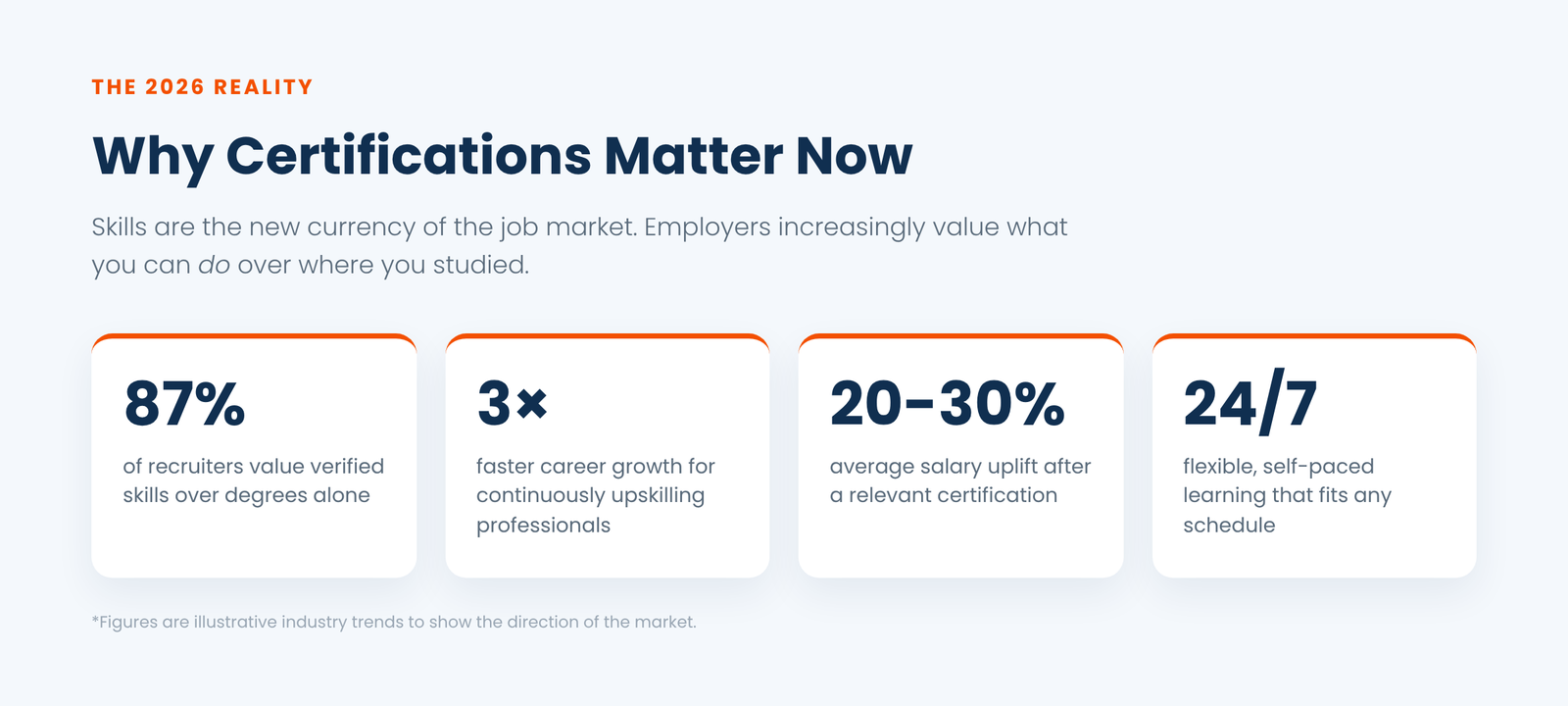
We are living through the biggest shift in the labour market in a generation. Automation, artificial intelligence, and rapidly evolving technology mean that the skills that got someone hired five years ago may not be enough today. At the same time, employers are under pressure to fill roles quickly with people who can contribute from day one. These two forces have made verified, up-to-date skills the single most valuable thing a professional can offer.

Why certifications matter in 2026

Here is why online certifications have moved from “nice to have” to “essential” for career growth:

1. The skills gap is widening

Technology changes faster than traditional education can keep up. New tools, frameworks, and ways of working appear every year, and companies struggle to find people who already know them. A certification course is often the quickest route to closing that gap, because good programmes are updated far more frequently than a typical degree curriculum. When you hold a current certification, you are telling employers that your knowledge is fresh and relevant, not years out of date.

2. Employers increasingly hire for skills, not just degrees

A growing number of organisations have adopted “skills-first” hiring, where a candidate’s demonstrated abilities matter more than where — or whether — they went to university. Many large employers have removed strict degree requirements from entire categories of jobs. In this environment, a focused certification that proves you can do the work can be just as persuasive as a diploma, and sometimes more so, because it maps directly to the role.

3. Lifelong learning is the new normal

The idea that you study for the first twenty years of your life and then simply work for the next forty is gone. Careers now span multiple roles, industries, and even complete reinventions. Continuous learning is no longer optional — it is how you stay employable and keep your earning power rising. Online certifications are built for exactly this: bite-sized, flexible, and designed to fit around a full-time job or studies.

4. Access has never been more democratic

Perhaps the most profound change is access. A learner in a small town now has access to the same courses, taught by the same world-class instructors, as someone in a major metropolitan city. All it takes is an internet connection and the determination to learn. This has opened doors for millions of people who were previously locked out of elite education by geography or cost — and it is one of the reasons CareerHike is so passionate about guiding learners toward the right online programmes.

“The most important skill of the 21st century is the ability to keep learning. Certifications are simply the proof that you are doing it.”

The Key Benefits of Online Certification Courses

It is one thing to say certifications are valuable; it is another to understand exactly how they help you. Let us break down the real, practical benefits you can expect when you choose the right programme and commit to finishing it.

Flexibility that fits your life

This is the benefit learners mention most. Online certifications let you study at your own pace, on your own schedule, from wherever you are. Early mornings before work, a lunch break, late evenings after the children are asleep — you decide. For working professionals and students juggling multiple responsibilities, this flexibility is often the difference between upskilling and never finding the time. Most platforms also let you pause, rewind, and revisit lessons as many times as you need, which is impossible in a traditional classroom.

Affordability and strong value for money

Compared with a full degree, most certification courses cost a fraction of the price — and many excellent ones are free or very low cost. Because you are paying for a focused skill rather than years of general education, the value for money can be exceptional. When you factor in that you can keep earning while you study, the financial case becomes even stronger. You are not giving up income to go back to school; you are investing a small amount to increase your income.

Faster results

A degree takes years. A certification can take weeks or a few months. When the job market is moving quickly and opportunities appear suddenly, speed matters. You can identify a skill that is in demand, learn it, prove it, and start applying for roles — all within a single season. This agility is one of the biggest advantages certifications hold over longer qualifications.

Validated, job-ready skills

The best certification courses are deeply practical. Instead of only teaching theory, they have you build real projects: a marketing campaign, a working dashboard, a small application, a security audit. By the time you finish, you do not just have a certificate — you have a portfolio of work that demonstrates your skills to employers. That combination of a credential and tangible proof is incredibly persuasive in interviews.

Career growth and new opportunities

Certifications open doors. They can qualify you for a promotion, make you eligible for roles you could not previously apply to, or give you the confidence and credibility to switch into an entirely new field. Many professionals use a well-chosen certification as the pivot point that moves them from a role they have outgrown into one with far more scope and reward.

Confidence and credibility

There is a psychological benefit that is easy to overlook. Completing a structured course and passing its assessments builds genuine confidence. You stop guessing whether you can do something and start knowing that you can. That confidence shows in interviews, in client meetings, and in the quality of your work — and the credential gives others a reason to trust you before they have even seen what you can do.

Networking and community

Modern online courses are rarely solitary. Discussion forums, peer-review assignments, live sessions, and alumni communities connect you with learners and professionals around the world. These connections can lead to mentorship, collaboration, referrals, and even job offers. The network you build while earning a certification can be just as valuable as the certificate itself.

Global recognition and remote opportunities

Many online certifications are recognised internationally, which means the skills you prove can travel with you across companies, cities, and even borders. In an era where remote and hybrid work has become mainstream, a globally respected credential can qualify you for opportunities far beyond your local job market — including freelance and contract work for clients anywhere in the world. For ambitious learners, this reach is one of the most exciting advantages of all: your postcode no longer limits your potential.

CareerHike tip: The learners who benefit most are the ones who treat a certification as the beginning of a journey, not the end. Use the credential to get noticed, then let your real skills and portfolio do the rest.

Online Certifications vs Traditional Degrees

One of the most common questions learners ask is whether a certification can really compete with a traditional degree. The honest answer is that they are different tools for different jobs — and the smartest professionals often use both. A degree gives you breadth, depth, and a formal foundation; a certification gives you speed, focus, and current, job-ready skills. Here is how they compare across the factors that matter most.

Factor Online Certification Traditional Degree
Time to completeWeeks to a few monthsTwo to four years
CostLow to moderate (many free)Moderate to high
FocusSpecific, job-ready skillsBroad, foundational knowledge
FlexibilityVery high — learn anywhereLower — fixed schedules
Currency of contentUpdated frequentlyUpdated less often
Best forUpskilling, switching, fast proofFoundations, regulated professions

The takeaway is not that one replaces the other. For some regulated professions — medicine, law, engineering licensure — a formal degree is non-negotiable. But for a huge and growing share of roles in technology, business, design, and marketing, a strong certification combined with a portfolio can get you hired and promoted. And when you pair a degree with targeted certifications, you become genuinely hard to ignore.

The Most In-Demand Certification Domains in 2026

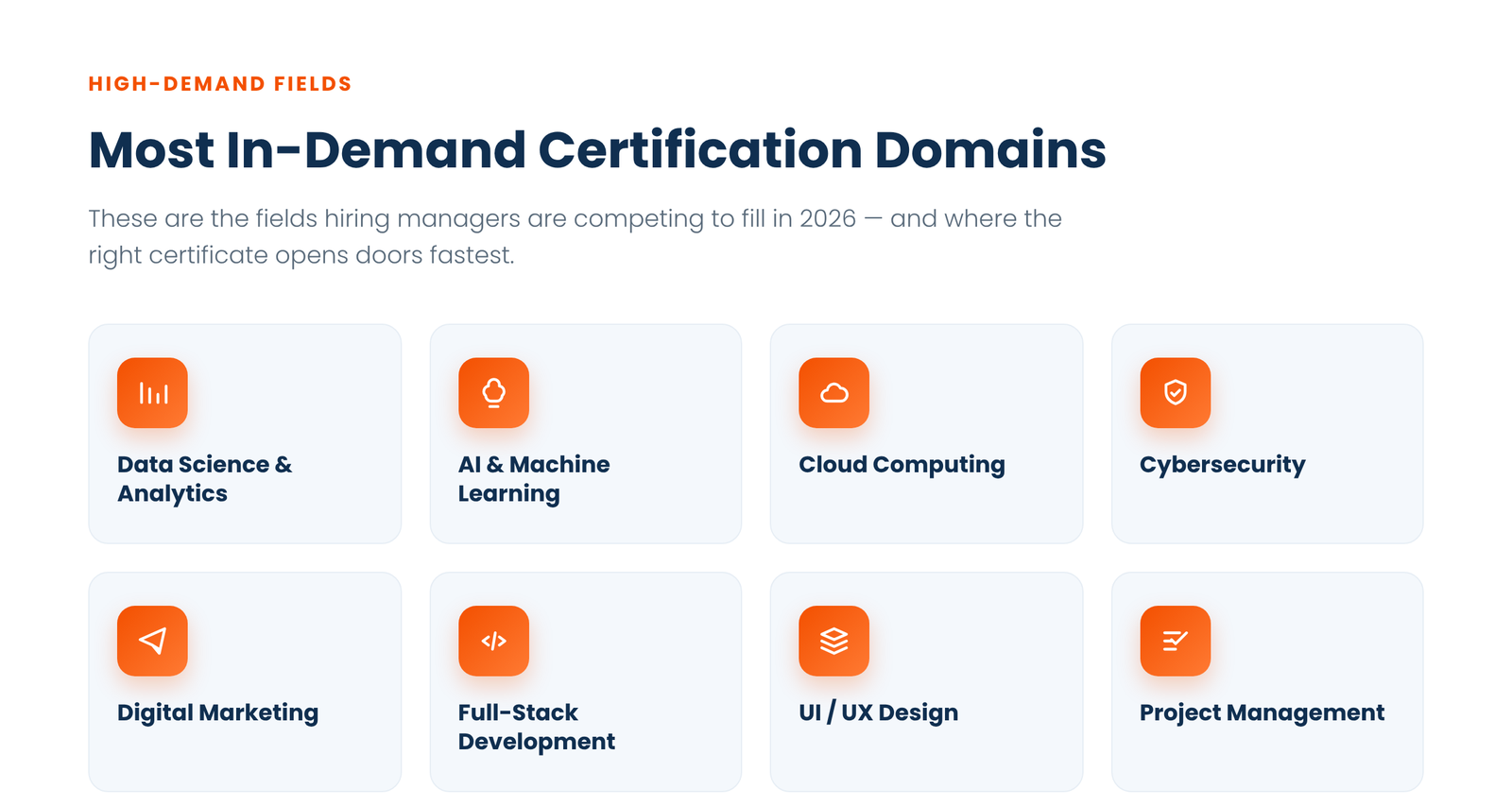
Not all certifications are created equal. Some fields are growing so quickly that a credential in them can transform your career almost overnight, while others are more crowded. Below are the domains where demand is strongest and where a well-chosen certification offers the best return in 2026. Think of this as a map of where the opportunities are — use it to point your learning in a direction the market is actively rewarding.

Most in-demand certification domains in 2026

1. Data Science & Analytics

Every organisation now runs on data, but very few have enough people who can turn that data into decisions. Certifications in data analytics, business intelligence, and data science teach you to collect, clean, analyse, and visualise information, and to communicate insights that leaders can act on. You will typically learn tools for spreadsheets, databases, and visualisation, along with the fundamentals of statistics. This is one of the most versatile skill sets you can own, because every industry — from retail to healthcare to finance — needs it.

2. Artificial Intelligence & Machine Learning

AI has moved from research labs into everyday business, and the demand for people who understand it has exploded. Certifications in machine learning, deep learning, generative AI, and prompt engineering are among the most sought-after credentials of the decade. Even if you are not aiming to become a specialist engineer, a foundational AI certification helps you understand how these tools work and how to apply them responsibly in your own field — a skill that is quickly becoming essential across almost every profession.

3. Cloud Computing

As companies move their systems to the cloud, people who can design, deploy, and manage cloud infrastructure are in enormous demand. The major cloud providers offer tiered certifications — from foundational to professional — and these are some of the highest-paying credentials in all of technology. A cloud certification is an excellent choice for anyone with an interest in IT, systems, or software, and it pairs beautifully with data and AI skills.

4. Cybersecurity

With every new connected device and online service, the attack surface for cybercrime grows — and so does the need for skilled defenders. Cybersecurity is one of the few fields with a persistent global shortage of qualified professionals, which means strong job security and excellent pay. Certifications range from entry-level credentials that establish the fundamentals to advanced qualifications in ethical hacking, security operations, and risk management. If you enjoy problem-solving and want a field that will never run short of demand, this is a superb option.

5. Digital Marketing

Businesses of every size now live or die by their online presence, and digital marketing skills are in constant demand. Certifications cover search engine optimisation, paid advertising, social media marketing, content strategy, email marketing, and analytics. The beauty of digital marketing is that it rewards creativity and data skills in equal measure, and you can often start applying what you learn immediately — even on your own projects — to build a portfolio while you study.

6. Full-Stack & Web Development

The ability to build websites and applications remains one of the most reliably employable skills in the world. Full-stack development certifications teach you both the front end (what users see) and the back end (the logic and databases behind it). Because you can demonstrate your skills directly through the things you build, a strong portfolio of projects combined with a certification can get you hired even without a formal computer science degree.

7. UI / UX Design

Good design is now a competitive advantage, and companies are investing heavily in the experience their products deliver. UI/UX certifications teach you user research, wireframing, prototyping, visual design, and usability testing. This field is ideal for people who combine creativity with empathy and logic, and — like development and marketing — it lets you build a portfolio that speaks louder than any résumé.

8. Project & Product Management

Someone has to turn ideas into finished results, on time and on budget — and that someone is increasingly expected to hold a recognised project management credential. Certifications in project management and agile methodologies are respected across every industry and often lead directly to higher-responsibility, higher-paying roles. Product management certifications, which focus on deciding what to build and why, are also rising fast in demand.

9. Finance, Accounting & FinTech

Finance remains a cornerstone of the economy, and certifications in financial modelling, accounting software, investment analysis, and the fast-growing field of financial technology are highly valued. These credentials suit detail-oriented learners who enjoy working with numbers and want roles with clear progression and strong earning potential.

10. Business, Management & Soft Skills

Technical skills open doors, but leadership, communication, and business skills determine how far you go once you are inside. Certifications in business analysis, leadership, human resources, communication, and entrepreneurship complement any technical path and are especially valuable for those aiming at management. Never underestimate how much a certified grounding in these “human” skills can accelerate a career.

11. Healthcare & Allied Technology

Healthcare is one of the largest and most resilient employers in the world, and technology is transforming it rapidly. Certifications in health informatics, medical coding, healthcare data, telemedicine support, and allied health roles are opening doors for people who want a stable, meaningful career. Because healthcare rarely slows down, credentials in this space tend to offer excellent long-term security, and many roles can now be performed partly or wholly online.

12. Supply Chain, Logistics & Operations

Global commerce depends on goods moving efficiently from one place to another, and the people who manage that flow are in steady demand. Certifications in supply chain management, logistics, procurement, and operations teach you to optimise processes, reduce costs, and keep complex systems running smoothly. For analytical, organised learners, this is a field with clear progression and genuine impact on how businesses perform.

13. Emerging Tech: Blockchain, IoT & More

Beyond the established fields, a wave of emerging technologies — blockchain, the Internet of Things, extended reality, and automation — is creating brand-new roles with relatively little competition. Getting certified early in an emerging area can position you as one of the few genuine experts as the field matures. These credentials carry a little more risk, since the technology is still evolving, but the reward for getting in early can be considerable.

Which one is right for you? The “best” domain is the one that sits where your interests, your strengths, and market demand overlap. If you are unsure, that overlap is exactly what CareerHike’s career experts help you find.

Trusted Platforms for Online Certifications

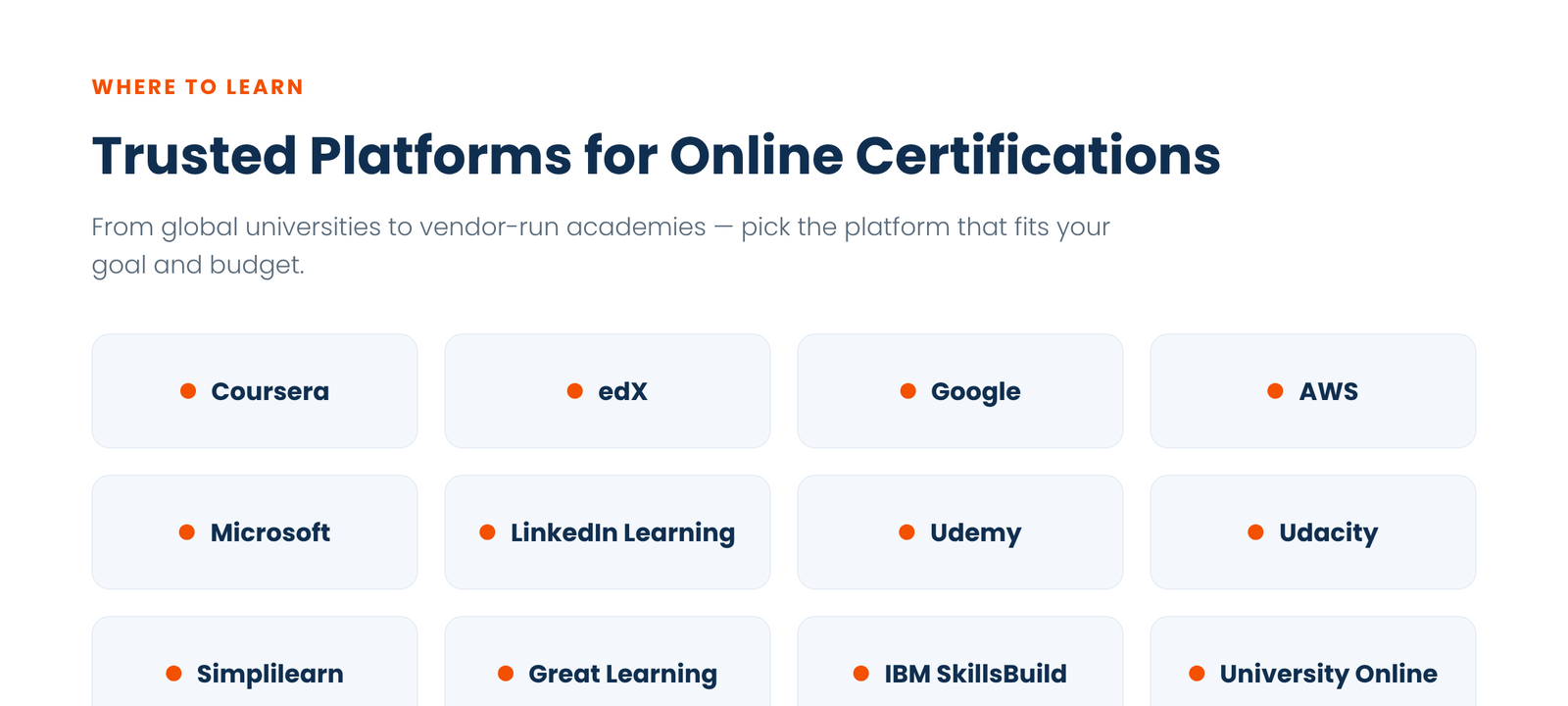
Once you know what you want to learn, the next question is where to learn it. The online education landscape is rich with excellent providers, each with its own strengths. Choosing a reputable, recognised platform matters, because the credibility of your certificate depends partly on who issued it. Here is an overview of the main categories and what each is best suited for.

Trusted online certification platforms

University-backed platforms

Platforms that partner with leading universities offer certificates and professional programmes carrying the weight of established academic institutions. These are ideal when you want recognised credibility, structured learning, and the option to progress toward deeper qualifications. They tend to balance theory and practice well, and many offer financial aid or scholarships.

Technology company academies

The major technology companies run their own certification programmes for their platforms — cloud, data, AI, productivity, and development tools. If you want to work with a specific technology, a certification straight from the company that built it is about as credible as it gets, and these credentials are frequently named directly in job postings.

Marketplace and specialist platforms

Open marketplaces host enormous libraries of affordable courses on almost every topic imaginable, which is perfect for learning a specific tool quickly or exploring a new interest cheaply. Specialist upskilling platforms focus on in-demand professional tracks with mentorship, live classes, and career support. These are excellent when you want guided, outcome-focused learning rather than self-study alone.

Professional body certifications

For fields such as project management, finance, human resources, and quality management, globally recognised professional associations award certifications that are the gold standard in their industry. These usually involve a formal exam and sometimes experience requirements, but they carry exceptional credibility and are often tied to higher pay.

Online and distance education institutions

Accredited online and distance education bodies — including recognised university online divisions — offer certificates, diplomas, and full degrees delivered entirely online. These are an outstanding choice for learners who want a formal, accredited qualification with the flexibility of remote study, and they bridge the gap between a quick certificate and a full on-campus degree.

Before you enrol anywhere: check that the provider is reputable, read recent learner reviews, confirm the certificate is recognised in your target industry, and make sure the curriculum is up to date. A beautiful course page means nothing if the content is years old.

How to Choose the Right Certification Course

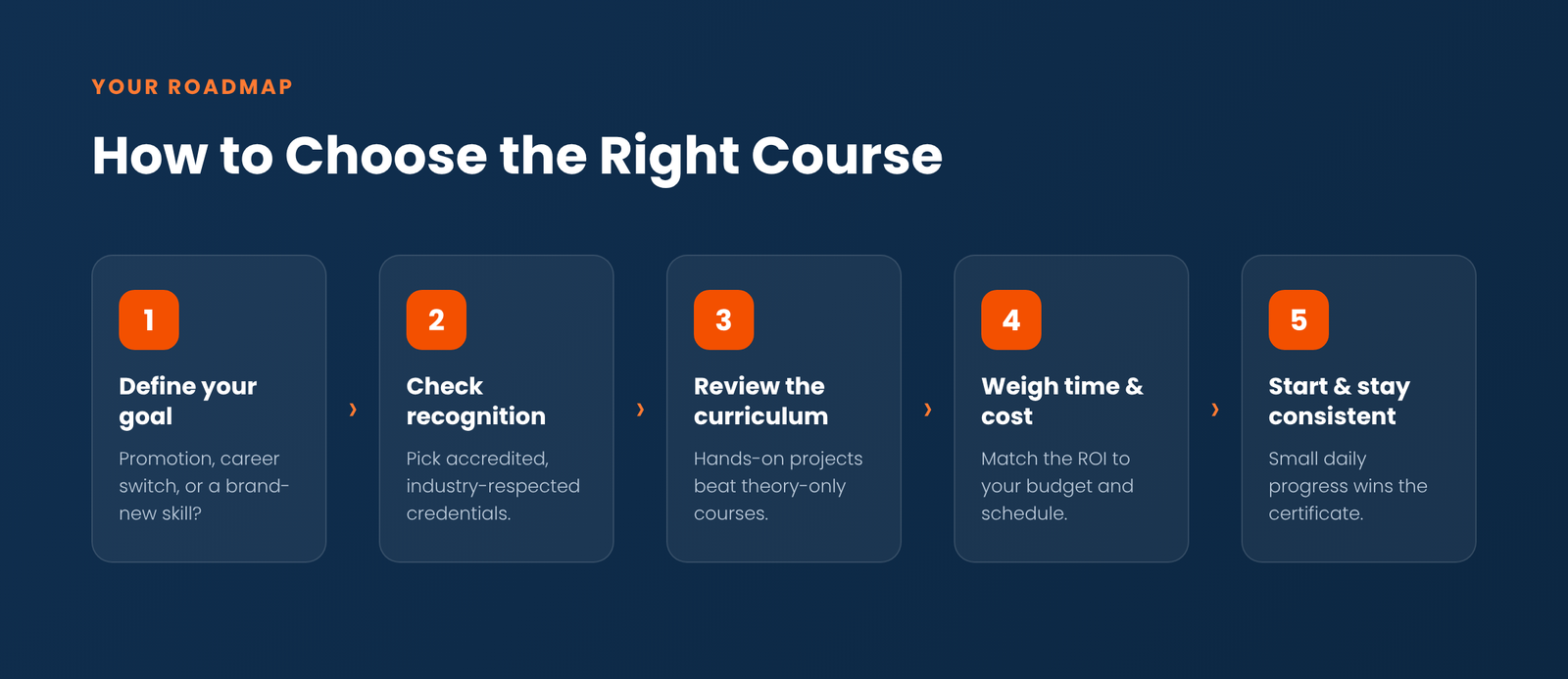
With thousands of courses competing for your attention, the hardest part is often simply choosing. The wrong course wastes your time and money; the right one changes your career. Use the following framework to make a confident, well-reasoned decision rather than picking whatever appears first in an advertisement.

How to choose the right certification course

Start with your goal, not the course

Before you look at a single course, get clear on what you actually want. Are you aiming for a promotion in your current field? Switching to a new industry? Building a skill to freelance? Trying to get your first job? Your goal determines everything that follows. A certification that is perfect for a career switcher may be completely wrong for someone seeking a senior promotion. Write your goal down in one sentence and keep it in front of you as you compare options.

Check recognition and accreditation

A certificate is only as valuable as the trust employers place in it. Research whether the credential is recognised in your target industry. Look at real job postings for the roles you want and note which certifications they mention by name. If a qualification keeps appearing in the listings you care about, that is a strong signal it is worth pursuing.

Scrutinise the curriculum

Read the full syllabus carefully. Does it cover current tools and practices, or does it feel dated? Is there a healthy balance of theory and hands-on work? Are there real projects you will complete? A great course should leave you with demonstrable skills and portfolio pieces, not just a certificate and a head full of concepts you have never applied.

Consider the instructor and the format

Who is teaching, and what is their real-world experience? Does the format suit how you learn — self-paced videos, live cohorts, or a mix? Do you need mentorship and feedback, or are you disciplined enough for pure self-study? Being honest about your own learning style will save you from abandoning a course that simply was not the right fit.

Weigh cost against return

Price matters, but it should be judged against value, not in isolation. A free course that teaches you a high-demand skill can deliver an enormous return; an expensive course in a saturated field may not. Estimate the realistic benefit — a raise, a new role, freelance income — and compare it with the total cost in money and time. The best certifications pay for themselves many times over.

Read reviews and talk to alumni

Finally, learn from people who have already taken the course. Recent, detailed reviews tell you whether the content delivers on its promises and whether the certificate actually helped graduates. Where possible, connect with alumni on professional networks and ask them directly whether they would recommend it. Real experiences are worth more than any marketing page.

The Real Return on Investment of Certifications

Let us talk honestly about results, because at the end of the day a certification is an investment and you deserve to know what it can return. The impact shows up in several ways, and understanding them helps you set realistic, motivating expectations.

Career growth and return on investment of certifications

Higher earning potential

The most direct return is money. Across many fields, professionals who hold relevant, in-demand certifications tend to command higher salaries than those who do not, because they can do more and need less training. A certification can strengthen your case in a salary negotiation, qualify you for higher pay bands, or open the door to better-paid roles entirely. The uplift varies by field and experience, but in high-demand domains it can be substantial.

Faster promotions and career mobility

Certifications signal initiative and competence — two things managers love to promote. They can also make you mobile, giving you the freedom to move between companies, industries, and even countries, because recognised credentials travel well. Many professionals find that each certification they earn widens the range of roles realistically open to them.

The power of stacking skills

The real magic happens over time. A single certification is useful; a thoughtfully built stack of complementary skills is transformative. Imagine combining data analysis with a cloud certification and a touch of AI, or pairing digital marketing with analytics and design. Each credential multiplies the value of the others, turning you into a rare, well-rounded professional who is genuinely difficult to replace. This compounding effect is why continuous learning pays off far more than any single course.

Beyond salary: opportunity and freedom

Not every return is financial. Certifications can give you the freedom to work remotely, to freelance, to start your own venture, or simply to do work you find more meaningful. They can rescue you from a career dead-end and hand you options you did not have before. For many learners, that sense of expanded possibility is worth as much as any pay rise.

Consider a common pattern we see again and again: a professional stuck in an entry-level role spends a few focused months earning a certification in a high-demand skill, builds two or three portfolio projects along the way, and uses that combination to move into a specialist position with noticeably better pay and prospects. They did not go back to university for years or take on crippling debt — they identified a gap, filled it deliberately, and proved it. That is the quiet power of certifications: they let ordinary, determined people engineer extraordinary career changes one skill at a time. The investment is modest; the compounding return, over a whole career, can be life-changing.

How to Get the Most Out of Your Certification

Enrolling is easy; finishing well is where the real value is created. Many people start online courses and never complete them — not because the content is too hard, but because self-directed learning requires strategy. Here is how to make sure you are one of the learners who finishes strong and actually benefits.

Treat it like a real commitment

Block fixed time in your calendar for study, just as you would for an important meeting, and protect it. Consistency beats intensity: thirty focused minutes a day will take you further than an occasional frantic weekend. Tell someone your goal so you feel accountable, and track your progress so you can see yourself moving forward.

Learn by doing, not just watching

Passive watching creates the illusion of learning without the substance. After every lesson, apply what you learned — rebuild the example yourself, tweak it, break it, fix it. The skills that stick are the ones your hands have practised, not just the ones your eyes have seen. If the course offers projects, do every single one, and then invent extra projects of your own.

Build a portfolio as you go

Every project you complete is potential portfolio material. Save your best work, document what you did and why, and publish it where employers can see it. By the time you earn your certificate, you will also have tangible proof of your abilities — and that combination is what actually gets you hired.

Engage with the community

Ask questions in the forums, answer other learners’ questions, join study groups, and attend any live sessions. Teaching a concept to someone else is one of the most powerful ways to cement your own understanding, and the relationships you build can lead to opportunities long after the course ends.

Showcase your credential

Once you earn your certificate, do not let it gather dust. Add it to your résumé and your professional profiles, share the achievement in your network, and reference specific projects when you talk about it. A certificate you never mention cannot help you; one you present confidently can change the trajectory of your search.

Common Challenges — and How to Beat Them

Online learning is powerful, but it comes with its own obstacles. Knowing them in advance means you can plan around them instead of being derailed.

Staying motivated without a classroom

Without fixed classes and in-person deadlines, motivation can fade. Beat this by setting your own milestones, rewarding yourself when you hit them, and remembering your “why” — the specific career outcome you are working toward. A visible countdown to your target completion date works wonders.

Choosing from too many options

The sheer number of courses can be paralysing. Avoid analysis paralysis by using the selection framework earlier in this guide, limiting yourself to a short list of two or three strong options, and then simply committing. A good-enough course you actually finish beats a “perfect” course you keep researching but never start.

Balancing study with life and work

Finding time is the universal struggle. The answer is not to find huge blocks of free time — they rarely appear — but to use small pockets consistently. Learn during a commute, on a lunch break, or in the quiet half-hour before bed. Those small sessions add up to a finished certificate faster than you expect.

Making sure the skills stick

It is easy to forget what you do not use. Reinforce your learning by applying it to real problems as soon as possible — in your current job, on freelance work, or on personal projects. The faster you put a new skill to work, the more permanently it becomes yours.

Certifications for Every Career Stage

The right certification depends heavily on where you are in your journey. Here is how to think about it at each stage.

Students and recent graduates

If you are still studying or have just finished, certifications are your secret weapon for standing out in a crowded entry-level market. While your peers have only a degree, you can arrive with a degree plus proven, practical skills and a portfolio. Focus on foundational, job-ready certifications in a field you are genuinely interested in, and start building projects early.

Freshers and early-career professionals

In your first few years of work, certifications help you specialise and accelerate. Identify the skills that lead to the next role you want, and earn the credentials that prove you are ready for it. This is the stage where a well-chosen certification can fast-track you past colleagues who are relying on time served alone.

Mid-career professionals

If you have experience but feel your growth has slowed, certifications can reignite your trajectory. They keep your skills current, qualify you for leadership or specialist tracks, and signal that you are still investing in yourself. Mid-career is also the perfect time to add management, strategy, or emerging-technology credentials on top of your existing expertise.

Career switchers

Changing fields can feel daunting, but certifications are the most practical bridge available. They let you build credibility in a new area quickly and affordably, without returning to university for years. Pair a focused certification with a portfolio of projects in your target field, and you can make a convincing case to employers even without prior experience.

Returning to work after a break

If you have been away from the workforce, a current certification is a powerful way to refresh your skills and reassure employers that you are up to date. It also rebuilds your own confidence, which is often the biggest hurdle when returning. Choose something in demand, and let the credential signal that you are ready and current.

Well-Known Certifications Worth Knowing About

While the right certification always depends on your personal goals, it helps to know some of the widely recognised credentials that regularly appear in job postings. The examples below are grouped by field to give you a sense of the landscape — use them as starting points for your own research rather than as a definitive ranking, since programmes evolve and new ones appear all the time.

Data, AI & cloud

In data and cloud, credentials such as the Google Data Analytics certificate, cloud certifications from the major providers (for example foundational and associate-level architect credentials), and AI and machine learning certificates from universities and technology companies are frequently requested. These validate both the tools and the thinking employers need, and they pair naturally with one another as you stack skills over time.

Cybersecurity & IT

In security and IT, foundational credentials that establish core knowledge are a common entry point, while more advanced certifications in security operations, ethical hacking, and information security management are respected markers of expertise for experienced professionals. Because the field has a persistent talent shortage, these credentials tend to hold their value exceptionally well.

Project management & business

For project and delivery roles, globally recognised project management credentials and agile or scrum certifications appear again and again in senior job descriptions. In business and finance, credentials in financial analysis, accounting software, and business analysis are widely valued and often linked to clear salary progression.

Marketing & design

In digital marketing, platform-specific advertising and analytics certifications from major technology companies are a practical, respected way to prove hands-on ability. In design, professional UI/UX certificates from universities and specialist platforms — backed by a strong portfolio — carry real weight with hiring teams.

Whatever field you choose, remember the principle that runs through this entire guide: the credential gets you noticed, but it is the real, demonstrable skill behind it that gets you hired and promoted. Pick recognised certifications, learn the material properly, and build proof of what you can do.

Free vs Paid Certifications: Which Should You Choose?

A question almost every learner faces is whether to pay for a certification or stick to free options. Both have a place, and the right choice depends on your goal, your budget, and how much credibility you need the certificate to carry.

Free certifications are an excellent way to explore a new field, learn a specific tool, or build foundational knowledge without any financial risk. Many reputable companies and platforms offer genuinely valuable free courses, some with free or low-cost certificates. They are perfect when you are testing whether you enjoy a subject, when you need a quick, practical skill, or when money is tight. The main limitation is that some free certificates carry less weight with employers than paid, accredited ones, and free courses sometimes offer less support and structure.

Paid certifications typically offer deeper content, more structured learning, mentorship or instructor feedback, graded projects, career services, and a credential that employers recognise more readily. When you are serious about a career move and need a credential that will stand up to scrutiny, a paid programme from a respected provider is usually worth the investment. The key is to make sure you are paying for genuine value — recognition, support, and up-to-date content — not just a fancy certificate.

A smart strategy many learners use is to start free and upgrade when it counts: explore a field with free courses to confirm your interest, then invest in a recognised paid certification once you know you want to commit. That way you minimise wasted money while still ending up with a credential that carries real weight.

Rule of thumb: pay when the certificate itself needs to impress employers; go free when you simply need the skill or want to explore. Either way, it is the skill you actually gain — and prove — that creates the value.

Common Myths About Online Certifications

Despite their popularity, online certifications are still surrounded by outdated myths that stop people from taking advantage of them. Let us clear up the most persistent ones.

Myth 1: “Online certificates are not taken seriously”

This may have been partly true years ago, but it is no longer the case. Credentials from reputable universities, major technology companies, and professional bodies are widely respected, and many employers now actively look for them. What matters is the credibility of the issuer and the relevance of the skill — not whether you learned online.

Myth 2: “They are too easy to be meaningful”

Good certifications are genuinely challenging. They involve real projects, graded assessments, and often a formal exam. Passing one takes real effort and real understanding, which is exactly why employers trust them. The ease people imagine usually belongs to low-quality courses, not to respected credentials.

Myth 3: “You need to be tech-savvy to study online”

Modern learning platforms are designed to be simple and welcoming, even for people who are not confident with technology. If you can watch a video and send an email, you can take an online course. Many platforms also offer support to help you get comfortable, so do not let this fear hold you back.

Myth 4: “One certificate guarantees a job”

A certificate is a powerful tool, but it is not a magic ticket. It gets you noticed and proves your baseline ability; your skills, portfolio, interview performance, and persistence do the rest. Treat a certification as the start of a strategy, not the whole strategy, and you will get far more from it.

Red Flags to Avoid When Choosing a Course

For every excellent course there are a few poor ones, and knowing the warning signs protects your time and money. Be cautious when you notice any of the following.

  • Vague or hidden curriculum. If a provider will not show you exactly what you will learn, be wary — transparency is a sign of quality.
  • Guaranteed jobs or unrealistic salary promises. No honest course can guarantee employment. Bold income promises are a classic warning sign.
  • No reviews or only suspiciously perfect ones. A complete absence of independent feedback, or reviews that all sound identical, should make you pause.
  • Outdated content. In fast-moving fields, material that has not been updated in years can leave you learning skills employers no longer want.
  • High-pressure sales tactics. Countdown timers, relentless follow-ups, and “today only” discounts are marketing, not education. Make your decision calmly.

A trustworthy provider is transparent about what you will learn, honest about outcomes, backed by real reviews, current in its content, and respectful of your decision-making process. When in doubt, slow down and do a little more research — or ask an expert for a second opinion.

Online & Distance Education: A Growing Path

Alongside short certifications, formal online and distance education has grown into a serious, respected route to qualifications — and it deserves special mention. Recognised institutions now offer certificates, diplomas, and full degrees delivered entirely online, giving learners the credibility of an accredited qualification with the flexibility of remote study.

This path is ideal for students who are working, who live far from a campus, who have family responsibilities, or who simply prefer to learn at their own pace. Online and distance programmes from established universities combine structured academic rigour with the convenience of studying from home, and the qualifications they award are increasingly viewed on par with traditional on-campus study. For many learners, a formal online programme is the perfect middle ground — more comprehensive and more widely recognised than a short certificate, yet far more flexible and accessible than a conventional degree.

If your goal is a complete, accredited qualification rather than a single skill, exploring reputable online and distance education options is well worth your time. And whether you are choosing a short certification or a full online degree, the same principles apply: check recognition, examine the curriculum, read reviews, and align the choice with your career goal.

Making Your Certification Shine on Your Résumé & LinkedIn

Earning a certification is only half the job — presenting it well is what turns it into opportunities. Too many learners bury a valuable credential at the bottom of their résumé or forget to mention it entirely. Here is how to make yours work hard for you.

Give it a prominent place

Create a clear “Certifications” section on your résumé and list each credential with its name, the issuing organisation, and the date. If a certification is directly relevant to the role you are applying for, mention it near the top, in your summary, so it is impossible to miss.

Show the skills, not just the certificate

Employers care about what you can do. Alongside the credential, highlight the specific skills you gained and, ideally, point to a project that demonstrates them. “Completed a data analytics certification” is fine; “completed a data analytics certification and built a sales dashboard that revealed a 20% drop-off” is far more compelling.

Optimise your professional profile

Add your certifications to your LinkedIn profile using the dedicated section, include relevant keywords so recruiters can find you, and share a short post when you earn a new credential. Public achievements attract attention, spark conversations, and often lead to opportunities you did not go looking for.

Talk about it with confidence

In interviews, be ready to explain why you pursued the certification, what you learned, and how you have applied it. A credential you can speak about with genuine enthusiasm and concrete examples is far more persuasive than one you simply list. Let your learning tell a story about your drive and direction.

The Future of Online Certifications

Online learning is not standing still. Understanding where it is headed helps you make choices today that will still be valuable tomorrow.

Stackable, modular credentials are becoming the norm. Instead of one giant qualification, learners increasingly collect small, focused credentials that stack together into larger recognised achievements over time — letting you build a qualification in flexible steps that fit your life.

AI-powered, personalised learning is reshaping how courses are delivered. Adaptive platforms now adjust to your pace, identify your weak spots, and recommend exactly what to study next, making learning faster and more efficient than ever before.

Verified digital credentials — shareable, tamper-proof certificates you can display and that employers can instantly verify — are making credentials more trustworthy and more portable, reducing fraud and friction in hiring.

Closer ties between learning and hiring are emerging, with more employers partnering directly with course providers and even recognising specific certifications as a fast track into their roles. The line between “learning a skill” and “getting the job” is getting shorter every year.

The direction is clear: certifications are becoming more flexible, more credible, and more tightly connected to real career outcomes. The learners who embrace continuous, modular upskilling now will be the ones best positioned for the opportunities ahead.

Get free career guidance from CareerHike

Your Step-by-Step Starter Plan

Feeling inspired but unsure where to begin? Follow this simple, five-step plan to go from “thinking about it” to holding your first certification.

  1. 1Define your one-sentence goal. Write down precisely what you want the certification to achieve — the role, the raise, or the switch you are aiming for.
  2. 2Research the market. Look at real job postings for your target role and note the skills and certifications that keep appearing.
  3. 3Shortlist and choose. Pick two or three reputable courses, compare curriculum, reviews, and cost, then commit to one.
  4. 4Schedule and start. Block regular study time, begin, and complete every project along the way.
  5. 5Earn, showcase, and repeat. Pass the assessment, add the credential and projects to your profile, and plan your next skill.

Frequently Asked Questions

Are online certification courses worth it?

For most people, yes — provided you choose a recognised course in an in-demand field and actually complete it. The combination of a trusted credential and a real portfolio can deliver a strong return in better jobs, higher pay, and new opportunities.

Can a certification replace a degree?

In many technology, business, design, and marketing roles, a strong certification plus a portfolio can get you hired. For regulated professions, a formal degree is still required. The best strategy is often to combine both.

How long does a certification take to complete?

It varies widely — from a few hours for a micro-credential to several months for a comprehensive professional programme. Most popular certifications can be completed in a few weeks to a few months of consistent, part-time study.

Do I need any experience to start?

Many certifications are designed for complete beginners and assume no prior knowledge. Others are intermediate or advanced. Always check the prerequisites before enrolling so the course matches your current level.

How do I choose between so many courses?

Start with your goal, check which credentials appear in real job postings, scrutinise the curriculum and reviews, and weigh cost against the realistic return. If you are still unsure, CareerHike’s experts can help you choose with confidence.

Do certifications expire?

Some do and some do not. Certain technology and professional certifications require periodic renewal to ensure your skills stay current, while many course-completion certificates last indefinitely. Always check the validity and renewal terms before enrolling, and treat renewal as a healthy prompt to keep your knowledge up to date rather than a burden.

Will employers actually recognise my certificate?

Recognition depends on who issued it and how respected it is in your industry. Certifications from reputable universities, major technology companies, and established professional bodies carry the most weight. This is exactly why choosing a recognised provider matters so much.

Final Thoughts: Your Next Step Starts Today

Online certification courses have quietly become one of the most powerful tools for building the career you want. They are flexible enough to fit any life, affordable enough for almost any budget, and credible enough to change how employers see you. In a world where skills are the new currency, a well-chosen certification is one of the smartest investments you can make in yourself.

Throughout this guide, one idea has come up again and again, and it is worth repeating one final time: the certificate opens the door, but your skills and your effort carry you through it. Choose a recognised programme in a field that genuinely interests you, learn the material properly, build real things as you go, and present your achievement with confidence. Do that, and a single certification can become the first link in a chain of opportunities that stretches across your entire career.

But the real value does not come from reading about certifications — it comes from starting one. The perfect moment will never arrive; the best time to begin is now. Define your goal, choose a course that moves you toward it, and take the first small step today. A year from now, you will be glad you did.

And if you are not sure which path is right for you, you do not have to figure it out alone. CareerHike exists to help learners like you cut through the noise, choose the right certification, and build a career you are proud of. Reach out, ask your questions, and let us help you take the next step with confidence.

Ready to grow?

Let CareerHike help you choose the certification that changes your career.

Get Free Career Guidance →

Online MCA Degree Program 2026: Fees, Eligibility & Syllabus

BCom vs BBA

BCom vs BBA: Which Course is Better After 12th Commerce?

After completing Class 12th, many commerce students get confused between BCom and BBA. Both are popular undergraduate courses, both can lead to good career opportunities, and both are suitable for students who want to build a future in business, finance, management, banking, entrepreneurship, or corporate jobs. However, the purpose of both degrees is different.

BCom, or Bachelor of Commerce, is more focused on accounting, finance, taxation, economics, and commerce-related subjects. BBA, or Bachelor of Business Administration, is more focused on management, business operations, marketing, human resources, entrepreneurship, and leadership skills.

Quick Answer: Choose BCom if you are interested in accounting, taxation, finance, banking, or professional courses like CA, CMA, CS, CFA, or MCom. Choose BBA if you are interested in business management, marketing, HR, startups, entrepreneurship, or MBA in the future.

What is BCom?

BCom stands for Bachelor of Commerce. It is a three-year undergraduate degree that gives students a strong foundation in commerce, accounting, economics, business law, taxation, finance, auditing, and banking. BCom is one of the most chosen courses after 12th commerce because it is flexible, affordable, and suitable for many career paths.

Students who want to become accountants, financial analysts, tax consultants, bankers, auditors, investment professionals, or commerce teachers often prefer BCom. It is also a good degree for students planning to pursue professional qualifications like CA, CMA, CS, CFA, CPA, ACCA, or MBA later.

Common Subjects in BCom

  • Financial Accounting
  • Corporate Accounting
  • Business Law
  • Income Tax
  • GST and Indirect Tax
  • Cost Accounting
  • Economics
  • Auditing
  • Banking and Insurance
  • Financial Management

What is BBA?

BBA stands for Bachelor of Business Administration. It is a three-year undergraduate degree designed for students who want to understand how businesses are managed. BBA focuses on business planning, marketing, human resource management, operations, entrepreneurship, leadership, communication, and decision-making.

BBA is suitable for students who want to enter corporate management roles, start their own business, work in sales and marketing, or pursue an MBA after graduation. Compared to BCom, BBA is more practical and management-oriented. It helps students develop communication, presentation, teamwork, and leadership skills.

Common Subjects in BBA

  • Principles of Management
  • Marketing Management
  • Human Resource Management
  • Business Communication
  • Organizational Behaviour
  • Business Strategy
  • Entrepreneurship
  • Operations Management
  • Financial Management
  • Business Analytics Basics

BCom vs BBA: Quick Comparison Table

Point BCom BBA
Full Form Bachelor of Commerce Bachelor of Business Administration
Main Focus Accounting, finance, tax, economics Management, business, marketing, HR
Best For Students interested in finance and commerce Students interested in management and business
Course Type Commerce-focused Management-focused
Best Higher Study Option MCom, CA, CMA, CS, MBA, CFA MBA, PGDM, entrepreneurship, business analytics
Career Direction Accounts, finance, banking, taxation Marketing, HR, sales, business development

Eligibility for BCom and BBA

The eligibility for both BCom and BBA is usually simple. Students who have completed Class 12th from a recognized board can apply. Commerce students are naturally more comfortable with BCom because they already study accounting, business studies, and economics in school. However, students from science and arts backgrounds can also pursue BBA in many universities.

For BCom, some colleges may prefer students with commerce or mathematics background, especially for BCom Honours or finance-related specializations. For BBA, colleges usually focus on overall marks, entrance tests, interviews, or merit-based admission depending on the institution.

BCom vs BBA: Course Curriculum Difference

The biggest difference between BCom and BBA is the curriculum. BCom teaches students how commerce, accounts, finance, taxation, and banking systems work. BBA teaches students how businesses are managed, how teams operate, how brands grow, and how companies make strategic decisions.

BCom Subjects BBA Subjects
Financial Accounting Principles of Management
Cost Accounting Marketing Management
Business Law Human Resource Management
Taxation Organizational Behaviour
Auditing Business Strategy
Economics Entrepreneurship

BCom vs BBA: Which is More Practical?

BBA is generally considered more practical because it includes presentations, case studies, group discussions, projects, business simulations, internships, and management activities. It is designed to build workplace-ready skills such as communication, leadership, teamwork, and decision-making.

BCom is more academic and concept-based, especially in traditional colleges. However, modern BCom programs with specializations in finance, accounting, banking, business analytics, and taxation are becoming more practical. If students combine BCom with internships, certification courses, and professional qualifications, it can become highly career-oriented.

BCom vs BBA: Which is Better for MBA?

Both BCom and BBA students can pursue an MBA. However, BBA gives a direct foundation in management subjects, so students may feel more familiar with MBA concepts like marketing, HR, operations, strategy, and organizational behaviour.

BCom students also do very well in MBA, especially in finance, banking, business analytics, and consulting. If a BCom student wants to pursue MBA Finance, investment banking, financial analytics, or corporate finance, BCom can be a strong base.

Simple Rule: Choose BBA before MBA if you want a management-focused foundation. Choose BCom before MBA if you want a finance and commerce-focused foundation.

BCom vs BBA: Which is Better for CA, CMA, or CS?

BCom is usually better if you want to pursue professional commerce courses like CA, CMA, or CS. This is because BCom subjects overlap with these courses. Accounting, business law, taxation, auditing, economics, and financial management are common areas in BCom and professional courses.

BBA can also be pursued along with CA, CMA, or CS, but it is not as closely aligned as BCom. BBA is more suitable for students who want to move towards management, startups, marketing, HR, or MBA.

Career Options After BCom

BCom gives students a strong base for careers in finance, accounts, taxation, banking, insurance, audit, investment, and business operations. Students can start working after graduation or pursue higher studies for better roles.

Popular Jobs After BCom

  • Accountant
  • Tax Assistant
  • Audit Assistant
  • Banking Executive
  • Finance Executive
  • Insurance Advisor
  • Accounts Manager
  • Investment Associate
  • GST Executive
  • Business Analyst Trainee

Higher Studies After BCom

  • MCom
  • MBA
  • CA
  • CMA
  • CS
  • CFA
  • CPA
  • ACCA
  • PG Diploma in Banking and Finance

Career Options After BBA

BBA gives students a business and management foundation. It is good for students who want to work in corporate roles or pursue MBA later. BBA graduates can find entry-level jobs in marketing, sales, HR, operations, customer relations, business development, and startups.

Popular Jobs After BBA

  • Business Development Executive
  • Marketing Executive
  • Sales Executive
  • HR Executive
  • Operations Executive
  • Management Trainee
  • Digital Marketing Executive
  • Customer Relationship Executive
  • Startup Operations Associate
  • Brand Executive

Higher Studies After BBA

  • MBA
  • PGDM
  • MBA in Marketing
  • MBA in HR
  • MBA in Finance
  • MBA in Business Analytics
  • Digital Marketing Certification
  • Entrepreneurship Programs

Salary After BCom vs BBA

Salary after BCom or BBA depends on skills, college, internships, location, communication ability, specialization, and additional certifications. At entry level, both courses may offer moderate salary packages. However, salary improves significantly after professional qualifications, MBA, work experience, and skill-based certifications.

Course Entry-Level Career Area Growth Path
BCom Accounts, tax, banking, finance CA, CMA, CS, MBA, finance roles
BBA Marketing, sales, HR, operations MBA, management roles, entrepreneurship

BCom vs BBA: Which Has Better Scope?

Both BCom and BBA have good scope, but the scope is different. BCom has better scope in finance, accounting, tax, banking, commerce, and professional qualifications. BBA has better scope in management, marketing, HR, business development, entrepreneurship, and MBA-related career paths.

If a student wants a stable finance-oriented career, BCom may be better. If a student wants a business-oriented and management-focused career, BBA may be better. Neither course is automatically better than the other; the right choice depends on your future plan.

BCom vs BBA: Which is Better for Government Jobs?

Both BCom and BBA graduates can apply for many government exams after graduation, depending on eligibility. These may include banking exams, SSC, UPSC, state government exams, railway exams, insurance sector exams, and other graduate-level recruitment exams.

BCom students may have an advantage in banking, finance, accounting, and audit-related government roles because their subjects are closer to these areas. BBA students can also perform well in government exams if they prepare properly.

BCom vs BBA: Which is Better for Business?

BBA is usually better for students who want to start a business because it teaches management, marketing, operations, entrepreneurship, leadership, and business planning. These subjects directly help students understand how to run and grow a business.

BCom is also useful for business because it teaches accounting, taxation, finance, and compliance. A business owner must understand money, cash flow, profit, tax, and financial planning. So, BCom is better for the financial side of business, while BBA is better for the management side of business.

BCom vs BBA: Which is Better for Online Degree?

Online BCom and Online BBA are both good options for students who want flexible learning. An online degree can be useful for students who want to study along with internships, professional courses, family responsibilities, or work. However, students should always check whether the university is recognized and approved before taking admission.

You can check university recognition and higher education updates from the official UGC website. Students should also read the UGC Fee Refund Policy PDF before paying admission fees, so they understand refund timelines and deductions.

Top Online Universities for BCom and BBA

If you are planning to pursue BCom or BBA in online mode, compare universities based on recognition, fees, learning platform, student support, exam system, placement assistance, and specialization options.

University Suitable For Explore
Amity University Online Online BBA, commerce, management, flexible learning View University
NMIMS CDOE Management-focused online and distance programs View University
Online Manipal University Online BCom, BBA, and management programs View University
Jain University Online Commerce, business, and professional online programs View University
Chandigarh University Online Online BBA, BCom, and career-oriented degree options View University

Helpful Career Tools

If you are still confused between BCom, BBA, MBA, finance, management, or other career options, career tools can help you understand your interest and direction better.

Tool Use Link
Personality Interest EQ Assessment Understand your personality, interest, and emotional strengths Use Tool
Career Analysis For Working Professionals Useful for professionals planning career growth or course change Use Tool
Career Options After Graduation Explore career paths after completing BCom, BBA, BA, BSc, or other degrees Use Tool
Career Options After 12th Find suitable courses after 12th based on your stream and interest Use Tool

UGC Fee Refund Policy: Important for Students

Before taking admission in any university, students should understand the refund rules. The UGC fee refund guidelines help students know how much refund they may get if they cancel admission within a specific timeline. This is important because many students pay fees in a hurry and later change their decision.

Admission Cancellation Timeline Refund Percentage Institutional Deduction
15 days or more before the formally announced last date of admission 100% Refund Maximum ₹5,000 as processing fee
Less than 15 days before the formally announced last date of admission 90% Refund Actual processing charge limits
15 days or less after the formally announced last date of admission 80% Refund Actual processing charge limits
16 to 30 days after the formally announced last date of admission 50% Refund Actual processing charge limits
More than 30 days after the formally announced last date of admission 0% Refund Institutional retention applies

BCom vs BBA: Which One Should You Choose?

Choose BCom if your interest is in finance, accounting, taxation, banking, investment, or professional commerce courses. It is a strong option for students who like numbers, financial statements, tax rules, and commerce subjects.

Choose BBA if your interest is in management, marketing, HR, business development, entrepreneurship, or MBA. It is a better option for students who like communication, leadership, teamwork, business strategy, and practical business activities.

Final Verdict: BCom is better for finance and commerce careers, while BBA is better for management and business careers. If you want CA, CMA, CS, banking, or finance, choose BCom. If you want MBA, marketing, HR, business development, or entrepreneurship, choose BBA.

FAQs on BCom vs BBA

1. Which is better, BCom or BBA?

BCom is better for accounting, finance, taxation, and commerce careers. BBA is better for management, marketing, HR, business, and MBA-focused careers.

2. Is BBA better than BCom for MBA?

BBA gives a direct management foundation, so it is useful before MBA. However, BCom students also do very well in MBA, especially in finance and business analytics.

3. Is BCom good for CA?

Yes, BCom is one of the best graduation degrees for CA because many subjects overlap, such as accounting, law, taxation, auditing, and finance.

4. Can I get a job after BBA?

Yes, BBA graduates can get entry-level jobs in marketing, sales, HR, operations, business development, customer relations, and startups.

5. Can I get a job after BCom?

Yes, BCom graduates can get jobs in accounts, taxation, banking, insurance, finance, audit support, and business operations.

6. Which course has more salary, BCom or BBA?

Salary depends on skills, college, internships, and higher studies. BCom can lead to high salaries with CA, CMA, CFA, or MBA. BBA can lead to high salaries after MBA or strong corporate experience.

7. Is BBA good for entrepreneurship?

Yes, BBA is good for entrepreneurship because it teaches business planning, marketing, management, leadership, and operations.

8. Which is easier, BCom or BBA?

BBA may feel easier for students who like practical learning and management. BCom may feel easier for students who like accounts, commerce, finance, and theory-based concepts.

9. Can science students pursue BBA or BCom?

Yes, science students can pursue BBA in most universities. They can also pursue BCom in many institutions, but some colleges may prefer commerce or mathematics background.

10. Which course is best for banking?

BCom is generally better for banking because it includes accounting, finance, economics, and banking-related subjects.

Suggested Blogs – Career Options

IAS Full Form 2026

IAS Full Form

IAS Full Form: IAS full form is Indian Administrative Service. All you need to know about the ias full form , officer details and interesting facts for IAS exam.

What is the full form of IAS?

The full form of IAS is Indian Administrative Service. It is one of the most prestigious and competitive exams in India. The Union Public Service Commission (UPSC) conducts the IAS exam annually to select and recruit eligible candidates for various posts in the Government of India.

What is the IAS Exam?

The prestigious IAS Exam was initially established in 1858 as the Imperial Civil Service. It was renamed the Indian Administrative Service (IAS) in 1950. The IAS is the highest-ranking position among Indian administrative posts, both in terms of power and prestige.

The Union Public Service Commission (UPSC) conducts the IAS exam annually. Candidates who qualify may be appointed by the Union or State governments or assigned to district-level positions.

The IAS is part of the executive branch of the Government of India and is considered a permanent bureaucracy. Each year, lakhs of candidates from various backgrounds and categories attempt the exam.

Become our partner & earn with us

IAS Eligibility Criteria

The essential prerequisites that one has to fulfill in order to qualify for the IAS exam are as follows:

  1. Candidate’s Nationality- The candidate has to be an Indian national in order to try and attempt the Indian Civil Service Exam.
  2. Age Limit – The minimum age limit to sit for the exam is 21 years while the maximum age limit is determined to be 32.
  3. Educational Qualification – The candidate must be a graduate from a university registered under or recognised by the Government. However, candidates who are awaiting their graduation results may also apply for the examination.
  4. Number of Attempts – There is a distinct number of attempts that are assigned to the following categories. 
    • General – 6 attempts
    • OBC – 9 attempts
    • SC/ST – No fixed limit
    • Any number of attempts can be made by the SC/ST candidates until the candidate reaches the maximum age limit for the examination, i.e, 37 years
    • Economically Weaker Section – 6 attempts

Age Relaxation for IAS

The upper age relaxation that is assigned to each category can be listed as follows –

SC/ST5 years
OBC3 years
Defense Service Personnel3 years
Ex-Servicemen5 years
Deaf/Mute/Blind/Orthopedically Handicapped10 years

Tips to crack IAS 2025

Here’s a list of tips to ease the tension of aspirants and help them increase the possibilities of cracking the IAS 2025

  • Formulating a strict schedule

Time management is a major ‘make it or break it’ factor when it comes to the UPSC CSE – GS papers. But with a steady focus and rigorous schedule, Learners can work hard every day to prepare effectively and increase their chances of success.

  • Evaluating and understanding the examination pattern

The UPSC portal mentions the complete examination pattern. Go through it, familiarise yourself with the syllabus, question patterns, and structure your preparation plan accordingly.

  • Structuring your study plan efficiently

Given how vast the IAS syllabus is, the preparation process may differ for everyone. Some may entail follow-ups with specific study material; others may need particular notes to understand better.

  • Practise tests

Solving previous years’ question papers and undertaking mock tests is significantly helpful. This will help you familiarise yourself with the UPSC CSE-GS exam patterns and analyse the areas that require improvement.

IAS Salary and Benefits

According to the 7th pay commission recommendations, the pay grades for the civil servants have been abolished and Consolidated Pay levels have come into existence now. Check the IAS Salary details here-

Basic Pay (Rs.)Pay Level (Years of Service)Posts
56,10010 (1-4 years)Assistant Secretary in Central Secretariat
Undersecretary in State Secretariat
Sub-divisional Magistrate in District Administration
67,70011 (5-8 years)Deputy Secretary in State Secretariat
Additional District Magistrate in District Administration
Under-Secretary in Central Secretariat
78,80012 (9-12 year)Deputy Secretary in Central Secretariat
District Magistrate in District Administration
Joint Secretary in State Secretariat
1,18,50013 (13-16 years)Special Secretary-cum-Director in State Secretariat
District Magistrate in District Administration
Director in Central Secretariat
1,44,20014 (16-24 years)Joint Secretary in Central Secretariat
Divisional Commissioner in District Administration
Secretary-cum-Commissioner in State Secretariat
1,82,20015 (25-30 years)Principal Secretary in State Secretariat
Divisional Commissioner in District Administration
Additional Secretary in Central Secretariat
2,05,40016 (30-33 years)Additional Chief Secretary in State Secretariat
2,25,00017 (34-36 years)Secretary in Central Secretariat
Chief Secretary in State Secretariat
2,50,00018 (37+ years)Cabinet Secretary of India

Commitment and Duties of an IAS Officer

The prestigious post of an IAS officer comprises numerous roles and responsibilities. A person having utmost sincerity, patience and numerous distinct capabilities is chosen to offer his allegiance to this prestigious post. The roles and duties that an IAS officer has to assume can be listed as follows –

  1. The roles and responsibilities that are assigned to an IAS officer vary through different stages of their career. 
  2. An IAS officer is assigned to handle different governmental affairs ranging from district to state level. 
  3. An officer has to perform his/her duties in accordance with the order of the Government of India. 
  4. May be assigned to frame and furthermore implement a certain policy according to the order of the Government.
  5. Travelling to places where the respective policy is assigned to be implemented.
  6. Establishing policies to disburse required funds for concerned affairs.
  7. If an officer during his career is assigned to fulfill his duties at the state or sub-divisional level, he/she has to assume duties pertaining to law and order. 
  8. Has to fulfill developmental duties at the district level. 
  9. May serve as a State Secretariat or as Heads of governmental departments. 
  10. At the Central level, an officer plays a major role in formulating and furthermore in implementing valuable policies.

Interesting Facts about IAS

  1. Satyendranath Tagore was the first IAS officer in India.
  2. Anna Rajam Malhotra was the first woman IAS officer of India. A woman who qualified for the Civil Service Exam in 1951.
  3. Kiran Bedi qualified as Indian Police Service (IPS) officer in 1972. She is the first Indian woman in India to become an Indian Police Service (IPS) officer.
  4. IAS officers are posted at various locations like Rural, Urban, & Semi- Urban areas
  5. The youngest IAS officer of India is Ansar Ahmad Shaikh who was born on 1st June 1995

FAQ's - Your Quick Reference Guide

The full form of IAS is Indian Administrative Service.

To be eligible for the IAS Exam, a candidate must hold a graduate degree, be in the final year of their graduation course, or be awaiting their graduation results.

The maximum number of attempts that can be made by a general category student is 6.

The maximum attempts that a candidate belonging from the OBC category can be made is 9.

There is no fixed attempt limit assigned to the SC/ST category to sit for the IAS Exam. The candidate can make as many attempts as desired till he/she teaches the maximum age limit for the examination.

The maximum attempt that can be made by candidates belonging to EWS category is 6.

The number of attempts that can be made by a person (candidate) with benchmark disability is 9.

The highest post that an IAS officer can assume in his career is the post of Cabinet Secretary of India.

The minimum age limit to sit for an IAS Exam is 21

Yes, the candidate has to belong from Indian nationality.

The general age limit to sit for the IAS Examination is 32 years. There are however certain age relaxations pertaining to different categories that can be traced in the article above.

Career Options After an MBA : Exploring Your Best Path

The Value of an MBA

In today’s competitive job market, obtaining a Master of Business Administration (MBA) has become increasingly valued by employers across various industries. An MBA program not only provides candidates with a strong foundation in business principles but also equips them with essential leadership and analytical skills necessary to excel in organizational settings. With a curriculum designed to address multifaceted business challenges, an MBA cultivates a comprehensive understanding of management practices, finance, marketing, and operations.

One of the primary benefits of pursuing an MBA is the development of critical thinking and problem-solving abilities. These skills enable professionals to analyze intricate business scenarios and devise effective strategies. Additionally, an MBA program often emphasizes teamwork and collaboration, preparing candidates to work effectively in diverse teams. This aspect of training is particularly significant as many employers today prioritize candidates who can thrive in collaborative environments.

Current trends indicate a growing demand for MBA graduates, with companies actively seeking individuals who possess the skill set developed during these programs. Employers are not merely looking for technical competencies but are also emphasizing soft skills such as communication, adaptability, and emotional intelligence. As organizations navigate the complexities of digital transformation and global markets, the ability to lead teams through change has become paramount. Therefore, MBA graduates are seen as assets due to their enhanced ability to drive innovation and lead strategic initiatives.

Furthermore, a diverse range of career options opens up for MBA holders as they enter various sectors, including finance, healthcare, technology, and consulting. Such versatility is a testament to the broad applicability of the skills learned during an MBA program, making these candidates appealing to a multitude of employers.

Traditional Career Paths for MBA Graduates

Upon completion of an MBA program, graduates often have access to a variety of traditional career paths that are highly sought after in the business world. Among the most prominent avenues available to MBA graduates are roles in finance, consulting, and marketing, each offering distinct responsibilities and potential for career progression.

In the finance sector, MBA graduates may pursue positions such as financial analyst, investment banker, or financial manager. These roles typically involve analyzing financial data, developing financial reports, and advising organizations on investment strategies. Key skills for success in finance include analytical thinking, numeracy, and a thorough understanding of financial modeling and valuation techniques. With experience, finance professionals can advance to senior roles like Chief Financial Officer (CFO) or finance director, commanding significant compensation packages.

Consulting is another traditional career path for MBA graduates, providing an opportunity to work with a variety of clients across different industries. Roles such as management consultant or strategy consultant involve analyzing businesses to devise solutions for inefficiencies or growth opportunities. Professionals in consulting are expected to possess excellent problem-solving skills, effective communication abilities, and strong interpersonal skills. As they gain experience, consultants can progress to senior management positions, such as partner in a consulting firm, which often leads to lucrative earnings.

Marketing presents an equally exciting career option, with roles like marketing manager or brand strategist being highly popular among MBA graduates. In these positions, individuals are tasked with creating and implementing marketing strategies, analyzing market trends, and managing promotional campaigns. Essential skills in this field include creativity, strategic thinking, and adeptness in digital marketing tools. Career advancement in marketing can lead to higher-level roles, such as Chief Marketing Officer (CMO) or even executive positions influencing the overall direction of a company.

Emerging Career Opportunities in Tech and Startups

The technology sector and startup environments have become increasingly attractive to MBA graduates, presenting a multitude of career opportunities. This trend is largely driven by the rapid innovation and transformation occurring within these fields, which require skilled professionals who can navigate complex business landscapes. An MBA equips graduates with a diverse skill set, making them well-suited for various roles within tech companies and startups.

One of the prominent roles that MBA graduates are stepping into is product management. This position involves overseeing the development of products from inception to launch, requiring a mix of strategic thinking, market analysis, and teamwork. MBA programs often cover essential areas such as product lifecycle management and consumer behavior, providing graduates with the knowledge necessary to excel in this demanding role.

Another growing field for MBA graduates in the tech industry is business analytics. Companies are increasingly relying on data-driven decision-making, which necessitates skilled analysts who can interpret data trends and provide actionable insights. MBA programs typically emphasize analytical skills and statistical methods, preparing graduates to compete in the burgeoning field of analytics.

Moreover, entrepreneurship is a significant avenue for MBA graduates, particularly within startups. The curriculum at many MBA programs often includes courses on startup management, financing, and strategic growth, which are vital for launching and sustaining a new business. This specialized knowledge allows graduates to embrace entrepreneurial ventures with confidence and a strategic perspective.

In conclusion, the convergence of business acumen and technological prowess positions MBA graduates favorably in the evolving landscape of tech and startups. As these sectors continue to flourish, the opportunities for career advancement and personal fulfillment will undoubtedly expand for individuals well-versed in the intricacies of both business and innovation.

Exploring Non-Profit and Social Enterprise Careers

Graduates with a Master of Business Administration (MBA) degree are increasingly finding their calling in non-profit organizations and social enterprises. The skills acquired during an MBA program can exceptionally position professionals to tackle significant social issues while fostering community development. Non-profit sectors, which include organizations that operate without the pursuit of profit, often require effective management to align their missions with efficient operational practices.

In this context, various career paths become available to MBA graduates. For instance, leadership roles such as program directors and executive directors are essential in steering these organizations towards their goals. These positions demand strategic thinking, financial management, and operational oversight—core competencies typically developed during MBA studies. Additionally, graduates may specialize in areas like fundraising, where they apply business acumen to generate resources crucial for sustaining non-profit initiatives.

Moreover, social enterprises, which aim to solve social challenges through market-driven approaches, are another avenue where MBA graduates can make an impactful difference. Roles in these organizations often focus on balancing social impact with financial sustainability. Professionals in this arena may engage in project management, business development, or impact assessment—tasks that hinge on the analytical and leadership skills honed in an MBA program.

The intersection of business principles and social priorities exemplifies the versatility of an MBA. Many programs now emphasize social entrepreneurship and the unique challenges faced by the non-profit sector, equipping graduates with the tools needed to lead effectively. By leveraging their education, MBA holders can drive organizational effectiveness in non-profits and social enterprises, leading to sustainable solutions that improve communities and enhance quality of life.

International Career Options After an MBA

The evolving landscape of global business has expanded opportunities for MBA graduates seeking international careers. With businesses increasingly operating on a worldwide scale, the demand for individuals equipped with a global perspective has surged. An MBA program often emphasizes cross-cultural management and international business strategies, which are crucial for professionals planning to navigate foreign markets.

One significant advantage for MBA graduates is their enhanced cultural fluency, which is instrumental when pursuing roles in diverse environments. Understanding cultural nuances can significantly impact negotiations, leadership, and collaboration in international settings. Furthermore, many companies value employees who can adapt to different cultures, thereby increasing their marketability as candidates for global roles.

Relocation is another aspect to consider when contemplating an international career post-MBA. Many organizations are open to relocating their employees to various countries, providing employees the chance to gain international experience while advancing their careers. With an MBA, graduates often find roles that not only facilitate relocation but also include competitive compensation packages that reflect the challenges of adapting to new environments.

Language skills further enhance an MBA graduate’s attractiveness to multinationals. The ability to communicate in multiple languages opens doors in regions where certain languages dominate the business landscape. Proficiency in languages such as Mandarin, Spanish, or French can be particularly advantageous for securing positions in global corporations.

As business continues to grow on a worldwide scale, the scope for MBA graduates to explore international career options becomes increasingly accessible. By leveraging their skills in cultural fluency, relocation readiness, and language proficiency, these professionals can significantly impact the global business arena and shape their career trajectories in remarkable ways.

Different Industries Hiring MBA Graduates

Upon obtaining an MBA, graduates find themselves equipped with versatile skills applicable across numerous industries. Various sectors actively seek the expertise that MBA holders bring, thereby broadening their career opportunities. One such prominent industry is healthcare, where professionals with an MBA can affect change by managing healthcare facilities, overseeing operations, or strategizing for health services delivery. By integrating business acumen with healthcare knowledge, MBA graduates become indispensable in navigating evolving challenges faced by the industry.

Another sector that presents numerous openings for MBA graduates is education. Within this field, professionals can assume roles such as academic administrators, program directors, or policy advisors. The MBA skillset enables graduates to implement efficient operational strategies, develop partnerships, and enhance resource allocation, thereby contributing positively to educational institutes and organizations.

The manufacturing industry also values the analytical and managerial competencies cultivated in MBA programs. Graduates can step into roles that focus on supply chain management, production oversight, or operational excellence. Their ability to streamline processes and improve efficiencies makes them vital contributors in a competitive market characterized by continual evolution and the integration of technology.

Moreover, government sectors are increasingly seeking MBA graduates to manage public resources and implement effective policies. Roles in public administration, urban planning, and various governmental agencies often require the advanced problem-solving and leadership skills that an MBA curriculum emphasizes. This synergy ensures that government operations align with modern business practices, ultimately improving service delivery to the community.

In summary, the diversity of industries hiring MBA graduates highlights the versatility of the skills acquired during the program. From healthcare and education to manufacturing and government, these sectors recognize the valuable insights and innovative strategies that MBA professionals bring to their organizations.

Personal Branding and Networking Post-MBA

Personal branding and networking are critical elements for MBA graduates looking to carve out a successful career path. The competitive landscape requires professionals to present themselves effectively to potential employers and industry peers. Developing a strong personal brand involves introspection and clarity regarding one’s unique strengths, values, and career aspirations. This branding process is not merely about aesthetics; it includes crafting a compelling narrative that accurately reflects your professional persona.

One effective strategy for enhancing one’s personal brand is to establish a strong online presence. Leveraging platforms such as LinkedIn enables MBA graduates to showcase their skills, achievements, and career journey. Regularly updating one’s LinkedIn profile with relevant experiences, certifications, and thought leadership content can significantly augment visibility to recruiters and industry leaders. Additionally, participating in discussions or sharing insights on relevant topics can position graduates as knowledgeable professionals within their field.

Networking goes hand-in-hand with personal branding. It is imperative to foster relationships within the industry, as many opportunities arise through connections rather than conventional job searches. Attending industry conferences, joining professional organizations, and participating in alumni events can provide valuable networking opportunities. Building authentic relationships with peers, mentors, and industry veterans can lead to mentorship and guidance, facilitating career advancement.

Moreover, many MBA programs offer access to extensive alumni resources, which can be an invaluable asset. Engaging with alumni can lead to insights about various career paths and can open doors to unadvertised job opportunities. Reaching out to alumni for informational interviews not only broadens one’s network but also provides real-world perspectives on the skills and traits necessary for success in specific industries.

In summary, personal branding and networking are essential for MBA graduates aiming to maximize their career potential. By strategically enhancing their online presence and cultivating meaningful professional relationships, graduates can successfully navigate the complexities of the job market and build fulfilling careers.

Continuing Education and Specializations After MBA

In the competitive landscape of modern business, an MBA is often seen as a pivotal stepping stone towards success. However, the desire for continuous growth and adaptability in one’s career may prompt many MBA graduates to consider further education and specialized training after attaining their degree. Pursuing additional certifications or executive programs can significantly enhance an individual’s skill set and increase their employability in specific fields of interest.

One of the most common paths for MBA graduates is obtaining professional certifications. Credentials such as Certified Project Manager (PMP), Chartered Financial Analyst (CFA), or Six Sigma certification can be transformative. These programs not only provide specialized knowledge but also demonstrate a commitment to professional development and mastery of a specific domain. Employers often view these qualifications favorably, as they reflect both the candidate’s dedication to their career and their capacity to contribute effectively to the organization.

Moreover, executive education programs offered by prestigious institutions can equip MBA holders with contemporary skills and insight into emerging business practices. These short-term programs often cater to working professionals, enabling them to gain advanced knowledge without pausing their careers. Specialized areas of study might include digital marketing, data analytics, or supply chain management, addressing the increasing demand for expertise in these disciplines.

In conclusion, furthering one’s education after achieving an MBA can present numerous opportunities for career advancement. By pursuing specialized training or certifications, individuals can enhance their marketability, gain deeper sector-specific knowledge, and keep pace with industry evolution. This commitment to lifelong learning is instrumental in carving out a successful career path and maximizing the return on the investment made in an MBA degree.

Conclusion: Tailoring Your Career Path

As we have explored throughout this discussion on career options after an MBA, it is essential for individuals to evaluate their unique interests and aspirations to navigate their career journeys effectively. The versatility of an MBA opens numerous doors, allowing graduates to choose paths in management consulting, finance, marketing, operations, and beyond. Each of these fields carries its own dynamics and prospects, necessitating a thoughtful approach to career planning.

To tailor your career path post-MBA, it is crucial to reflect on your personal strengths and the specific skills you have acquired during your studies. Consider the industries that resonate with you, and don’t hesitate to reach out to professionals within those sectors to gain insights and mentorship. Engaging in networking activities and leveraging platforms such as LinkedIn can provide invaluable connections that may lead to potential job opportunities.

Moreover, understanding current market trends and demands will empower you to make informed decisions. Conducting thorough research on industry growth areas can help identify where your skills may be in high demand, ultimately guiding you toward a fulfilling and successful career. The emphasis should not solely be on immediate employment but on aligning your career choices with long-term satisfaction and professional development.

In summary, it is imperative that MBA graduates approach their career paths with a tailored strategy, taking into account both personal inclinations and market realities. By doing so, they can carve out a career that not only aligns with their professional ambitions but also enhances their overall quality of life. Take time to explore various options, seek guidance, and stay adaptable as you embark on your post-MBA journey.

Is ABC ID Mandatory for Admission?

Is ABC ID Mandatory for Admission?

Many students are asking, is ABC ID mandatory for admission? The simple answer is: it depends on the institution, course, and admission process. Many colleges, universities, and online degree providers now ask students to create an ABC ID for academic records and credit mapping.

ABC ID is connected with the Academic Bank of Credits and APAAR ID. It helps students store and manage academic credits digitally. Even if it is not required everywhere, students should create it because it is useful for admission, university records, credit transfer, and future education.

Learn More: What is ABC ID?

Official ABC Website: https://www.abc.gov.in/

Official UGC Website: https://www.ugc.gov.in/

Is ABC ID Compulsory for College Admission?

ABC ID may be required by many colleges and universities during admission or enrollment. However, whether it is compulsory depends on the rules of the specific institution. Some institutions ask for ABC ID at the time of admission, while others may ask for it later for academic credit mapping.

Situation Is ABC ID Needed?
Online degree admission Often required by universities for student records
Regular college admission May be required depending on institution rules
Distance education admission May be asked for academic record mapping
Skill-based programs Useful for linking skill credits with academic profile
School admission Rules may differ by board, state, and institution

Why Do Colleges Ask for ABC ID?

Colleges ask for ABC ID because it helps them manage student academic records digitally. It also helps in credit storage, credit transfer, and verification of student learning history.

Reason How It Helps
Digital student identity Creates one academic ID for the student
Credit mapping Helps connect course credits with the student profile
Record verification Makes student academic records easier to verify
Credit transfer Supports transfer of credits between eligible institutions
Online learning support Useful for online degree and distance education students

ABC ID Creation Steps

Students can create ABC ID online through the official ABC portal. Keep your Aadhaar-linked mobile number, DigiLocker account, and academic details ready before starting.

01

Visit ABC Portal

Go to abc.gov.in.

02

Choose Student Login

Click student login or get started option.

03

Login With DigiLocker

Use mobile number, Aadhaar, or DigiLocker details.

04

Verify OTP

Enter the OTP received on your registered mobile number.

05

Select Category

Choose school, higher education, skill learner, or other learner.

06

Enter Details

Select institution and enter roll number or admission year.

07

Submit Form

Check details carefully and accept the terms.

08

Download ABC ID

Download your ABC/APAAR card from DigiLocker.

Documents Required for ABC ID

Document / Detail Purpose
Aadhaar details For identity verification
Aadhaar-linked mobile number For OTP verification
DigiLocker account For login and ABC/APAAR card access
Institution name To connect your academic profile
Roll number or enrollment number For student record matching

What If You Do Not Have ABC ID During Admission?

If your institution asks for ABC ID and you do not have it, create it as soon as possible from the official ABC portal. In many cases, colleges may allow students to submit it later, but this depends on the admission rules of that institution.

To avoid delay, students should create ABC ID before admission or during the early enrollment stage.

Common Problems and Solutions

Problem Simple Solution
OTP not received Wait and try again with a stable network
DigiLocker login issue Check login details or reset your account
Institution not found Search using official college or university name
Name mismatch Update Aadhaar or academic records before submitting
ABC ID not showing Check whether APAAR ID was created successfully

FAQs

Is ABC ID mandatory for admission?

It depends on the college, university, course, or board. Many institutions ask for it, especially for credit mapping and academic records.

Can I take admission without ABC ID?

Some institutions may allow it, while others may require ABC ID during admission or enrollment. Always check your institution’s latest admission instructions.

Is ABC ID required for online degree admission?

Many online universities ask students to submit ABC ID because it helps with digital academic records and credit mapping.

Where can I create ABC ID?

You can create ABC ID from the official Academic Bank of Credits website: https://www.abc.gov.in/.

Is ABC ID free?

Yes, students can create ABC ID online through the official portal without paying any fee.

Conclusion

ABC ID may not be universally mandatory for every admission process, but it is becoming important for colleges, universities, online degrees, and academic credit records. Students should create ABC ID early to avoid admission delays and keep their academic records ready.

If you want to understand the basics first, read this guide: What is ABC ID?

Suggested Blogs – ABC ID

Suggested Blogs

Government Jobs After Arts 2026

Government Jobs After Arts: Courses, Jobs, Scope and Future Opportunities

Government jobs after Arts are one of the most reliable and respected career options for students who are interested in stability, public service, administration, law, teaching, and social impact. Arts graduates have access to a wide range of government roles because subjects like political science, history, sociology, economics, and languages build strong reasoning, communication, and analytical skills valued across the public sector.

Earlier, government jobs after Arts were mostly seen as limited to clerical roles, but today they include opportunities in civil services, banking, defence, teaching, police services, railways, public sector undertakings, and state-level administrative services. With increasing numbers of vacancies and structured exam-based recruitment, the scope for Arts graduates in government jobs is increasing.

Quick Answer: Arts graduates can pursue government jobs in civil services, banking, teaching, police and defence services, railways, and public sector organizations through various competitive examinations.

What are Government Jobs After Arts?

Government jobs after Arts refer to public sector roles that Arts graduates can apply for, typically through competitive examinations conducted by central or state government bodies. These jobs span administration, teaching, banking, law enforcement, defence, and public services.

In simple words, an Arts degree does not limit students to private-sector roles. Subjects like political science, economics, history, and sociology directly support careers in policy-making, administration, and public welfare. An Arts graduate may work in central government offices, state secretariats, banks, schools, or law enforcement agencies depending on the exam they qualify for.

Why Choose Government Jobs After Arts?

Government jobs are a good career choice for Arts students because they offer job security, structured career growth, pension benefits, and the opportunity to contribute to public welfare. The demand for Arts graduates in government roles is strong because civil services, teaching, and administrative positions specifically value strong communication, analytical, and general awareness skills.

Government jobs after Arts are also useful for long-term career stability. Civil services offer leadership roles in policy and administration. Banking sector jobs offer structured growth and nationwide postings. Teaching roles in government schools offer stability and social respect. Defence and police services offer discipline-oriented careers with strong benefits and pension structures.

Main Benefits of Government Jobs After Arts

  • Job security and stability compared to many private-sector roles
  • Wide range of options: administration, banking, teaching, defence, and railways
  • Suitable for students strong in reasoning, communication, and general awareness
  • Opportunities in civil services, PSUs, police, and state government departments
  • Pension, healthcare, and retirement benefits in most permanent government roles
  • Reservation and age relaxation benefits applicable as per government norms
  • Strong scope for career growth through promotions and departmental exams

Government Exams for Arts Students After 12th

Arts students can start preparing for certain government jobs right after 12th, while others require a bachelor's degree. Many students also pursue a BA alongside exam preparation to keep both academic and career paths open.

Exam/Course Eligibility Best For
SSC CHSL After 12th Students wanting clerical and assistant-level central government roles
Railway RRB Group D / NTPC (Undergraduate) After 12th Students interested in railway sector jobs
State Police Constable Exams After 12th Students interested in law enforcement and discipline-based roles
Defence Entry Exams (Agniveer, NDA) After 12th Students interested in armed forces careers

Government Exams for Arts Students After Graduation

After completing a BA degree, Arts graduates become eligible for a much wider range of prestigious government examinations, many of which specifically favour strong reasoning, writing, and general studies preparation.

  • UPSC Civil Services Examination: Suitable for students aiming for IAS, IPS, IFS, and other central administrative services.
  • State Public Service Commission (State PSC) Exams: Suitable for state-level administrative and allied services.
  • SSC CGL: Suitable for graduate-level roles in various central government departments.
  • Banking Exams (IBPS PO/Clerk, SBI PO/Clerk): Suitable for students interested in public sector banking careers.
  • Teaching Eligibility Tests (CTET/State TET) with BEd: Suitable for students aiming for government school teaching positions.
  • UGC NET: Suitable for Arts postgraduates aiming for college-level teaching and research roles.

Top Government Job Options for Arts Graduates

1. IAS/IPS/IFS Officer (Civil Services)

Civil services officers manage administration, law and order, and policy implementation at the district, state, or national level, making it one of the most prestigious paths for Arts graduates.

2. Bank PO/Clerk

Bank probationary officers and clerks manage banking operations, customer service, and financial transactions in public sector banks across the country.

3. SSC CGL Officer

SSC CGL recruits Arts graduates into various central government departments for roles like Inspector, Assistant, and Auditor, among others.

4. Government School Teacher

Arts graduates with a BEd and a qualifying TET score can teach in government schools, offering stability and structured career progression.

5. Police Officer / Sub-Inspector

Arts graduates can join police services as constables or sub-inspectors through state-level recruitment exams, focusing on law enforcement and public safety.

6. Railway Officer/Staff

Indian Railways offers various roles for Arts graduates through RRB exams, including administrative, clerical, and technical support positions.

7. Defence Services Officer

Arts graduates can join the armed forces as commissioned officers through exams like CDS, offering leadership roles in the Army, Navy, or Air Force.

8. State PSC Officer

State Public Service Commission exams recruit Arts graduates into various administrative and allied services within individual states.

9. Public Sector Undertaking (PSU) Executive

Some PSUs recruit Arts graduates for HR, administration, and general management roles through management trainee and graduate-level exams.

10. College Lecturer (Government Colleges)

Arts postgraduates who clear UGC NET can teach at government-aided colleges and universities, combining teaching with research opportunities.

Government Job Options Table

Career Option Recruiting Body Best For
IAS/IPS/IFS Officer UPSC Students aiming for top administrative and policy roles
Bank PO/Clerk IBPS, SBI Students interested in banking and finance
SSC CGL Officer SSC Students seeking central government department roles
Government School Teacher State Education Boards Students interested in teaching with stability
Defence Services Officer UPSC (CDS), Ministry of Defence Students interested in armed forces careers

Skills Required for Government Jobs After Arts

Government job preparation requires both academic knowledge and disciplined exam-focused skills. Arts graduates should build strong general awareness, reasoning ability, and consistent study habits.

  • General Awareness: Important for exams covering current affairs, history, and polity.
  • Reasoning and Aptitude: Required for objective-type sections in most competitive exams.
  • Written Communication: Useful for essay and descriptive papers in exams like UPSC.
  • Time Management: Important for completing lengthy syllabi and multiple exam attempts.
  • Discipline and Consistency: Essential given the long-term nature of exam preparation.
  • Analytical Thinking: Helps interpret case studies, passages, and policy questions.
  • Interview Skills: Important for personality tests conducted in services like UPSC and SSC.
  • Current Affairs Awareness: Continuously important throughout preparation and in the job itself.

Top Universities for Arts Degree and Government Exam Preparation

Students planning to pursue a BA or MA through regular or online mode before appearing for government exams should verify university recognition from the official UGC website before taking admission.

University Suitable For Explore
Amity University Online Online Arts and humanities degrees for exam aspirants View University
Online NMIMS Online management and general studies-oriented programs View University
Dr. D.Y. Patil, Pune Arts, humanities, and professional degree programs View University
Online Manipal University Online humanities and flexible Arts degree options View University
Shoolini University Arts, humanities, and career-focused programs View University
Jain University Online Online humanities, Arts, and general studies programs View University
LPU Online Flexible online degrees for Arts and general studies students View University
Chandigarh University Online Online Arts, management, and exam-focused learning options View University
Sikkim Manipal University (Distance Education) Distance education for Arts and general studies programs View University

UGC Fee Refund Policy for Students

Students should understand fee refund rules before taking admission in any Arts or humanities-related course. The complete UGC Fee Refund Policy document and further details are available on the official UGC website, and the refund percentages based on the admission cancellation timeline are summarized below.

Admission Cancellation Timeline Refund Percentage Institutional Deduction
15 days or more before the formally announced last date of admission 100% Refund Maximum ₹5,000 as processing fee
Less than 15 days before the formally announced last date of admission 90% Refund Actual processing charge limits
15 days or less after the formally announced last date of admission 80% Refund Actual processing charge limits
16 to 30 days after the formally announced last date of admission 50% Refund Actual processing charge limits
More than 30 days after the formally announced last date of admission 0% Refund Institutional retention applies

How to Prepare for Government Jobs After Arts?

To start preparing for government jobs after Arts, students should first complete their 12th and decide whether to begin with exams open right after school (like SSC CHSL or railway exams) or pursue a BA degree for wider eligibility. During graduation, they should read newspapers regularly, join test series, and build strong general studies notes.

After graduation, students should choose their target exams based on interest — administrative services, banking, teaching, or defence — and follow a structured study plan with mock tests, current affairs revision, and previous years' papers. Joining coaching institutes or online exam preparation platforms, along with consistent self-study, is very important for cracking competitive government exams.

Final Verdict: Government jobs after Arts are a good career path for students who value stability, public service, and structured career growth. Success requires discipline, consistent preparation, and strong general awareness, but it can lead to a secure and respected career.

FAQs on Government Jobs After Arts

1. Are government jobs good for Arts students?

Yes, government jobs are a good option for Arts students because subjects like political science, history, and sociology directly support exams like UPSC, State PSC, and SSC.

2. Which government exams can be attempted right after 12th?

SSC CHSL, Railway RRB exams, state police constable exams, and defence entry exams like Agniveer are open to students right after 12th.

3. Can Arts students appear for UPSC?

Yes, Arts graduates are among the most common candidates for UPSC Civil Services, as subjects like history, political science, and sociology are popular optional subjects.

4. Is a BA degree compulsory for government jobs?

Not for all jobs — some exams like SSC CHSL and railway group D are open after 12th, but most prestigious roles like UPSC, State PSC, and bank PO require a bachelor's degree.

5. What are the top government jobs after Arts?

Popular options include IAS/IPS officer, bank PO/clerk, SSC CGL officer, government school teacher, police officer, and defence services officer.

6. Is government exam preparation difficult?

Government exam preparation is not difficult if approached with a structured plan, though it does require long-term discipline and consistent revision.

7. Is maths required for government jobs after Arts?

Basic numerical ability is often tested in most government exams, but advanced maths is not required for Arts-related government roles.

8. Can Arts graduates get banking jobs?

Yes, Arts graduates are eligible for banking exams like IBPS PO/Clerk and SBI PO/Clerk, which do not require a specific academic background.

9. Is an online Arts degree valid for government job eligibility?

An online degree may be valid if offered by a UGC-recognized university, but students should verify recognition carefully before relying on it for exam eligibility.

10. How do I start preparing for government jobs after Arts?

Start by choosing your target exam, complete a relevant BA degree if required, follow a structured study plan with regular current affairs reading, and practice with mock tests and previous years' papers.

Suggested Blogs – Career Options

Is Shoolini University Online Worth It in 2026? Honest Review, Fees, Placements & ROI

Is Shoolini University Online Worth It in 2026? Honest Review, Fees, Placements & ROI

If you're researching Shoolini University Online before making an admission decision in 2026, you're likely trying to answer one core question: is this university genuinely worth the fee you'll pay, or is it just another online degree that looks good on a landing page but doesn't deliver in the real world? This review has been updated using the exact, current fee structures published on Shoolini's own official platform (shoolini.online), covering every active program, along with accreditation, the Pay-After-Placement model, admission process, placement partners, and a practical ROI analysis.

Shoolini University itself has an established on-campus history, based in Kasauli Hills, Solan, Himachal Pradesh, and has built a reputation as one of India's top-ranked private universities. Shoolini University Online is the university's online learning arm, offering UGC-entitled degrees across management, commerce, computer applications, data science, journalism, and English literature. This review is based on publicly available fee and program information from the official Shoolini University Online pages, and we still encourage you to independently verify current details directly with the admissions team before paying any fee, since scholarship offers and fee structures are described as "limited period" and can change.

Quick Answer: Shoolini University Online is a reasonable choice if you want a NAAC A+, UGC-entitled degree with a genuine Pay-After-Placement option (pay roughly 80% upfront, 20% after placement) and moderate fees ranging from about ₹60,000 (MA English, after scholarship) to ₹1,80,000 (MBA Premium, after scholarship). It may not suit you if you want the absolute lowest-cost online degree, or if you're not comfortable with fees that vary based on which scholarship/PAP option you choose.

Note: All fee figures below are taken directly from the official program pages on shoolini.online at the time of writing (2026 admission cycle). Scholarship amounts are explicitly listed as "limited period offers," so always confirm the live fee applicable to your batch with the admissions team (+91 78070 71777 or admissions@shoolini.online) before making a payment.

About Shoolini University Online

Shoolini University is based in Kasauli Hills, Solan, Himachal Pradesh, and has grown into one of India's recognized private universities. Building on its on-campus reputation, the university operates Shoolini University Online to extend undergraduate and postgraduate programs to students who prefer flexible, remote learning through its Centre for Distance and Online Education.

According to the official website, the university's online programs currently carry the following recognitions: NAAC 2024 Accredited A+, a position in the Top 200 Universities in the world (Times Higher Education Impact Rankings), #1 in India and #6 in Asia in Citations per Paper (QS), a Diamond Rated University status, #2 in India in Engineering, #3 in India in Patents Filed, and a UGC-entitled degree status for its online programs. These are strong, specific claims (more detailed than generic "top-ranked" marketing), and prospective students should still verify the current UGC-DEB entitlement status of their specific program and batch year directly on the UGC website, since entitlement lists are refreshed periodically.

Shoolini University Online Sample Certificate

Sample certificate image shared for illustrative purposes. Actual design and wording may vary by course and batch.

Alongside this sample certificate, the university highlights a UGC-entitled degree, NAAC A+ accreditation, a Times Higher Education Top 200 global ranking, and QS citation-based rankings as the credentials backing its online degrees. As with all marketing claims, it's worth confirming the specific ranking category and year directly through the original NAAC, THE, and QS publications, since ranking claims can sometimes refer to a specific sub-category (like "citations per paper") rather than an overall institutional ranking.

Key Facts About Shoolini University Online

  • Extension of an established Himachal Pradesh-based university into the online learning space
  • NAAC 2024 A+ accredited, with UGC entitlement stated for its online programs
  • Degrees are delivered through a Learning Management System (LMS) with live sessions and discussion forums
  • Distinctive Pay-After-Placement (PAP) model — pay roughly 80% of the fee across semesters, and the remaining ~20% after placement (varies slightly by program)
  • India's first Pay-After-Placement Online MBA, according to the university
  • Claims 250+ hiring partners across its various programs, including Accenture, Deloitte, KPMG, Ericsson, and ICICI
  • Offers free value add-ons with every program: AI-based interview prep, mock interviews, certifications, government exam prep (Banking/SSC/Railways/UPSC), and self-paced upskilling courses (Data Science, Python, Full Stack Dev)
  • Also offers a "Global Gateway" option — IELTS prep and a 1+1 pathway to transfer to a global university partner for a Master's after one year

Is an Online Degree From Shoolini Valid and Recognized?

According to the university, its online degrees are equivalent to on-campus degrees in terms of curriculum and recognition. This claim is backed by a specific citation: UGC Notification No. F. 1-1/2020(DEB-I), dated 4th September 2020 — Part VI, Page 79, Point 22, which states that degrees and postgraduate diplomas awarded through the Online mode by recognized Higher Educational Institutions are treated as equivalent to the corresponding awards offered through the conventional mode.

That said, "equal recognition" claims are common across most online universities, and the real-world value of a degree also depends on whether the university's UGC-DEB entitlement for that specific program is active in the year you enroll. Before paying any fee, it's worth independently confirming this entitlement status directly through the official UGC website, since entitlement lists are refreshed annually.

Shoolini University Online: Accurate 2026 Fee Structure (Program-Wise)

Unlike many online universities that only publish a single flat fee, Shoolini's official website lists two distinct paths for most programs: a Pay-After-Placement (PAP) option and a Standard (opt-out of PAP) option, each with its own scholarship percentage. Below is the exact, program-wise fee breakdown as published on the official site for the 2026 admission cycle.

1. Online MBA (19 Specializations, 2 Years, 4 Semesters)

Option Regular Fee Fee After Scholarship Per Semester Pay After Placement
Offer 1: With Pay-After-Placement ₹2,00,000 ₹1,58,000 (save 21%) ₹31,600 ₹31,600 (paid after job/placement)
Offer 2: Opt-out of PAP (Standard) ₹2,00,000 ₹1,30,000 (save 35%) ₹32,500 N/A

Application Fee: ₹500 (non-refundable). Additional 10% merit scholarship if 90%+ in your qualifying exam. International fee: $3,000 standard, $1,800–$2,000 after scholarship.

2. Online MBA Premium (2 Years, 4 Semesters)

Regular Fee Scholarship Fee After Scholarship Per Semester
₹2,00,000 ₹20,000 ₹1,80,000 ₹45,000

No Pay-After-Placement option on this specific track. Additional 10% scholarship for full one-time payment, plus 5% more for full annual payment. No-interest EMI and loan options available. Application Fee: ₹500 (non-refundable).

3. Online BCA (3 Years, 6 Semesters)

Option Regular Fee Fee After Scholarship Per Semester Pay After Placement
Offer 1: Pay-After-Placement BCA ₹1,35,000 ₹1,12,500 (save 17%) ₹15,000 ₹22,500
Offer 2: Standard BCA ₹1,35,000 ₹96,000 (save 29%) ₹16,000 N/A

Specializations: AI & ML, Cyber Security, Full-Stack Development, Data Science. Additional 15% scholarship if you opt out of PAP. Application Fee: ₹500 (non-refundable).

4. Online BBA (3 Years, 6 Semesters)

Option Regular Fee Fee After Scholarship Per Semester Pay After Placement
Offer 1: Pay-After-Placement BBA ₹1,35,000 ₹1,12,500 (save 17%) ₹15,000 ₹22,500
Offer 2: Standard BBA ₹1,35,000 ₹96,000 (save 29%) ₹16,000 N/A

Subject areas: Marketing, HR, Finance, Digital Marketing, Direct Selling, Computer Science. India's first BBA offering Pay-After-Placement, per the university. Includes a 3rd-year internship placement component. Application Fee: ₹500 (non-refundable).

5. Online B.Com (Honours) (3 Years, 6 Semesters)

Regular Fee Scholarship Fee After Scholarship Per Semester
₹1,20,000 ₹30,000 ₹90,000 (save 25%) ₹15,000

No Pay-After-Placement option currently listed for this program. Specialization areas: Accounting, Finance, and Taxation. Application Fee: ₹500 (non-refundable).

6. Online MCA (2 Years, 4 Semesters)

Option Regular Fee Fee After Scholarship Per Semester Pay After Placement
Offer 1: Pay-After-Placement MCA ₹2,00,000 ₹1,50,000 (save 25%) ₹30,000 ₹30,000
Offer 2: Standard MCA ₹2,00,000 ₹1,30,000 (save 35%) ₹32,500 N/A

Specializations: AI & ML, Data Science, Full-Stack Development. Additional 13% scholarship if you opt out of PAP. Eligibility requires a compulsory bridge course for students without a Maths background at +2 or UG level. Application Fee: ₹500 (non-refundable).

7. Online M.Sc in Data Science (2 Years, 4 Semesters)

Regular Fee Scholarship Fee After Scholarship Per Semester
₹1,60,000 ₹40,000 ₹1,20,000 (save 25%) ₹30,000

Includes exclusive access to Coursera certifications from Google, Johns Hopkins, University of Pennsylvania, University of Colorado, DeepLearning.AI, and University of London at no extra cost. No Pay-After-Placement option currently listed. Application Fee: ₹500 (non-refundable).

8. Online MA in Journalism & Mass Communication (MAJMC) (2 Years, 4 Semesters)

Regular Fee Scholarship Fee After Scholarship Per Semester
₹1,33,333 ₹53,333 ₹80,000 (save 40%) ₹20,000

This program currently shows the highest scholarship percentage (40%) among all Shoolini Online programs. No Pay-After-Placement option currently listed. Application Fee: ₹500 (non-refundable).

9. Online MA English Literature (2 Years, 4 Semesters)

Regular Fee Scholarship Fee After Scholarship Per Semester
₹84,000 ₹24,000 ₹60,000 (save 29%) ₹15,000

This is currently the lowest full-fee program at Shoolini Online. No Pay-After-Placement option currently listed. International fee: $300/semester (non-SAARC), $150/semester (SAARC countries). Application Fee: ₹500 (non-refundable).

Summary Table: All Shoolini Online Programs at a Glance

Program Duration Regular Fee Best Fee After Scholarship PAP Available?
Online MBA 2 Years ₹2,00,000 ₹1,30,000 Yes
Online MBA Premium 2 Years ₹2,00,000 ₹1,80,000 No
Online BCA 3 Years ₹1,35,000 ₹96,000 Yes
Online BBA 3 Years ₹1,35,000 ₹96,000 Yes
Online B.Com (Honours) 3 Years ₹1,20,000 ₹90,000 No
Online MCA 2 Years ₹2,00,000 ₹1,30,000 Yes
Online M.Sc Data Science 2 Years ₹1,60,000 ₹1,20,000 No
Online MAJMC 2 Years ₹1,33,333 ₹80,000 No
Online MA English Literature 2 Years ₹84,000 ₹60,000 No

The Pay-After-Placement (PAP) Model: What It Actually Means

One of the most talked-about features of Shoolini University Online is its Pay-After-Placement option, currently available on the MBA, BCA, BBA, and MCA programs. Based on the exact fee tables published by the university, the structure works out to approximately 80% of the (scholarship-adjusted) fee paid across your semesters, and roughly 20% paid only after you secure a placement or admission to a study-abroad university. For example, on the MBA PAP track, ₹1,26,400 is paid across 4 semesters and ₹31,600 (20% of the ₹1,58,000 total) is paid after placement.

Importantly, opting into PAP currently gets you a smaller scholarship than opting out. For instance, on the BCA program, the PAP track only saves you 17% (final fee ₹1,12,500) while the Standard, non-PAP track saves you 29% (final fee ₹96,000). This means PAP genuinely reduces your immediate cash outflow and risk, but it is not free — you effectively pay a premium (in the form of a smaller scholarship) for that flexibility. Whether this trade-off is worth it depends on your personal cash-flow situation and confidence in the job market for your specialization.

Questions to Ask Before Enrolling in the Pay-After-Placement Track

  • What is the minimum salary or job type that qualifies as a "successful placement" under this scheme?
  • Is there a maximum time window after course completion within which placement must occur, after which the remaining ~20% becomes due regardless?
  • Are there penalties or interest charges if a student doesn't get placed within the specified window?
  • Does opting for PAP restrict eligibility for the "pay once, save more" full-payment scholarships offered on the Standard track?
  • Is the specific placement support (number of interview attempts, resume reviews, referrals) guaranteed, or "best effort" only?

The university does publish a formal Pay-After-Placement Policy document on its website's footer links — request and read this document in full before signing up for the PAP track, since it should spell out the exact conditions referenced above.

EMI and Education Loan Options

Unlike the earlier version of this review, the official program pages now explicitly confirm: "No-Interest EMI and loan options are applicable for all payment options: semester/annual/full fees" across most programs, including MBA, BCA, BBA, MCA, B.Com, M.Sc Data Science, and MBA Premium. This is a meaningful update — students who need to spread out payments in smaller monthly installments (separate from the semester-wise structure) do have this option available directly through the university, in addition to the Pay-After-Placement route on eligible programs.

Additional Discount and Scholarship Opportunities

Beyond the headline PAP vs. Standard fee options, the university lists several additional, stackable discount opportunities across most programs:

  • Special Merit Scholarship: An additional 10% scholarship if you scored more than 90% in Class 12 (for UG entry) or more than 90% in your UG degree (for PG admission).
  • Opt-out of PAP bonus: If you choose not to use Pay-After-Placement, you get an extra scholarship — 15% for BCA/BBA, 18% for MBA, and 13% for MCA — on top of the standard scholarship already reflected in the fee tables above.
  • Full one-time payment discount (MBA Premium): An additional 10% scholarship for paying the entire course fee in a single payment, plus another 5% for paying the full annual fee in advance.
  • International student discounts: A 30% scholarship for a single full-fee payment, and a 20% scholarship for paying one year's fee in advance (applicable to international fee structures).

Admission Process and Eligibility for Shoolini University Online (2026)

Admission to Shoolini Online is direct-entry, without a formal entrance exam, based on eligibility criteria and document verification. Start dates vary by program — for example, BBA, MCA, MAJMC, and MA English Literature list a January 2026 start date, while MBA and BCom (Honours) list an August 2026 start date, and BCA and MSc Data Science also show January 2026 in their published tables. Always confirm the exact current intake cycle for your specific program with the admissions team, as these dates are refreshed periodically.

Program Eligibility
BCA / BBA / B.Com (Hons) 10+2 in any discipline with 40% marks (60% for international students)
MBA / MBA Premium Bachelor's degree (min. 3 years) with at least 50% marks (45% for reserved category, 60% for international students)
MCA Bachelor's degree in any discipline with min. 50% marks (bridge course required if no Maths background at +2/UG level)
M.Sc Data Science Graduation in Science, Technology, Engineering, CSE, or related discipline with min. 50% marks
MAJMC Graduation in any discipline with min. 40% marks
MA English Literature Bachelor's degree in any discipline with min. 40% marks (60% for international students)

Documents Required for Admission

  • Grade Sheet of Class X
  • Grade Sheet of Class XII
  • Grade Sheets of all Semesters of Bachelor's Degree / Consolidated Marksheet (PG programs only)
  • Degree Certificate / Provisional Degree Certificate (PG programs only)
  • Aadhaar Card (Indian nationals) or Passport (foreign nationals), both sides
  • Photocopy of signature and a passport-size photograph
  • Category certificate (if applicable) and Bonafide Certificate (if from Himachal Pradesh)

Free Value Add-Ons Included With Every Program

A notable positive from the updated information is that every Shoolini Online program bundles in one free "value add-on" of the student's choice, at no extra cost:

  • Power Job Preparation: AI-based interview preparation or communication skills training, plus two certifications from a range of specialized programs and industry mentorship with career coaching.
  • Global Gateway: IELTS prep or a 1+1 international pathway, with the option to transfer to a global university partner after one year for a Master's degree, plus guidance for UK, US, Australia, and Canada admissions.
  • Govt. Test Prep Exams: Coverage of 200+ government exams (Banking, SSC, Railways) with live classes, mock tests, books, and 10,000+ mock test access.
  • UPSC CSE-GS Prep (via StudyIQ): 1,000+ hours of recorded classes, 1-to-1 mentorship, prelims and mains test series, and a 3-month mains residential program.
  • Upskilling Courses: 200+ self-paced courses in Data Science, Python, and Full-Stack Development with industry-oriented projects and certification on completion.

These value add-ons don't cost extra on top of your course fee, and they materially improve the overall value proposition, especially for students who also want to prepare for government exams or study-abroad pathways alongside their degree.

Placement Support and Hiring Partners

Shoolini Online states it has 250+ hiring partners across its various programs. Named companies specifically listed as recruiters include Accenture, Deloitte, KPMG, Ericsson, ICICI, Mercer, Adani, Grant Thornton, L'Oréal, Piramal Group, Hindustan Unilever Limited (HUL), Aditya Birla Group, Bank of America, and Genpact — a notably more recognizable and diverse list of names than a typical online-only program.

Career pathways highlighted for MBA graduates specifically include roles like Business Analyst, Marketing Manager, Financial Analyst, Operations Manager, HR Manager, Data Scientist, Investment Banker, Management Consultant, and Product Manager, among others. As with any placement claim, treat the "250+ hiring partners" figure as an indication of breadth of relationships rather than a guarantee — ask the admissions team for actual placement data (number of students placed, average package, and which of these named companies hired from your specific specialization) in the last one or two batches before enrolling.

Examination Pattern at Shoolini University Online

Examinations at Shoolini Online follow a semester system and are conducted through AI-proctored technology, allowing students to appear for exams remotely while maintaining fair examination practices. Students can interact with faculty during live sessions and through the LMS discussion forum or chat, and a complete calendar of due dates and deadlines is made available on the Learning Management System (LMS).

If you're considering this program, confirm your internet connectivity and device compatibility with the proctoring software well before your first semester exam, since technical issues during a proctored exam can create unnecessary stress.

Honest Pros and Cons of Shoolini University Online

Pros

  • Detailed, program-specific fee tables: Unlike vague "starting from" pricing, Shoolini publishes exact regular fees, scholarship amounts, and per-semester breakdowns for each program.
  • Genuine EMI and no-interest loan options: Confirmed available across almost all programs, in addition to the Pay-After-Placement route.
  • Strong, named hiring partners: Companies like Accenture, Deloitte, KPMG, and HUL lend real credibility to placement claims.
  • NAAC A+ and multiple ranking credentials: A more detailed accreditation profile (NAAC 2024 A+, THE Top 200, QS citations ranking, UGC entitlement) than many peers.
  • Free value add-ons on every program: Government exam prep, study-abroad pathways, and upskilling courses bundled in at no extra cost.
  • Direct-entry admission: No entrance exam requirement simplifies and speeds up enrollment.

Cons / Things to Verify Carefully

  • PAP comes at a scholarship cost: Choosing Pay-After-Placement gets you a smaller discount (e.g., 17% vs. 29% on BCA) than opting out, so it isn't a purely "extra" benefit — you're trading a bigger discount for reduced upfront risk.
  • Fees and scholarships are explicitly "limited period": The exact numbers in this review reflect the 2026 cycle at the time of writing and can change — always reconfirm before paying.
  • Placement statistics need program-specific verification: "250+ hiring partners" is a strong claim across all programs combined; ask specifically about outcomes for your chosen specialization.
  • Terms of Pay-After-Placement aren't fully detailed on the program pages: Request the full Pay-After-Placement Policy document from admissions to understand qualifying conditions before enrolling.
  • No PAP option on several programs: B.Com (Hons), M.Sc Data Science, MAJMC, and MA English Literature currently do not offer the Pay-After-Placement route at all.

Is Shoolini University Online Worth the ROI in 2026?

For Undergraduate Courses (BCA, BBA, B.Com Honours)

At ₹90,000 to ₹96,000 after scholarship for a full 3-year UG degree (Standard/non-PAP track), or roughly ₹1,12,500 with Pay-After-Placement, the fee is relatively affordable, and the inclusion of no-interest EMI options makes it accessible without needing a large lump sum. This represents solid value for a NAAC A+, UGC-entitled degree, provided current entitlement is confirmed for your enrollment year.

For the Online MBA and MBA Premium

An online MBA at ₹1,30,000 (Standard, non-PAP) to ₹1,58,000 (PAP) for 2 years is priced competitively for a NAAC A+ university with 250+ named hiring partners. MBA Premium, at ₹1,80,000, offers a wider specialization list (16 subject areas) but no PAP option — this track suits students who are confident in their post-MBA outcome and want the widest specialization choice without needing the placement-linked deferral.

For MCA and M.Sc Data Science

MCA (₹1,30,000 Standard / ₹1,50,000 PAP) and M.Sc Data Science (₹1,20,000, with bundled Coursera certifications from Google, Johns Hopkins, and others) both offer strong technical specializations at a reasonable price point relative to many premium online tech-focused programs elsewhere.

Overall ROI Verdict

Based on the now-confirmed, exact fee-to-recognition ratio, Shoolini University Online offers genuinely good value on paper — particularly given the confirmed EMI/loan availability, NAAC A+ accreditation, and a long list of named hiring partners. The Pay-After-Placement option is a real, distinctive feature, but it's important to recognize it comes at the cost of a smaller scholarship, not as a pure bonus. "Worth it" ultimately still depends on your specific program, effort in leveraging placement support, and independent verification of current entitlement and placement outcomes.

UGC Fee Refund Policy for Shoolini University Online Students

Shoolini University Online links directly to the official UGC Fee Refund Policy document from its website footer, and further details are available on the official UGC website. The refund percentages based on the admission cancellation timeline are summarized below.

Admission Cancellation Timeline Refund Percentage Institutional Deduction
15 days or more before the formally announced last date of admission 100% Refund Maximum ₹5,000 as processing fee
Less than 15 days before the formally announced last date of admission 90% Refund Actual processing charge limits
15 days or less after the formally announced last date of admission 80% Refund Actual processing charge limits
16 to 30 days after the formally announced last date of admission 50% Refund Actual processing charge limits
More than 30 days after the formally announced last date of admission 0% Refund Institutional retention applies

Note that the ₹500 application fee is explicitly stated as non-refundable on every program page, regardless of when the cancellation occurs. Always request written confirmation of the exact refund terms applicable to your specific program before making your first payment.

Top Universities to Compare Against Shoolini Online

University Suitable For Explore
Shoolini University Online Program-specific scholarships, genuine Pay-After-Placement, EMI/loan options View University
Amity University Online Online management, tech, and business-related pathways View University
Online NMIMS Online management and business-oriented programs View University
Online Manipal University Online management, tech, and flexible degree options View University
Jain University Online Online business, management, and tech-related programs View University
LPU Online Flexible online degrees for management and tech students View University
Chandigarh University Online Online management, tech, and career-focused learning options View University
Sikkim Manipal University (Distance Education) Distance education for management and business programs View University

Who Should (and Shouldn't) Choose Shoolini University Online?

Good Fit If You...

  • Want exact, transparent, program-specific fee and scholarship figures rather than vague pricing
  • Are interested in reducing upfront cash outflow through Pay-After-Placement, and are comfortable trading a smaller scholarship for that flexibility
  • Need genuine no-interest EMI or loan options and want confirmation these exist before applying
  • Value having NAAC A+ accreditation and a long list of named corporate hiring partners
  • Want free bundled value add-ons like government exam prep or a study-abroad pathway alongside your degree

Consider Alternatives If You...

  • Want the Pay-After-Placement option specifically on B.Com (Hons), M.Sc Data Science, MAJMC, or MA English Literature — it's currently not offered on these programs
  • Want independently audited, program-specific placement data before enrolling, rather than a combined "250+ hiring partners" figure
  • Are uncomfortable with fee structures that change based on which scholarship option you select

Final Verdict: Is Shoolini University Online Worth It in 2026?

Final Verdict: Based on accurate, program-specific fee data now confirmed directly from the official Shoolini University Online website, this university offers competitively priced, NAAC A+ accredited, UGC-entitled degrees, with genuinely confirmed no-interest EMI/loan options and a real (though scholarship-adjusted) Pay-After-Placement model on select programs. Fees range from around ₹60,000 (MA English Literature, after scholarship) up to ₹1,80,000 (MBA Premium, after scholarship), making it accessible across a range of budgets. It is worth serious consideration in 2026, provided you carefully compare the PAP vs. Standard scholarship trade-off for your chosen program and independently verify current entitlement and placement claims with the admissions team before enrolling.

Let's clear up some doubts

What is the exact fee for the Shoolini Online MBA?

The regular fee is ₹2,00,000. With the Pay-After-Placement option, it comes to ₹1,58,000 after scholarship. If you opt out of PAP (Standard track), it comes to ₹1,30,000 after scholarship — a bigger discount.

Does Shoolini University Online offer EMI or education loans?

Yes. The official program pages confirm that no-interest EMI and loan options are applicable across semester, annual, and full-fee payment options for nearly all programs.

Is Pay-After-Placement really free money, or does it cost something?

It comes at a cost — choosing PAP gives you a smaller scholarship than opting out. For example, on BCA, PAP saves 17% while opting out saves 29%. PAP reduces upfront risk but is not a pure bonus on top of the best discount.

Which programs currently don't offer Pay-After-Placement?

B.Com (Honours), M.Sc in Data Science, MA in Journalism & Mass Communication, and MA English Literature do not currently list a Pay-After-Placement option on their official fee pages.

Is there an entrance exam for admission to Shoolini University Online?

No, admission is based on a direct application process with document verification and eligibility checks, not a formal entrance exam.

What accreditations does Shoolini Online currently hold?

The university states NAAC 2024 A+ accreditation, a Times Higher Education Top 200 global ranking, a QS #1 India/#6 Asia ranking in Citations per Paper, Diamond Rated University status, and UGC entitlement for its online degrees.

What is the cheapest program at Shoolini University Online?

The MA English Literature program currently has the lowest fee, at ₹60,000 after scholarship (regular fee ₹84,000) for the full 2-year program.

Who are the placement partners for Shoolini University Online?

The university lists 250+ hiring partners including Accenture, Deloitte, KPMG, Ericsson, ICICI, Hindustan Unilever Limited, Aditya Birla Group, Genpact, and Bank of America, among others.

Is the online degree from Shoolini equal to an on-campus degree?

The university states this is backed by UGC Notification No. F. 1-1/2020(DEB-I), which treats online-mode degrees as equivalent to conventional-mode degrees, provided the program held valid UGC entitlement at the time of enrollment.

What is the refund policy if I cancel my admission?

The university follows the UGC-aligned refund policy: 100% refund (minus a small processing fee) if cancelled 15+ days before the admission deadline, tapering to 0% after 30 days past the deadline. The ₹500 application fee is non-refundable in all cases.