Online Certification Courses

- What Exactly Are Online Certification Courses?
- Why Online Certification Courses Matter So Much in 2026
- The Key Benefits of Online Certification Courses
- Online Certifications vs Traditional Degrees


The way the world learns and hires has changed forever. A decade ago, a university degree was the single most important line on a résumé. Today, employers are asking a sharper question: What can you actually do? Online certification courses have emerged as the fastest, most flexible, and most affordable answer to that question — and in 2026 they have become one of the most powerful tools for anyone who wants to start, switch, or supercharge a career.
Whether you are a student in your final semester wondering how to stand out, a working professional feeling stuck in the same role, or someone returning to work after a break, an online certification can be the bridge between where you are and where you want to be. In this comprehensive guide, CareerHike walks you through everything you need to know: what online certification courses really are, why they matter so much right now, which fields are in the highest demand, how to pick the right course, how to maximise your return on investment, and exactly how to get started.
This is not a quick list of “top ten courses” that you will forget in five minutes. It is a complete playbook designed to help you make a confident, well-informed decision about your own future. By the time you reach the end, you will understand not just which certifications matter, but how to choose, complete, and leverage one in a way that genuinely moves your career forward. Think of it as sitting down with a knowledgeable friend who has no agenda other than helping you succeed. Let us begin.
In this guide: what certifications are · why they matter in 2026 · benefits · online vs traditional · the most in-demand domains · trusted platforms · credentials worth pursuing · how to choose · ROI & career impact · study strategies · challenges · certifications by career stage · the future of credentials · a step-by-step starter plan · FAQs.
What Exactly Are Online Certification Courses?
An online certification course is a structured learning programme, delivered over the internet, that teaches you a defined set of skills and then verifies that you have mastered them by awarding a certificate. That certificate is proof — something you can add to your résumé, your LinkedIn profile, and your portfolio — that you have reached a recognised standard in a particular subject.
Unlike a casual tutorial or a free video you watch once and forget, a certification course is designed with clear outcomes in mind. It usually includes a planned curriculum, hands-on assignments or projects, quizzes and assessments, and a final evaluation. When you pass, you earn a credential that carries weight with employers because it signals that an independent organisation — a university, a technology company, or an industry body — is vouching for your ability.
It helps to understand that “online certification” is actually an umbrella term covering several different kinds of credentials:
- Professional certificates — multi-week programmes from universities or companies (for example a data analytics or digital marketing certificate) that prepare you for a specific job role.
- Vendor & technology certifications — credentials awarded by companies for mastering their platforms, such as cloud, networking, or software certifications. These are often tied to an exam.
- Micro-credentials & nano-degrees — short, focused certifications that validate one specific skill, often stackable into a larger qualification over time.
- University online certificates & diplomas — formal, often accredited programmes delivered entirely online by recognised institutions, including distance and online education bodies.
- Professional body certifications — credentials from globally recognised associations in fields such as project management, finance, and human resources.
What separates a certification from casual self-teaching is accountability and proof. Anyone can watch free videos, but very few can point to an independent assessment confirming they have truly mastered the material. That verification is the whole point. It transforms “I think I know this” into “here is evidence that I do” — and in a competitive job market, evidence wins. A certification also gives your learning structure and a finish line, which dramatically increases the odds that you will actually complete it rather than drifting halfway and moving on, as so often happens with unstructured study.
The common thread is simple: you learn a skill, you prove it, and you receive a credential that other people trust. That trust is what turns hours of study into real career opportunities.
Why Online Certification Courses Matter So Much in 2026
We are living through the biggest shift in the labour market in a generation. Automation, artificial intelligence, and rapidly evolving technology mean that the skills that got someone hired five years ago may not be enough today. At the same time, employers are under pressure to fill roles quickly with people who can contribute from day one. These two forces have made verified, up-to-date skills the single most valuable thing a professional can offer.
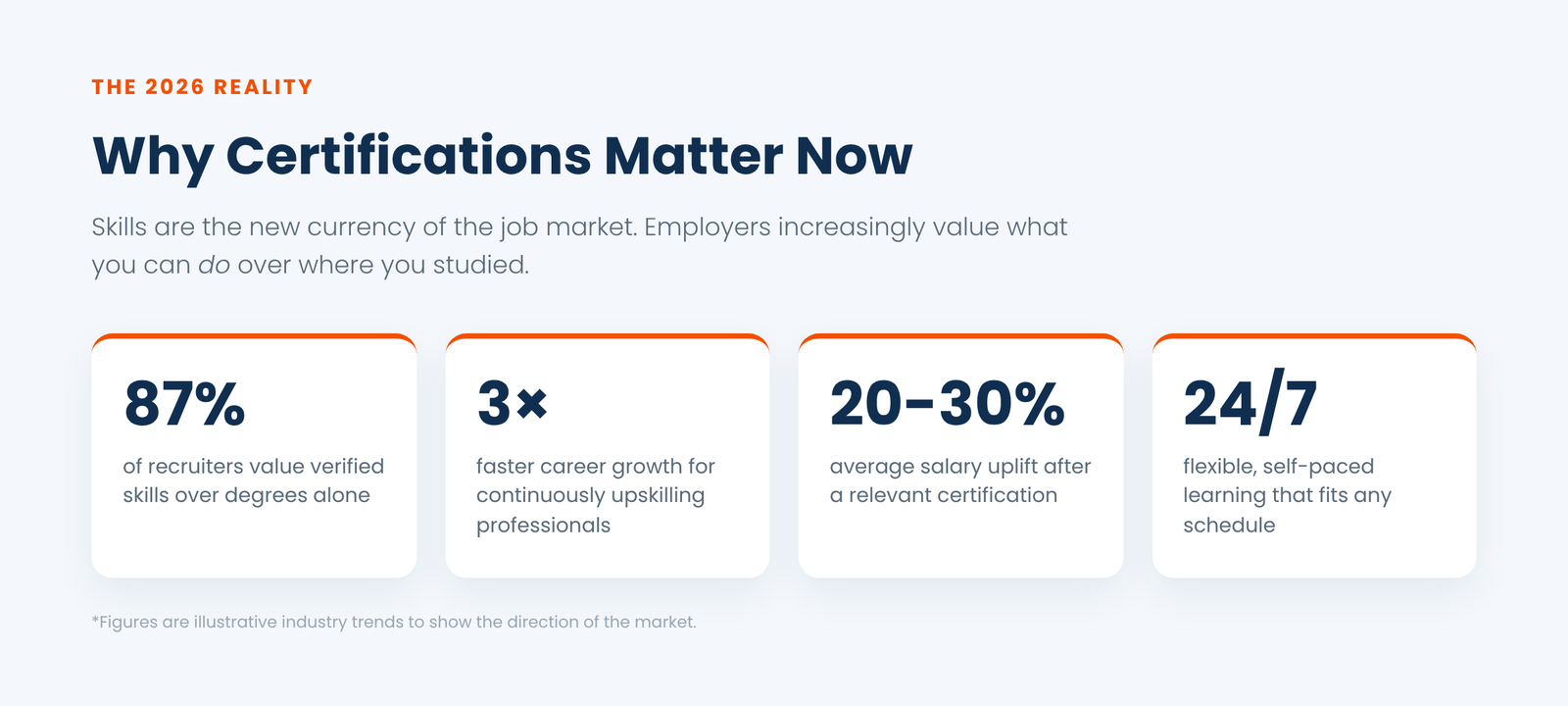
Here is why online certifications have moved from “nice to have” to “essential” for career growth:
1. The skills gap is widening
Technology changes faster than traditional education can keep up. New tools, frameworks, and ways of working appear every year, and companies struggle to find people who already know them. A certification course is often the quickest route to closing that gap, because good programmes are updated far more frequently than a typical degree curriculum. When you hold a current certification, you are telling employers that your knowledge is fresh and relevant, not years out of date.
2. Employers increasingly hire for skills, not just degrees
A growing number of organisations have adopted “skills-first” hiring, where a candidate’s demonstrated abilities matter more than where — or whether — they went to university. Many large employers have removed strict degree requirements from entire categories of jobs. In this environment, a focused certification that proves you can do the work can be just as persuasive as a diploma, and sometimes more so, because it maps directly to the role.
3. Lifelong learning is the new normal
The idea that you study for the first twenty years of your life and then simply work for the next forty is gone. Careers now span multiple roles, industries, and even complete reinventions. Continuous learning is no longer optional — it is how you stay employable and keep your earning power rising. Online certifications are built for exactly this: bite-sized, flexible, and designed to fit around a full-time job or studies.
4. Access has never been more democratic
Perhaps the most profound change is access. A learner in a small town now has access to the same courses, taught by the same world-class instructors, as someone in a major metropolitan city. All it takes is an internet connection and the determination to learn. This has opened doors for millions of people who were previously locked out of elite education by geography or cost — and it is one of the reasons CareerHike is so passionate about guiding learners toward the right online programmes.
“The most important skill of the 21st century is the ability to keep learning. Certifications are simply the proof that you are doing it.”
The Key Benefits of Online Certification Courses
It is one thing to say certifications are valuable; it is another to understand exactly how they help you. Let us break down the real, practical benefits you can expect when you choose the right programme and commit to finishing it.
Flexibility that fits your life
This is the benefit learners mention most. Online certifications let you study at your own pace, on your own schedule, from wherever you are. Early mornings before work, a lunch break, late evenings after the children are asleep — you decide. For working professionals and students juggling multiple responsibilities, this flexibility is often the difference between upskilling and never finding the time. Most platforms also let you pause, rewind, and revisit lessons as many times as you need, which is impossible in a traditional classroom.
Affordability and strong value for money
Compared with a full degree, most certification courses cost a fraction of the price — and many excellent ones are free or very low cost. Because you are paying for a focused skill rather than years of general education, the value for money can be exceptional. When you factor in that you can keep earning while you study, the financial case becomes even stronger. You are not giving up income to go back to school; you are investing a small amount to increase your income.
Faster results
A degree takes years. A certification can take weeks or a few months. When the job market is moving quickly and opportunities appear suddenly, speed matters. You can identify a skill that is in demand, learn it, prove it, and start applying for roles — all within a single season. This agility is one of the biggest advantages certifications hold over longer qualifications.
Validated, job-ready skills
The best certification courses are deeply practical. Instead of only teaching theory, they have you build real projects: a marketing campaign, a working dashboard, a small application, a security audit. By the time you finish, you do not just have a certificate — you have a portfolio of work that demonstrates your skills to employers. That combination of a credential and tangible proof is incredibly persuasive in interviews.
Career growth and new opportunities
Certifications open doors. They can qualify you for a promotion, make you eligible for roles you could not previously apply to, or give you the confidence and credibility to switch into an entirely new field. Many professionals use a well-chosen certification as the pivot point that moves them from a role they have outgrown into one with far more scope and reward.
Confidence and credibility
There is a psychological benefit that is easy to overlook. Completing a structured course and passing its assessments builds genuine confidence. You stop guessing whether you can do something and start knowing that you can. That confidence shows in interviews, in client meetings, and in the quality of your work — and the credential gives others a reason to trust you before they have even seen what you can do.
Networking and community
Modern online courses are rarely solitary. Discussion forums, peer-review assignments, live sessions, and alumni communities connect you with learners and professionals around the world. These connections can lead to mentorship, collaboration, referrals, and even job offers. The network you build while earning a certification can be just as valuable as the certificate itself.
Global recognition and remote opportunities
Many online certifications are recognised internationally, which means the skills you prove can travel with you across companies, cities, and even borders. In an era where remote and hybrid work has become mainstream, a globally respected credential can qualify you for opportunities far beyond your local job market — including freelance and contract work for clients anywhere in the world. For ambitious learners, this reach is one of the most exciting advantages of all: your postcode no longer limits your potential.
CareerHike tip: The learners who benefit most are the ones who treat a certification as the beginning of a journey, not the end. Use the credential to get noticed, then let your real skills and portfolio do the rest.
Online Certifications vs Traditional Degrees
One of the most common questions learners ask is whether a certification can really compete with a traditional degree. The honest answer is that they are different tools for different jobs — and the smartest professionals often use both. A degree gives you breadth, depth, and a formal foundation; a certification gives you speed, focus, and current, job-ready skills. Here is how they compare across the factors that matter most.
The takeaway is not that one replaces the other. For some regulated professions — medicine, law, engineering licensure — a formal degree is non-negotiable. But for a huge and growing share of roles in technology, business, design, and marketing, a strong certification combined with a portfolio can get you hired and promoted. And when you pair a degree with targeted certifications, you become genuinely hard to ignore.
The Most In-Demand Certification Domains in 2026
Not all certifications are created equal. Some fields are growing so quickly that a credential in them can transform your career almost overnight, while others are more crowded. Below are the domains where demand is strongest and where a well-chosen certification offers the best return in 2026. Think of this as a map of where the opportunities are — use it to point your learning in a direction the market is actively rewarding.
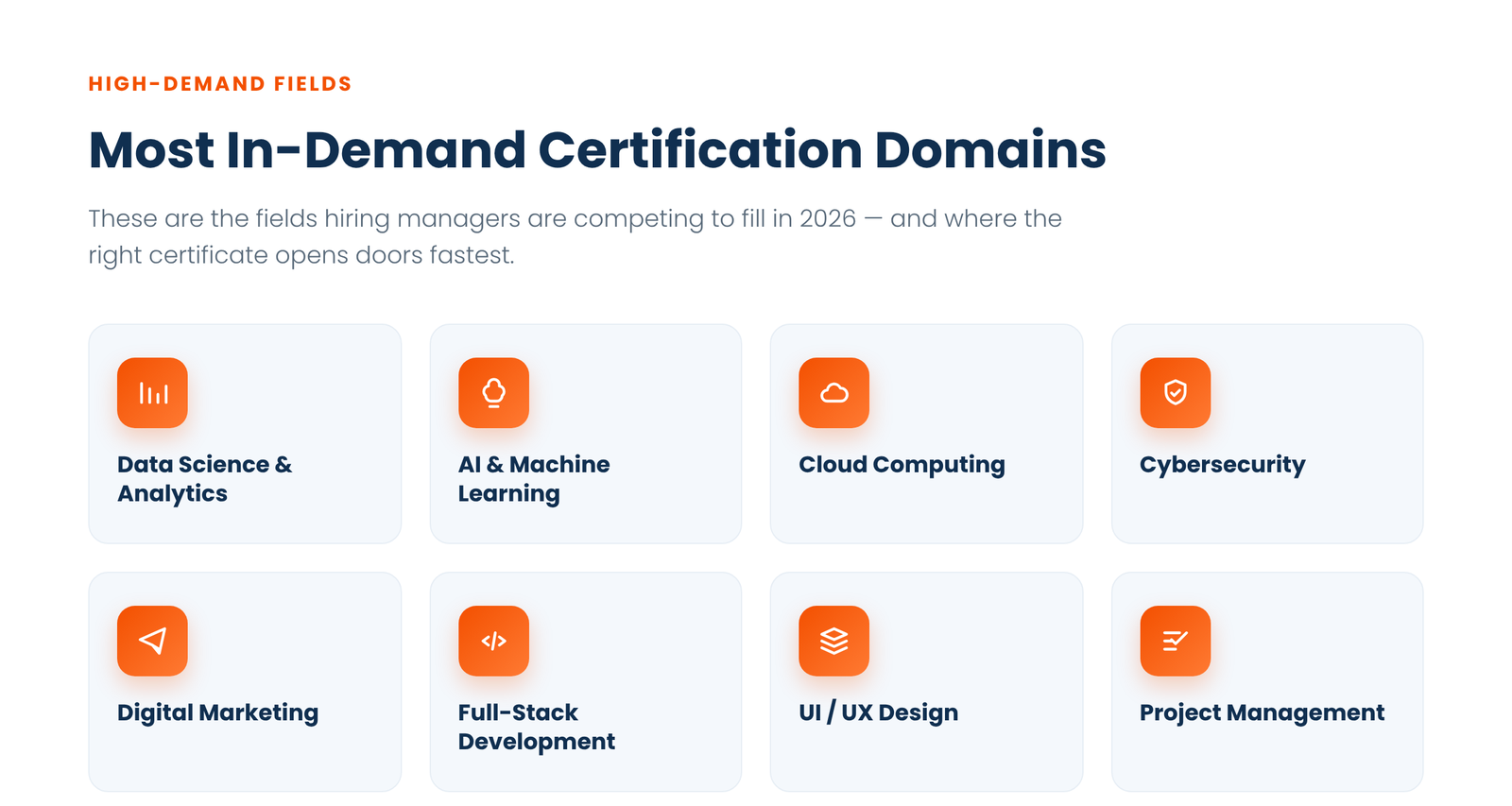
1. Data Science & Analytics
Every organisation now runs on data, but very few have enough people who can turn that data into decisions. Certifications in data analytics, business intelligence, and data science teach you to collect, clean, analyse, and visualise information, and to communicate insights that leaders can act on. You will typically learn tools for spreadsheets, databases, and visualisation, along with the fundamentals of statistics. This is one of the most versatile skill sets you can own, because every industry — from retail to healthcare to finance — needs it.
2. Artificial Intelligence & Machine Learning
AI has moved from research labs into everyday business, and the demand for people who understand it has exploded. Certifications in machine learning, deep learning, generative AI, and prompt engineering are among the most sought-after credentials of the decade. Even if you are not aiming to become a specialist engineer, a foundational AI certification helps you understand how these tools work and how to apply them responsibly in your own field — a skill that is quickly becoming essential across almost every profession.
3. Cloud Computing
As companies move their systems to the cloud, people who can design, deploy, and manage cloud infrastructure are in enormous demand. The major cloud providers offer tiered certifications — from foundational to professional — and these are some of the highest-paying credentials in all of technology. A cloud certification is an excellent choice for anyone with an interest in IT, systems, or software, and it pairs beautifully with data and AI skills.
4. Cybersecurity
With every new connected device and online service, the attack surface for cybercrime grows — and so does the need for skilled defenders. Cybersecurity is one of the few fields with a persistent global shortage of qualified professionals, which means strong job security and excellent pay. Certifications range from entry-level credentials that establish the fundamentals to advanced qualifications in ethical hacking, security operations, and risk management. If you enjoy problem-solving and want a field that will never run short of demand, this is a superb option.
5. Digital Marketing
Businesses of every size now live or die by their online presence, and digital marketing skills are in constant demand. Certifications cover search engine optimisation, paid advertising, social media marketing, content strategy, email marketing, and analytics. The beauty of digital marketing is that it rewards creativity and data skills in equal measure, and you can often start applying what you learn immediately — even on your own projects — to build a portfolio while you study.
6. Full-Stack & Web Development
The ability to build websites and applications remains one of the most reliably employable skills in the world. Full-stack development certifications teach you both the front end (what users see) and the back end (the logic and databases behind it). Because you can demonstrate your skills directly through the things you build, a strong portfolio of projects combined with a certification can get you hired even without a formal computer science degree.
7. UI / UX Design
Good design is now a competitive advantage, and companies are investing heavily in the experience their products deliver. UI/UX certifications teach you user research, wireframing, prototyping, visual design, and usability testing. This field is ideal for people who combine creativity with empathy and logic, and — like development and marketing — it lets you build a portfolio that speaks louder than any résumé.
8. Project & Product Management
Someone has to turn ideas into finished results, on time and on budget — and that someone is increasingly expected to hold a recognised project management credential. Certifications in project management and agile methodologies are respected across every industry and often lead directly to higher-responsibility, higher-paying roles. Product management certifications, which focus on deciding what to build and why, are also rising fast in demand.
9. Finance, Accounting & FinTech
Finance remains a cornerstone of the economy, and certifications in financial modelling, accounting software, investment analysis, and the fast-growing field of financial technology are highly valued. These credentials suit detail-oriented learners who enjoy working with numbers and want roles with clear progression and strong earning potential.
10. Business, Management & Soft Skills
Technical skills open doors, but leadership, communication, and business skills determine how far you go once you are inside. Certifications in business analysis, leadership, human resources, communication, and entrepreneurship complement any technical path and are especially valuable for those aiming at management. Never underestimate how much a certified grounding in these “human” skills can accelerate a career.
11. Healthcare & Allied Technology
Healthcare is one of the largest and most resilient employers in the world, and technology is transforming it rapidly. Certifications in health informatics, medical coding, healthcare data, telemedicine support, and allied health roles are opening doors for people who want a stable, meaningful career. Because healthcare rarely slows down, credentials in this space tend to offer excellent long-term security, and many roles can now be performed partly or wholly online.
12. Supply Chain, Logistics & Operations
Global commerce depends on goods moving efficiently from one place to another, and the people who manage that flow are in steady demand. Certifications in supply chain management, logistics, procurement, and operations teach you to optimise processes, reduce costs, and keep complex systems running smoothly. For analytical, organised learners, this is a field with clear progression and genuine impact on how businesses perform.
13. Emerging Tech: Blockchain, IoT & More
Beyond the established fields, a wave of emerging technologies — blockchain, the Internet of Things, extended reality, and automation — is creating brand-new roles with relatively little competition. Getting certified early in an emerging area can position you as one of the few genuine experts as the field matures. These credentials carry a little more risk, since the technology is still evolving, but the reward for getting in early can be considerable.
Which one is right for you? The “best” domain is the one that sits where your interests, your strengths, and market demand overlap. If you are unsure, that overlap is exactly what CareerHike’s career experts help you find.
Trusted Platforms for Online Certifications
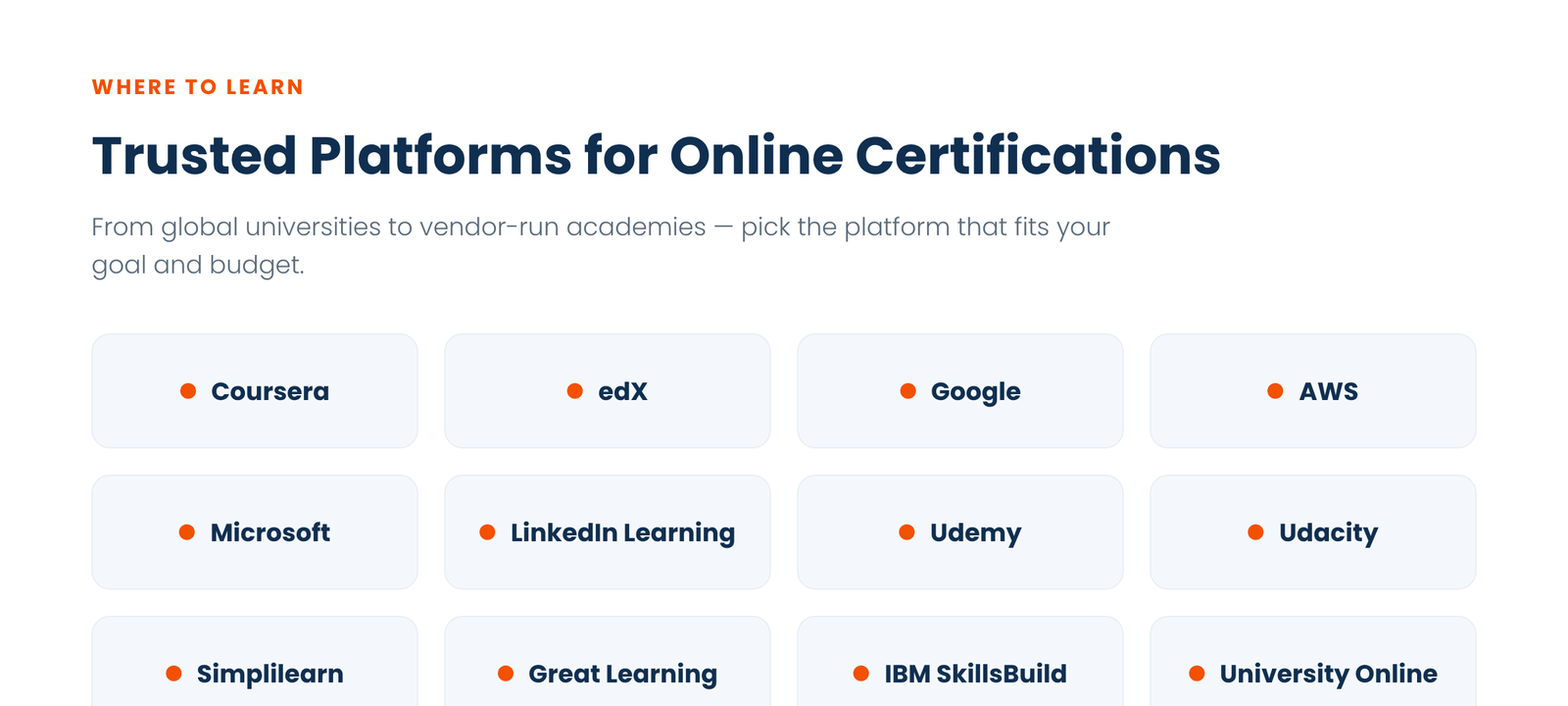
Once you know what you want to learn, the next question is where to learn it. The online education landscape is rich with excellent providers, each with its own strengths. Choosing a reputable, recognised platform matters, because the credibility of your certificate depends partly on who issued it. Here is an overview of the main categories and what each is best suited for.
University-backed platforms
Platforms that partner with leading universities offer certificates and professional programmes carrying the weight of established academic institutions. These are ideal when you want recognised credibility, structured learning, and the option to progress toward deeper qualifications. They tend to balance theory and practice well, and many offer financial aid or scholarships.
Technology company academies
The major technology companies run their own certification programmes for their platforms — cloud, data, AI, productivity, and development tools. If you want to work with a specific technology, a certification straight from the company that built it is about as credible as it gets, and these credentials are frequently named directly in job postings.
Marketplace and specialist platforms
Open marketplaces host enormous libraries of affordable courses on almost every topic imaginable, which is perfect for learning a specific tool quickly or exploring a new interest cheaply. Specialist upskilling platforms focus on in-demand professional tracks with mentorship, live classes, and career support. These are excellent when you want guided, outcome-focused learning rather than self-study alone.
Professional body certifications
For fields such as project management, finance, human resources, and quality management, globally recognised professional associations award certifications that are the gold standard in their industry. These usually involve a formal exam and sometimes experience requirements, but they carry exceptional credibility and are often tied to higher pay.
Online and distance education institutions
Accredited online and distance education bodies — including recognised university online divisions — offer certificates, diplomas, and full degrees delivered entirely online. These are an outstanding choice for learners who want a formal, accredited qualification with the flexibility of remote study, and they bridge the gap between a quick certificate and a full on-campus degree.
Before you enrol anywhere: check that the provider is reputable, read recent learner reviews, confirm the certificate is recognised in your target industry, and make sure the curriculum is up to date. A beautiful course page means nothing if the content is years old.
How to Choose the Right Certification Course
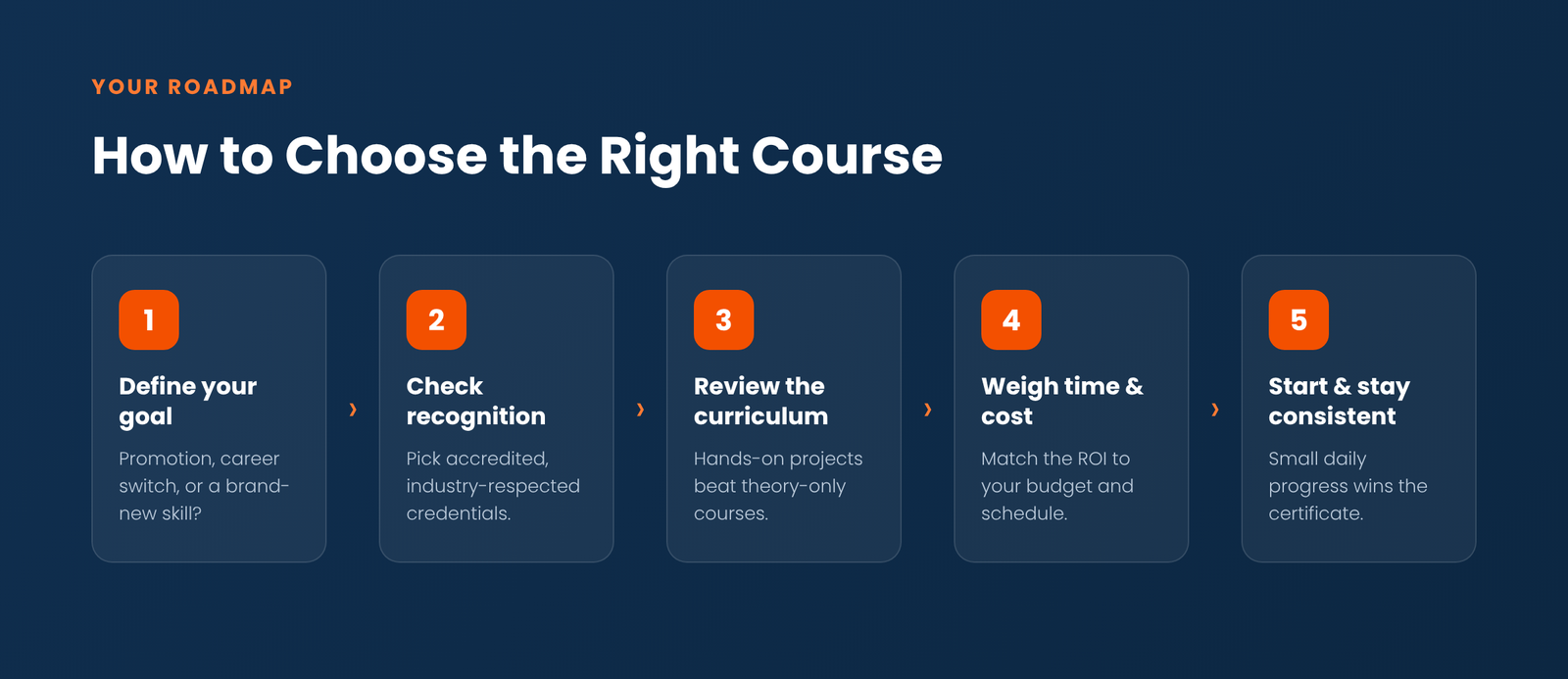
With thousands of courses competing for your attention, the hardest part is often simply choosing. The wrong course wastes your time and money; the right one changes your career. Use the following framework to make a confident, well-reasoned decision rather than picking whatever appears first in an advertisement.
Start with your goal, not the course
Before you look at a single course, get clear on what you actually want. Are you aiming for a promotion in your current field? Switching to a new industry? Building a skill to freelance? Trying to get your first job? Your goal determines everything that follows. A certification that is perfect for a career switcher may be completely wrong for someone seeking a senior promotion. Write your goal down in one sentence and keep it in front of you as you compare options.
Check recognition and accreditation
A certificate is only as valuable as the trust employers place in it. Research whether the credential is recognised in your target industry. Look at real job postings for the roles you want and note which certifications they mention by name. If a qualification keeps appearing in the listings you care about, that is a strong signal it is worth pursuing.
Scrutinise the curriculum
Read the full syllabus carefully. Does it cover current tools and practices, or does it feel dated? Is there a healthy balance of theory and hands-on work? Are there real projects you will complete? A great course should leave you with demonstrable skills and portfolio pieces, not just a certificate and a head full of concepts you have never applied.
Consider the instructor and the format
Who is teaching, and what is their real-world experience? Does the format suit how you learn — self-paced videos, live cohorts, or a mix? Do you need mentorship and feedback, or are you disciplined enough for pure self-study? Being honest about your own learning style will save you from abandoning a course that simply was not the right fit.
Weigh cost against return
Price matters, but it should be judged against value, not in isolation. A free course that teaches you a high-demand skill can deliver an enormous return; an expensive course in a saturated field may not. Estimate the realistic benefit — a raise, a new role, freelance income — and compare it with the total cost in money and time. The best certifications pay for themselves many times over.
Read reviews and talk to alumni
Finally, learn from people who have already taken the course. Recent, detailed reviews tell you whether the content delivers on its promises and whether the certificate actually helped graduates. Where possible, connect with alumni on professional networks and ask them directly whether they would recommend it. Real experiences are worth more than any marketing page.
The Real Return on Investment of Certifications
Let us talk honestly about results, because at the end of the day a certification is an investment and you deserve to know what it can return. The impact shows up in several ways, and understanding them helps you set realistic, motivating expectations.
Higher earning potential
The most direct return is money. Across many fields, professionals who hold relevant, in-demand certifications tend to command higher salaries than those who do not, because they can do more and need less training. A certification can strengthen your case in a salary negotiation, qualify you for higher pay bands, or open the door to better-paid roles entirely. The uplift varies by field and experience, but in high-demand domains it can be substantial.
Faster promotions and career mobility
Certifications signal initiative and competence — two things managers love to promote. They can also make you mobile, giving you the freedom to move between companies, industries, and even countries, because recognised credentials travel well. Many professionals find that each certification they earn widens the range of roles realistically open to them.
The power of stacking skills
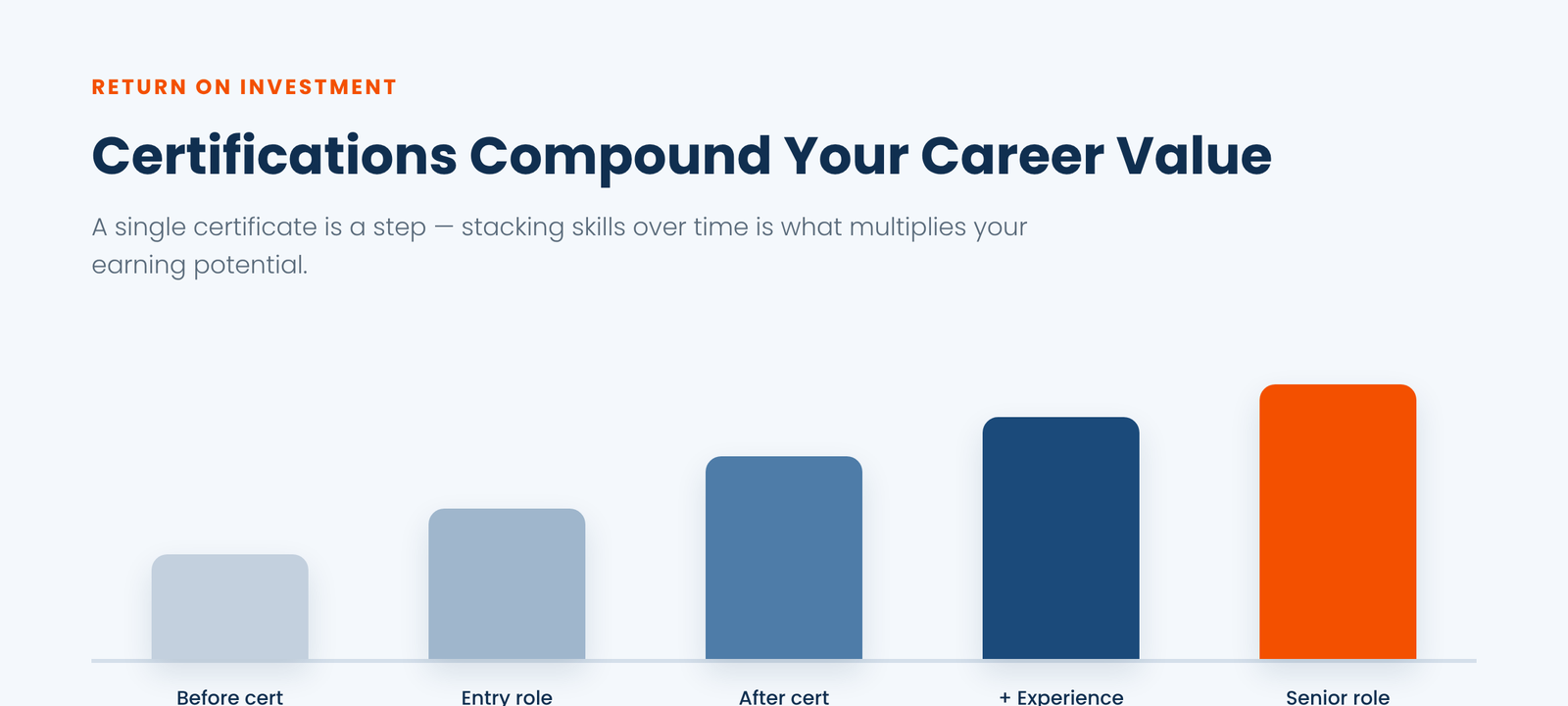
The real magic happens over time. A single certification is useful; a thoughtfully built stack of complementary skills is transformative. Imagine combining data analysis with a cloud certification and a touch of AI, or pairing digital marketing with analytics and design. Each credential multiplies the value of the others, turning you into a rare, well-rounded professional who is genuinely difficult to replace. This compounding effect is why continuous learning pays off far more than any single course.
Beyond salary: opportunity and freedom
Not every return is financial. Certifications can give you the freedom to work remotely, to freelance, to start your own venture, or simply to do work you find more meaningful. They can rescue you from a career dead-end and hand you options you did not have before. For many learners, that sense of expanded possibility is worth as much as any pay rise.
Consider a common pattern we see again and again: a professional stuck in an entry-level role spends a few focused months earning a certification in a high-demand skill, builds two or three portfolio projects along the way, and uses that combination to move into a specialist position with noticeably better pay and prospects. They did not go back to university for years or take on crippling debt — they identified a gap, filled it deliberately, and proved it. That is the quiet power of certifications: they let ordinary, determined people engineer extraordinary career changes one skill at a time. The investment is modest; the compounding return, over a whole career, can be life-changing.
How to Get the Most Out of Your Certification
Enrolling is easy; finishing well is where the real value is created. Many people start online courses and never complete them — not because the content is too hard, but because self-directed learning requires strategy. Here is how to make sure you are one of the learners who finishes strong and actually benefits.
Treat it like a real commitment
Block fixed time in your calendar for study, just as you would for an important meeting, and protect it. Consistency beats intensity: thirty focused minutes a day will take you further than an occasional frantic weekend. Tell someone your goal so you feel accountable, and track your progress so you can see yourself moving forward.
Learn by doing, not just watching
Passive watching creates the illusion of learning without the substance. After every lesson, apply what you learned — rebuild the example yourself, tweak it, break it, fix it. The skills that stick are the ones your hands have practised, not just the ones your eyes have seen. If the course offers projects, do every single one, and then invent extra projects of your own.
Build a portfolio as you go
Every project you complete is potential portfolio material. Save your best work, document what you did and why, and publish it where employers can see it. By the time you earn your certificate, you will also have tangible proof of your abilities — and that combination is what actually gets you hired.
Engage with the community
Ask questions in the forums, answer other learners’ questions, join study groups, and attend any live sessions. Teaching a concept to someone else is one of the most powerful ways to cement your own understanding, and the relationships you build can lead to opportunities long after the course ends.
Showcase your credential
Once you earn your certificate, do not let it gather dust. Add it to your résumé and your professional profiles, share the achievement in your network, and reference specific projects when you talk about it. A certificate you never mention cannot help you; one you present confidently can change the trajectory of your search.
Common Challenges — and How to Beat Them
Online learning is powerful, but it comes with its own obstacles. Knowing them in advance means you can plan around them instead of being derailed.
Staying motivated without a classroom
Without fixed classes and in-person deadlines, motivation can fade. Beat this by setting your own milestones, rewarding yourself when you hit them, and remembering your “why” — the specific career outcome you are working toward. A visible countdown to your target completion date works wonders.
Choosing from too many options
The sheer number of courses can be paralysing. Avoid analysis paralysis by using the selection framework earlier in this guide, limiting yourself to a short list of two or three strong options, and then simply committing. A good-enough course you actually finish beats a “perfect” course you keep researching but never start.
Balancing study with life and work
Finding time is the universal struggle. The answer is not to find huge blocks of free time — they rarely appear — but to use small pockets consistently. Learn during a commute, on a lunch break, or in the quiet half-hour before bed. Those small sessions add up to a finished certificate faster than you expect.
Making sure the skills stick
It is easy to forget what you do not use. Reinforce your learning by applying it to real problems as soon as possible — in your current job, on freelance work, or on personal projects. The faster you put a new skill to work, the more permanently it becomes yours.
Certifications for Every Career Stage
The right certification depends heavily on where you are in your journey. Here is how to think about it at each stage.
Students and recent graduates
If you are still studying or have just finished, certifications are your secret weapon for standing out in a crowded entry-level market. While your peers have only a degree, you can arrive with a degree plus proven, practical skills and a portfolio. Focus on foundational, job-ready certifications in a field you are genuinely interested in, and start building projects early.
Freshers and early-career professionals
In your first few years of work, certifications help you specialise and accelerate. Identify the skills that lead to the next role you want, and earn the credentials that prove you are ready for it. This is the stage where a well-chosen certification can fast-track you past colleagues who are relying on time served alone.
Mid-career professionals
If you have experience but feel your growth has slowed, certifications can reignite your trajectory. They keep your skills current, qualify you for leadership or specialist tracks, and signal that you are still investing in yourself. Mid-career is also the perfect time to add management, strategy, or emerging-technology credentials on top of your existing expertise.
Career switchers
Changing fields can feel daunting, but certifications are the most practical bridge available. They let you build credibility in a new area quickly and affordably, without returning to university for years. Pair a focused certification with a portfolio of projects in your target field, and you can make a convincing case to employers even without prior experience.
Returning to work after a break
If you have been away from the workforce, a current certification is a powerful way to refresh your skills and reassure employers that you are up to date. It also rebuilds your own confidence, which is often the biggest hurdle when returning. Choose something in demand, and let the credential signal that you are ready and current.
Well-Known Certifications Worth Knowing About
While the right certification always depends on your personal goals, it helps to know some of the widely recognised credentials that regularly appear in job postings. The examples below are grouped by field to give you a sense of the landscape — use them as starting points for your own research rather than as a definitive ranking, since programmes evolve and new ones appear all the time.
Data, AI & cloud
In data and cloud, credentials such as the Google Data Analytics certificate, cloud certifications from the major providers (for example foundational and associate-level architect credentials), and AI and machine learning certificates from universities and technology companies are frequently requested. These validate both the tools and the thinking employers need, and they pair naturally with one another as you stack skills over time.
Cybersecurity & IT
In security and IT, foundational credentials that establish core knowledge are a common entry point, while more advanced certifications in security operations, ethical hacking, and information security management are respected markers of expertise for experienced professionals. Because the field has a persistent talent shortage, these credentials tend to hold their value exceptionally well.
Project management & business
For project and delivery roles, globally recognised project management credentials and agile or scrum certifications appear again and again in senior job descriptions. In business and finance, credentials in financial analysis, accounting software, and business analysis are widely valued and often linked to clear salary progression.
Marketing & design
In digital marketing, platform-specific advertising and analytics certifications from major technology companies are a practical, respected way to prove hands-on ability. In design, professional UI/UX certificates from universities and specialist platforms — backed by a strong portfolio — carry real weight with hiring teams.
Whatever field you choose, remember the principle that runs through this entire guide: the credential gets you noticed, but it is the real, demonstrable skill behind it that gets you hired and promoted. Pick recognised certifications, learn the material properly, and build proof of what you can do.
Free vs Paid Certifications: Which Should You Choose?
A question almost every learner faces is whether to pay for a certification or stick to free options. Both have a place, and the right choice depends on your goal, your budget, and how much credibility you need the certificate to carry.
Free certifications are an excellent way to explore a new field, learn a specific tool, or build foundational knowledge without any financial risk. Many reputable companies and platforms offer genuinely valuable free courses, some with free or low-cost certificates. They are perfect when you are testing whether you enjoy a subject, when you need a quick, practical skill, or when money is tight. The main limitation is that some free certificates carry less weight with employers than paid, accredited ones, and free courses sometimes offer less support and structure.
Paid certifications typically offer deeper content, more structured learning, mentorship or instructor feedback, graded projects, career services, and a credential that employers recognise more readily. When you are serious about a career move and need a credential that will stand up to scrutiny, a paid programme from a respected provider is usually worth the investment. The key is to make sure you are paying for genuine value — recognition, support, and up-to-date content — not just a fancy certificate.
A smart strategy many learners use is to start free and upgrade when it counts: explore a field with free courses to confirm your interest, then invest in a recognised paid certification once you know you want to commit. That way you minimise wasted money while still ending up with a credential that carries real weight.
Rule of thumb: pay when the certificate itself needs to impress employers; go free when you simply need the skill or want to explore. Either way, it is the skill you actually gain — and prove — that creates the value.
Common Myths About Online Certifications
Despite their popularity, online certifications are still surrounded by outdated myths that stop people from taking advantage of them. Let us clear up the most persistent ones.
Myth 1: “Online certificates are not taken seriously”
This may have been partly true years ago, but it is no longer the case. Credentials from reputable universities, major technology companies, and professional bodies are widely respected, and many employers now actively look for them. What matters is the credibility of the issuer and the relevance of the skill — not whether you learned online.
Myth 2: “They are too easy to be meaningful”
Good certifications are genuinely challenging. They involve real projects, graded assessments, and often a formal exam. Passing one takes real effort and real understanding, which is exactly why employers trust them. The ease people imagine usually belongs to low-quality courses, not to respected credentials.
Myth 3: “You need to be tech-savvy to study online”
Modern learning platforms are designed to be simple and welcoming, even for people who are not confident with technology. If you can watch a video and send an email, you can take an online course. Many platforms also offer support to help you get comfortable, so do not let this fear hold you back.
Myth 4: “One certificate guarantees a job”
A certificate is a powerful tool, but it is not a magic ticket. It gets you noticed and proves your baseline ability; your skills, portfolio, interview performance, and persistence do the rest. Treat a certification as the start of a strategy, not the whole strategy, and you will get far more from it.
Red Flags to Avoid When Choosing a Course
For every excellent course there are a few poor ones, and knowing the warning signs protects your time and money. Be cautious when you notice any of the following.
- Vague or hidden curriculum. If a provider will not show you exactly what you will learn, be wary — transparency is a sign of quality.
- Guaranteed jobs or unrealistic salary promises. No honest course can guarantee employment. Bold income promises are a classic warning sign.
- No reviews or only suspiciously perfect ones. A complete absence of independent feedback, or reviews that all sound identical, should make you pause.
- Outdated content. In fast-moving fields, material that has not been updated in years can leave you learning skills employers no longer want.
- High-pressure sales tactics. Countdown timers, relentless follow-ups, and “today only” discounts are marketing, not education. Make your decision calmly.
A trustworthy provider is transparent about what you will learn, honest about outcomes, backed by real reviews, current in its content, and respectful of your decision-making process. When in doubt, slow down and do a little more research — or ask an expert for a second opinion.
Online & Distance Education: A Growing Path
Alongside short certifications, formal online and distance education has grown into a serious, respected route to qualifications — and it deserves special mention. Recognised institutions now offer certificates, diplomas, and full degrees delivered entirely online, giving learners the credibility of an accredited qualification with the flexibility of remote study.
This path is ideal for students who are working, who live far from a campus, who have family responsibilities, or who simply prefer to learn at their own pace. Online and distance programmes from established universities combine structured academic rigour with the convenience of studying from home, and the qualifications they award are increasingly viewed on par with traditional on-campus study. For many learners, a formal online programme is the perfect middle ground — more comprehensive and more widely recognised than a short certificate, yet far more flexible and accessible than a conventional degree.
If your goal is a complete, accredited qualification rather than a single skill, exploring reputable online and distance education options is well worth your time. And whether you are choosing a short certification or a full online degree, the same principles apply: check recognition, examine the curriculum, read reviews, and align the choice with your career goal.
Making Your Certification Shine on Your Résumé & LinkedIn
Earning a certification is only half the job — presenting it well is what turns it into opportunities. Too many learners bury a valuable credential at the bottom of their résumé or forget to mention it entirely. Here is how to make yours work hard for you.
Give it a prominent place
Create a clear “Certifications” section on your résumé and list each credential with its name, the issuing organisation, and the date. If a certification is directly relevant to the role you are applying for, mention it near the top, in your summary, so it is impossible to miss.
Show the skills, not just the certificate
Employers care about what you can do. Alongside the credential, highlight the specific skills you gained and, ideally, point to a project that demonstrates them. “Completed a data analytics certification” is fine; “completed a data analytics certification and built a sales dashboard that revealed a 20% drop-off” is far more compelling.
Optimise your professional profile
Add your certifications to your LinkedIn profile using the dedicated section, include relevant keywords so recruiters can find you, and share a short post when you earn a new credential. Public achievements attract attention, spark conversations, and often lead to opportunities you did not go looking for.
Talk about it with confidence
In interviews, be ready to explain why you pursued the certification, what you learned, and how you have applied it. A credential you can speak about with genuine enthusiasm and concrete examples is far more persuasive than one you simply list. Let your learning tell a story about your drive and direction.
The Future of Online Certifications
Online learning is not standing still. Understanding where it is headed helps you make choices today that will still be valuable tomorrow.
Stackable, modular credentials are becoming the norm. Instead of one giant qualification, learners increasingly collect small, focused credentials that stack together into larger recognised achievements over time — letting you build a qualification in flexible steps that fit your life.
AI-powered, personalised learning is reshaping how courses are delivered. Adaptive platforms now adjust to your pace, identify your weak spots, and recommend exactly what to study next, making learning faster and more efficient than ever before.
Verified digital credentials — shareable, tamper-proof certificates you can display and that employers can instantly verify — are making credentials more trustworthy and more portable, reducing fraud and friction in hiring.
Closer ties between learning and hiring are emerging, with more employers partnering directly with course providers and even recognising specific certifications as a fast track into their roles. The line between “learning a skill” and “getting the job” is getting shorter every year.
The direction is clear: certifications are becoming more flexible, more credible, and more tightly connected to real career outcomes. The learners who embrace continuous, modular upskilling now will be the ones best positioned for the opportunities ahead.

Your Step-by-Step Starter Plan
Feeling inspired but unsure where to begin? Follow this simple, five-step plan to go from “thinking about it” to holding your first certification.
- 1Define your one-sentence goal. Write down precisely what you want the certification to achieve — the role, the raise, or the switch you are aiming for.
- 2Research the market. Look at real job postings for your target role and note the skills and certifications that keep appearing.
- 3Shortlist and choose. Pick two or three reputable courses, compare curriculum, reviews, and cost, then commit to one.
- 4Schedule and start. Block regular study time, begin, and complete every project along the way.
- 5Earn, showcase, and repeat. Pass the assessment, add the credential and projects to your profile, and plan your next skill.
Frequently Asked Questions
Are online certification courses worth it?
For most people, yes — provided you choose a recognised course in an in-demand field and actually complete it. The combination of a trusted credential and a real portfolio can deliver a strong return in better jobs, higher pay, and new opportunities.
Can a certification replace a degree?
In many technology, business, design, and marketing roles, a strong certification plus a portfolio can get you hired. For regulated professions, a formal degree is still required. The best strategy is often to combine both.
How long does a certification take to complete?
It varies widely — from a few hours for a micro-credential to several months for a comprehensive professional programme. Most popular certifications can be completed in a few weeks to a few months of consistent, part-time study.
Do I need any experience to start?
Many certifications are designed for complete beginners and assume no prior knowledge. Others are intermediate or advanced. Always check the prerequisites before enrolling so the course matches your current level.
How do I choose between so many courses?
Start with your goal, check which credentials appear in real job postings, scrutinise the curriculum and reviews, and weigh cost against the realistic return. If you are still unsure, CareerHike’s experts can help you choose with confidence.
Do certifications expire?
Some do and some do not. Certain technology and professional certifications require periodic renewal to ensure your skills stay current, while many course-completion certificates last indefinitely. Always check the validity and renewal terms before enrolling, and treat renewal as a healthy prompt to keep your knowledge up to date rather than a burden.
Will employers actually recognise my certificate?
Recognition depends on who issued it and how respected it is in your industry. Certifications from reputable universities, major technology companies, and established professional bodies carry the most weight. This is exactly why choosing a recognised provider matters so much.
Final Thoughts: Your Next Step Starts Today
Online certification courses have quietly become one of the most powerful tools for building the career you want. They are flexible enough to fit any life, affordable enough for almost any budget, and credible enough to change how employers see you. In a world where skills are the new currency, a well-chosen certification is one of the smartest investments you can make in yourself.
Throughout this guide, one idea has come up again and again, and it is worth repeating one final time: the certificate opens the door, but your skills and your effort carry you through it. Choose a recognised programme in a field that genuinely interests you, learn the material properly, build real things as you go, and present your achievement with confidence. Do that, and a single certification can become the first link in a chain of opportunities that stretches across your entire career.
But the real value does not come from reading about certifications — it comes from starting one. The perfect moment will never arrive; the best time to begin is now. Define your goal, choose a course that moves you toward it, and take the first small step today. A year from now, you will be glad you did.
And if you are not sure which path is right for you, you do not have to figure it out alone. CareerHike exists to help learners like you cut through the noise, choose the right certification, and build a career you are proud of. Reach out, ask your questions, and let us help you take the next step with confidence.
Ready to grow?
Let CareerHike help you choose the certification that changes your career.
Get Free Career Guidance →Confused About Which Course to Pick?
Talk to CareerHike EduTech on WhatsApp — free, no obligation.
Chat on WhatsAppLatest Blogs