LPU Online MBA Placement Review: Salary, Jobs & Career Support

- Why Placement Outcomes Matter More for an Online MBA
- How LPU Online's MBA Placement Process Generally Works
- What Career Support Actually Includes
- Salary Expectations After an LPU Online MBA




LPU Online MBA Placement Review: Salary, Jobs & Career Support
For most people considering an online MBA, the fee structure and eligibility criteria are only half the decision. The other half — often the more important half — is what happens after the degree is in hand. Does an online MBA actually translate into a better job, a salary bump, or a career switch? Lovely Professional University (LPU) Online is one of the more widely searched options for an online MBA in India, largely because it pairs a UGC-DEB approved degree with an active placement and career-support wing, something not every online university offers in a structured way.
This guide breaks down how LPU Online's MBA placement process generally works, the kind of salary bands and job roles graduates typically move into, which specializations tend to see stronger placement interest, and what the actual career-support system looks like beyond just the word "placement" on a brochure. If you're still deciding on a specialization or haven't confirmed your base eligibility yet, it's worth reading our LPU Online MBA Specializations guide and LPU Online Eligibility Criteria page alongside this one, since your specialization choice often has a direct bearing on the kind of roles and recruiters you'll be eligible for during placement season.
Quick Answer: LPU Online's MBA placement support generally includes resume-building assistance, virtual interview preparation, access to a hiring-partner network, and career counselling sessions, with actual salary outcomes depending heavily on the student's prior work experience, specialization, industry background, and interview performance. Working professionals already employed in a relevant field tend to use the degree more for internal promotions and role transitions than for a fresh placement drive, while career-switchers and early-career professionals are more likely to rely on the university's placement cell directly. Because exact recruiter lists, average packages, and placement statistics can shift from one academic cycle to the next, this guide gives you the structural framework, and it's worth confirming the live, current numbers directly on LPU's official Online MBA course page before making a final decision.
Why Placement Outcomes Matter More for an Online MBA
For a full-time, on-campus MBA, placement is often the single biggest reason students enroll in the first place — the entire program is frequently built around a final placement season. An online MBA works differently. A meaningful share of students enrolling in LPU Online's MBA are already working professionals, and for them, the degree is less about a fresh campus placement drive and more about qualifying for internal promotions, lateral moves into management roles, or simply meeting a formal educational requirement their current employer expects for a leadership track.
That said, a genuine placement and career-support system still matters, and arguably matters more for online learners specifically, because they don't have the built-in advantage of a physical campus environment where recruiters visit in person. Career switchers, recent graduates pursuing an MBA online instead of full-time, and professionals looking for a complete industry change are the group most directly affected by how strong (or weak) a university's placement wing actually is. This is the audience this guide is most useful for, though the salary and role information below is relevant regardless of your starting point.
How LPU Online's MBA Placement Process Generally Works
Online MBA placement support typically doesn't mirror a traditional on-campus placement season, where recruiters show up for a fixed week of interviews. Instead, it usually runs as an ongoing, semester-linked process. Once a student progresses far enough into the program — generally in the later semesters, closer to program completion — the placement cell begins engaging students through virtual sessions covering resume writing, mock interviews, aptitude preparation, and profile-building guidance.
From there, eligible students are generally given access to a hiring-partner network, where recruiters post openings specifically for online-degree candidates, and shortlisted students go through virtual interview rounds rather than in-person ones. This structure means outcomes are less about a single placement week and more about consistent engagement with the career-services team over the final stretch of the program. Students who log in regularly, attend the virtual sessions, and keep their profile updated on the placement portal tend to see meaningfully better outcomes than those who treat placement support as something to think about only after their final exam.
What Career Support Actually Includes
"Placement support" is a broad term, and it's worth unpacking what it generally covers in practice, since different universities weight these components very differently.
Resume and profile building: Most online MBA placement cells, including LPU Online's, generally offer structured resume-review sessions and templates tailored to the specific industry a student is targeting — finance resumes are reviewed differently from marketing or operations resumes, for instance.
Mock interviews and aptitude preparation: Virtual mock interview rounds, along with preparation material for group discussions and case-study-based interview formats commonly used in MBA hiring, are generally part of the standard placement-prep cycle.
Access to a hiring-partner network: This is usually the core of what "placement support" means in practice — a pool of recruiting companies that specifically engage with the university's online-degree graduates for open roles, ranging from entry-level management trainee positions to more experienced hires depending on the candidate's background.
Career counselling: One-on-one or group counselling sessions to help students figure out which roles and industries realistically match their specialization and prior work experience, rather than applying broadly without direction.
Alumni network access: Many universities, LPU included, generally provide some form of alumni connectivity, which matters more for referrals and informal networking than for formal placement numbers, but is still a meaningful part of the overall career-support picture.
| Career Support Component | What It Generally Involves |
|---|---|
| Resume & Profile Building | Industry-specific resume templates and one-on-one review sessions |
| Mock Interviews | Virtual practice rounds, case-study and GD preparation |
| Hiring-Partner Network | Access to recruiters hiring specifically from the online-degree pool |
| Career Counselling | Guidance on matching specialization and experience to realistic roles |
| Alumni Network | Informal referrals and industry connectivity post-graduation |
For a broader look at how this fits into LPU Online's placement structure across all programs, not just the MBA, our general LPU Online Placement guide is a useful companion read.
Salary Expectations After an LPU Online MBA
This is usually the question prospective students care about most, and it's also the one that's hardest to answer with a single number, because online MBA salary outcomes vary far more widely than full-time MBA outcomes do. A fresh graduate with limited work experience entering the job market for the first time will see a very different outcome than a working professional with five years of prior experience using the MBA to move into a management role at their existing company.
Broadly, salary outcomes for online MBA graduates tend to fall into a wide band, and where a specific graduate lands within that band depends heavily on four factors: prior work experience going into the program, the specialization chosen, the industry and function they're targeting, and how actively they engage with the placement cell's resources. As a general, indicative reference — and not a guaranteed figure — the table below reflects the kind of spread typically seen across online MBA cohorts in India.
| Candidate Profile | Indicative Salary Range (Annual) |
|---|---|
| Fresh graduate / limited prior experience | Entry-level management trainee band |
| 1–3 years of prior work experience | Junior to mid-level executive band |
| 3–6 years of prior work experience | Mid-level manager band, often with an internal promotion element |
| 6+ years of prior work experience | Senior manager / functional lead band, typically an internal role shift |
Treat this as a directional guide rather than a confirmed placement report — actual figures depend on the specific recruiter, role, industry, and year, and LPU's own placement statistics (where published) on the official Online MBA course page will always be more current than any general estimate. It's also worth being honest with yourself about which category you fall into before enrolling — students entering with strong prior experience generally see the MBA function more as a career accelerator within their existing field, while those with limited experience should treat placement outcomes as one input among several, not a guarantee.
Common Job Roles for LPU Online MBA Graduates
The specific roles an online MBA opens up depend heavily on specialization, but there's a fairly consistent set of functional areas that online MBA graduates generally move into, regardless of which university the degree is from. The table below outlines the broad categories.
| Job Roles (Set A) | Job Roles (Set B) |
|---|---|
| Business Development Manager | Operations Manager |
| Marketing Manager | Financial Analyst |
| HR Manager | Product Manager |
| Sales Manager | Supply Chain Manager |
| Project Manager | Business Analyst |
| Digital Marketing Manager | Consultant |
It's worth noting that these role categories aren't unique to any single university — they broadly reflect the kind of functional positions any MBA, online or otherwise, tends to lead into. What differs between universities is less "which roles exist" and more "how effectively the placement cell connects you to recruiters hiring for these roles."
Does Your Specialization Affect Placement Outcomes?
Specialization choice matters more for placement than most applicants initially assume. An MBA in Finance opens a fairly different recruiter pool than an MBA in Marketing or an MBA in Information Technology, and a student picking a specialization purely based on personal interest without considering the job-market angle sometimes ends up narrowing their own placement options unintentionally.
Finance specializations generally lead toward roles in financial analysis, corporate finance, and banking-adjacent functions. Marketing specializations tend to open digital marketing, brand management, and sales-leadership paths. HR specializations lead toward talent management and organizational development roles. Operations and supply chain specializations are typically in demand across manufacturing, logistics, and e-commerce sectors specifically. If you haven't finalized your specialization yet, our detailed LPU Online MBA Specializations guide breaks down each option in more depth, which is worth reading before placement considerations even enter the picture, since specialization should generally be chosen based on career direction first and placement optics second.
Working Professionals vs Fresh Graduates: Different Placement Journeys
It's worth being explicit about a distinction that shapes how differently two LPU Online MBA students can experience "placement," even within the same batch. A working professional already employed in, say, a mid-level sales role, generally uses the MBA to qualify for an internal promotion or a lateral move into management — their placement journey is less about the university's hiring-partner network and more about how the degree strengthens their existing resume and internal case for advancement.
A fresh graduate or someone actively looking to switch industries entirely, on the other hand, relies far more heavily on the placement cell's external hiring-partner connections, mock interview support, and structured career counselling, since they don't have an existing internal pathway to lean on. Neither path is "better" — they're just different uses of the same degree, and it's worth being clear with yourself about which category you fall into before setting salary or role expectations based on general placement statistics that may not reflect your specific situation.
Online MBA Placement vs Full-Time MBA Placement: What's Different
A fair number of students compare online MBA placement outcomes against full-time, on-campus MBA placements, and the honest answer is that the two aren't directly comparable in most cases. Full-time MBA programs generally have a concentrated, high-intensity placement season with companies visiting campus specifically to hire that batch, often for management-trainee-style roles aimed at candidates with limited prior experience.
Online MBA placement, by contrast, is generally a more distributed, ongoing process spread across the later part of the program, and it leans more heavily on candidates who already bring some professional experience to the table. This doesn't make online MBA placement outcomes inherently worse — for a working professional using the degree to formalize existing experience, the online route is often the more practical path — but it does mean expectations should be calibrated differently from what a full-time MBA placement brochure might suggest. If you're weighing LPU Online's delivery mode against its distance-education counterpart specifically, our LPU Online vs LPU Distance Education comparison clarifies how the two modes differ structurally.
Factors That Actually Influence Your Placement Outcome
Beyond the university's placement infrastructure itself, individual outcomes tend to be shaped by a handful of factors that are largely within a student's own control, and it's worth being realistic about these rather than assuming placement support alone determines the result.
Prior work experience is generally the single biggest differentiator — candidates with relevant, demonstrable experience in a target function tend to see meaningfully stronger outcomes than those without. Specialization-industry fit matters almost as much — a Finance specialization paired with a genuine interest in and some exposure to financial roles will generally outperform a specialization chosen without much thought behind it. Engagement with placement resources — attending mock interviews, updating your resume promptly, responding to placement-cell communication — sounds obvious but is consistently one of the biggest gaps between students who get strong outcomes and those who don't. Academic performance across the program, while not always a hard filter for recruiters, can matter for certain roles or recruiters that specifically screen on academic record. And communication and interview skills, particularly for virtual interview formats, tend to matter more for online-degree candidates than they might for on-campus students who get more informal, in-person practice simply by being on campus.
LPU Online MBA Fees: What You're Investing In
Placement outcomes are only one side of the ROI equation — the other side is understanding what the program actually costs before you factor in any potential salary uplift. LPU Online's MBA fee structure is generally charged on a semester-wise basis, and the exact figure depends on the specialization chosen and any applicable scholarship discount based on your graduation percentage, covered in detail in our LPU Online Scholarship guide.
Fee Structure: Does It Change by Specialization?
Generally, no — LPU Online's MBA fee structure applies uniformly across specializations, since the difference between them lies in elective coursework rather than infrastructure or delivery cost. Based on the current published fee structure, here's how the numbers typically break down:
| Payment Mode | Actual Fee | Applicable Fee (with current grant/waiver) |
|---|---|---|
| Semester-wise | Rs. 50,000 per semester | Rs. 40,400 per semester (with 20% Student Grant) |
| Lumpsum (full program) | Rs. 2,00,000 | Rs. 1,46,240 (with 20% + 10% combined discount) |
For the complete, course-specific fee breakdown — including semester-wise figures and any applicable scholarship adjustments — our dedicated LPU Online MBA Fees page is the right resource to check before finalizing your admission decision. It's also worth cross-referencing this against the general LPU Online Fees page if you're comparing the MBA against other programs on the platform, such as the LPU Online MCA Fees or LPU Online BCA Fees structures.
What the Degree Certificate Looks Like
A reasonable question many prospective students have before enrolling is what the final degree document itself actually looks like, since this is what eventually gets submitted to employers, government bodies, or foreign credential-evaluation agencies. Below is a sample representation of the kind of degree format typically issued for an online MBA program.
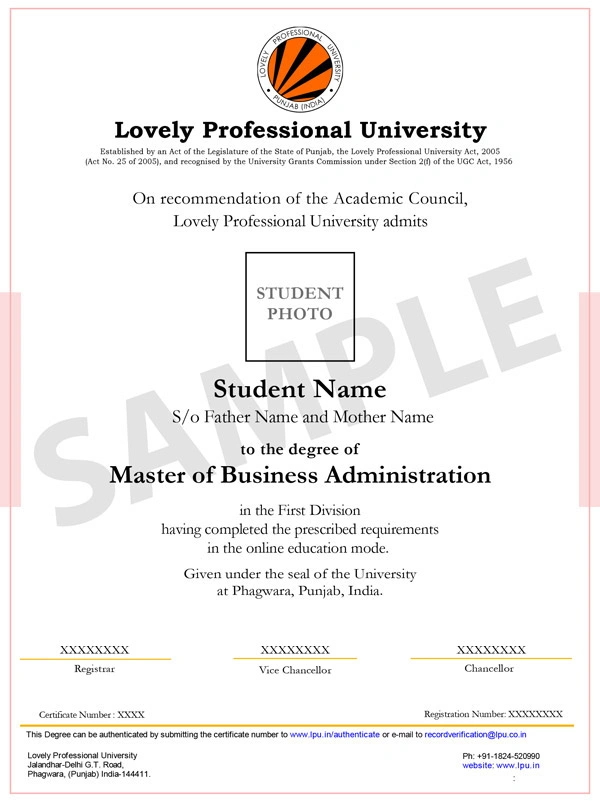
The degree carries the same UGC-DEB approval status as LPU's other online programs, which is the detail that actually determines its recognition for employment and further academic study — not the visual format of the certificate itself. If you want the full picture on how this recognition works in practice, our detailed LPU Online Degree Valid or Not explainer covers this comprehensively.
Is the Degree Valid for Government Jobs and Abroad?
This question comes up often enough alongside placement discussions that it's worth addressing directly here. LPU Online's MBA, being UGC-DEB approved, is generally treated as equivalent to a regular offline MBA for most employment and academic-progression purposes, including many government job applications that accept a recognized postgraduate degree as a qualifying criterion. Our dedicated guide on Is LPU Online Degree Valid for Government Jobs covers this in more depth, including specific caveats worth knowing before applying.
For students considering opportunities outside India — whether further study abroad or employment with an international company — our Is LPU Online Degree Valid Abroad guide walks through what recognition generally looks like internationally, and where it's worth double-checking directly with a specific foreign institution or employer rather than assuming blanket equivalence. UGC has also addressed the broader domestic equivalence question directly, stating that degrees earned through UGC-DEB approved online mode are treated as equivalent to regular/offline degrees for academic progression and most employment purposes, provided the specific program and institution carry valid approval at the time of enrollment. It's always worth independently verifying current approval status on the official UGC website before finalizing any admission decision.
Preparing for Placement: What to Do Before Your Final Semester
Placement outcomes aren't something that begin only once you've finished your final exam — the groundwork generally needs to start earlier. A few practical steps are worth prioritizing well before you reach your final semester.
Get comfortable with LPU's learning management system early, since your engagement pattern through the program often factors indirectly into how the placement cell prioritizes outreach to students. Our LPU Online Student Login & LMS guide is a useful starting point if you haven't explored the portal in depth yet. Understand the exam format ahead of time as well — LPU Online's term-end examinations are conducted through AI-based remote proctoring, and performing consistently well across semesters can matter for certain recruiters that screen on academic record. Our LPU Online Exam Pattern guide covers the exact structure and technical setup involved.
It's also worth generating your Academic Bank of Credits (ABC) ID early in your admission journey, since UGC-DEB approved programs generally require it for semester-wise credit deposit — a purely administrative requirement, but one that's easy to overlook until it becomes urgent closer to program completion. Our dedicated walkthrough, ABC ID for Lovely Professional University Online Students, covers exactly how and when to complete this step.
Common Mistakes Students Make Around Placement Expectations
One of the most common mistakes is assuming placement outcomes will mirror full-time MBA placement statistics, when the two programs generally serve different applicant profiles and different recruiter expectations altogether, as discussed earlier in this guide. A second common mistake is disengaging from the placement cell until the final semester, missing out on earlier resume-building or networking opportunities that generally compound in value the earlier they're used.
A third mistake is choosing a specialization purely on personal interest without considering the job-market angle, which can unintentionally narrow the pool of recruiters a student becomes eligible for. And a fourth, more subtle mistake is treating placement support as a guarantee of a specific salary or role rather than as a resource that improves your odds — the actual outcome still depends heavily on individual profile, effort, and interview performance, not on the university's placement wing alone.
Other Programs Worth Comparing Before You Decide
If you're still weighing the MBA against other postgraduate options on LPU Online's platform, it's worth browsing the full LPU Online Courses List before finalizing your choice. Students specifically comparing the MBA against a technical postgraduate route sometimes look at our LPU Online MCA Review, while those weighing a more traditional postgraduate arts or commerce route might find our LPU Online M.Com Review and LPU Online MA Review useful for comparison.
For a general read on whether an MBA specifically is the right call at LPU Online, our dedicated LPU Online MBA Review covers the program experience — curriculum, faculty, and student feedback — beyond just placement outcomes. And if you're still at the stage of deciding on LPU Online as a university altogether, our broader LPU Online University Complete Guide, our Is LPU Online Good or Bad assessment, and our LPU Online Pros and Cons breakdown are worth reading before narrowing down to the MBA specifically.
Admission Timeline and Getting Started
If you've decided the MBA is the right fit based on the placement and career-support picture above, the next practical step is understanding the admission timeline itself. Scholarship consideration and general admission deadlines don't always align perfectly, so it's worth reading our LPU Online Admission Last Date guide to avoid missing a scholarship-specific window. Our step-by-step LPU Online Admission walkthrough covers the full sequence from application through fee payment and document verification.
UGC Refund Policy for LPU Online MBA
Since LPU Online's programs, including the MBA, fall under UGC-DEB's regulatory framework, students who withdraw their admission after enrolling are entitled to a proportionate refund based on UGC's notified withdrawal timeline. This is worth understanding upfront, even if you're confident about your decision, simply as part of responsible fee planning.
| Withdrawal Timeline | Refund Entitlement |
|---|---|
| 15+ days before the last admission date | 100% refund of fees paid |
| Less than 15 days before the last admission date | 90% refund of fees paid |
| Within 15 days after the last admission date | 80% refund of fees paid |
| Between 15–30 days after the last admission date | 50% refund of fees paid |
| After 30 days of the last admission date | No refund |
| Application/registration fee | Non-refundable as per UGC norms |
Exact percentages and timelines can vary slightly by intake cycle, so it's worth confirming directly with LPU's admission office before withdrawing. The full official notification is available here: UGC Fee Refund Policy (PDF). UGC's notice on degree equivalence, referenced earlier in this guide, is also available here: UGC Notice on Equivalence of Degrees (PDF).
Putting It All Together: Your Placement-Readiness Checklist
Before you enroll purely on the promise of "placement support," take stock of your own starting point — your prior work experience, the specialization that genuinely fits your career direction, and whether you're using the degree for a fresh job search or an internal promotion, since each of these changes what "good placement outcomes" realistically looks like for you specifically. Engage with the placement cell early rather than waiting for your final semester, keep your resume and profile updated throughout the program, and treat mock interviews and career counselling sessions as genuinely useful rather than optional add-ons.
Calculate your realistic total cost using the fee guide linked above, factor in any applicable scholarship discount, and weigh that investment against the kind of salary band and role category that realistically matches your profile — not the most optimistic case you've seen mentioned somewhere online. And finally, verify current placement statistics, recruiter lists, and salary figures directly on LPU's official Online MBA course page before making your final decision, since these details are the most likely to change between academic cycles.
Final Verdict: LPU Online's MBA placement and career-support system genuinely adds value for the right kind of applicant — particularly working professionals looking to formalize existing experience and career switchers who need structured resume, interview, and recruiter-access support. It works less like a traditional campus placement season and more like an ongoing career-services relationship spread across your final semesters, so outcomes depend as much on your own engagement and starting profile as they do on the university's infrastructure. Confirm current salary bands, recruiter details, and placement statistics directly on the official LPU Online page before finalizing your decision.
Let's clear up some doubts
Does LPU Online guarantee placement for MBA students?
No, no university can guarantee placement. LPU Online generally provides placement support — resume help, mock interviews, and recruiter access — but the actual outcome depends on individual profile, experience, and interview performance.
Is the LPU Online MBA useful for working professionals who don't need a new job?
Yes, many working professionals use the degree for internal promotions or lateral role shifts within their current organization rather than relying on the university's external placement network.
Which MBA specialization has the best placement scope?
This depends on the industry you're targeting. Finance, Marketing, HR, and Operations specializations each open different recruiter pools, so specialization should generally be chosen based on career direction rather than placement optics alone.
How does online MBA placement differ from full-time MBA placement?
Full-time MBA placement is usually a concentrated campus season aimed at fresh candidates, while online MBA placement is generally an ongoing, distributed process that leans more on candidates with existing work experience.
Is the LPU Online MBA degree valid for government job applications?
Generally yes, since it is UGC-DEB approved and treated as equivalent to a regular offline MBA for most employment purposes, though it's worth checking specific eligibility notices for individual government roles.
When does the placement process generally begin?
Placement engagement typically ramps up in the later semesters of the program, closer to completion, though profile-building resources are often accessible earlier as well.
Does academic performance affect placement outcomes?
It can, for certain recruiters that screen on academic record, though most placement outcomes depend more heavily on prior work experience, interview performance, and specialization fit.
What happens to my fee if I withdraw after admission?
Refunds follow UGC's notified withdrawal timeline, ranging from a full refund if withdrawn well before the last admission date to no refund after 30 days past that date. The application fee is generally non-refundable.
Where can I check the latest recruiter list and salary data?
The most current placement statistics, recruiter details, and salary figures are best verified directly on LPU's official Online MBA course page, since these numbers can change between academic cycles.
Confused About Which Course to Pick?
Talk to CareerHike EduTech on WhatsApp — free, no obligation.
Chat on WhatsAppLatest Blogs





You're all set!

Welcome back
New to CareerHike? Create an account
First time signing in? Use Forgot password? below to set your password.